Rice varieties showed worldwide propensity to go feral
Domesticated animals or plants that revert to wild are referred to as escaped, introduced, naturalized, or sometimes as feral animals or plants.
Weedy rice, also known as red rice, is a variety of rice (Oryza) that produces far fewer grains per plant than cultivated rice. It has emerged as a severe global agricultural problem in recent decades. It is featured by a high degree of seed shattering and seed dormancy, by inferior grain quality, and by the ability to aggressively outcompete cultivated rice in paddy fields once established.
Led by Prof. FAN Longjiang from the Zhejiang University College of Agriculture and Biotechnology and Prof. Kenneth Olson of University of Washington, 12 teams from China, the United States, Brazil, Italy, Japan, Malaysia, and the Philippines analyzed whole-genome sequences of 524 weedy rice strains from all of the world’s major rice-growing regions. Their findings are published online in the journal of Genome Biology.
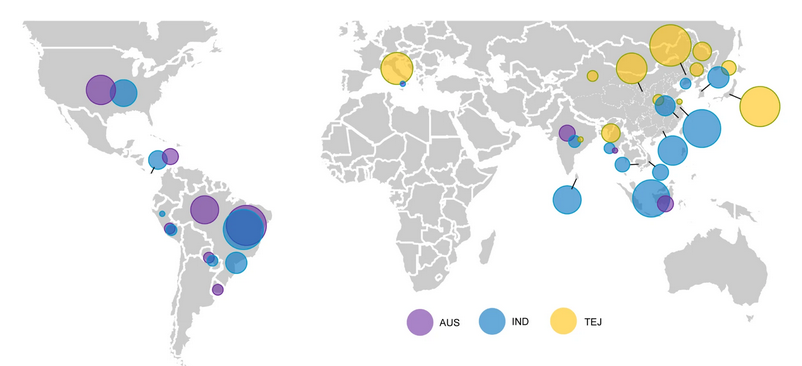
Geographic locations of global weedy rice sampled in this study. Sampling represents 16 countries spanning Asian, European, and American continents. Circle sizes indicate samples sizes by country (from 2 to 50 accessions), and colors indicate inferred crop ancestry (gold for temperate japonica; blue for indica; and purple for aus. Overlapping circles indicate geographic regions with more than one type of weedy rice.
With the recent availability of genome sequence data from over 4,500 worldwide cultivated rice varieties, it is now possible to infer geographical origins of global weedy rice with a high degree of resolution, and to potentially identify specific varieties that are progenitors of major weed strains. Crop-weed genome comparisons can provide insights into the genetic mechanisms of weedy rice adaptation.
“Accurate perceptions of feralization will play a positive role in controlling weedy rice,” FAN Longjaing said, “The more seeds fall onto paddy fields, the better chance weedy rice stands of growing and reproducing.” Therefore, one of the crucial ways to reduce weedy rice is to diminish the number of remnant seeds.
Feralization is a natural selection for survival of the fittest. With the continuous improvement of rice varieties, grains become larger and they are not prone to shed, thereby facilitating harvesting and increasing yields. However, this improvement fulfills human needs while changing the law of survival for rice in that the original reproduction and survival mechanism is destroyed.
Therefore, weedy rice needs to adapt constantly to new changes so as to survive. “Grain dropping is a vital step towards the return of seeds to the soil for propagation. It is also the most important mechanism for survival in nature. Meanwhile, reducing the size of seeds is also instrumental to dissemination and growth,” FAN Longjiang explained.
“De-domestication is an inevitable evolutionary mechanism for crops,” FAN Longjiang said, “This process has occurred many times throughout history, even after the Green Revolution (i.e. dwarf breeding.”
In this study, researchers discovered that weedy rice in Latin Americais unique among worldwide samples, with over half of samples (51/95) showing admixed genetic ancestry. Herbicide resistance (HR) weedy rice has likely acquired resistance by crop-weed hybridization and adaptive introgression—i.e., escape of resistance alleles from HR cultivars—although the possibility of parallel HR evolution in weedy rice by mutational convergence cannot be ruled out with the present data.
Selection scans indicate that most genomic regions underlying weedy adaptations do not overlap with domestication targets of selection, suggesting that feralization occurs largely through changes at loci unrelated to domestication.
This is the first investigation to provide the detailed genomic characterization of weedy rice on a global scale, and the results reveal diverse genetic mechanisms underlying worldwide convergent rice feralization, which is of tremendous significance to rice evolution, resource utilization and weedy rice control.
Researchers also point out that weediness of weedy rice can emerge through selection on “genomic islands,” and that the “genomic island strategy” could provide weedy rice with high fitness and a rapid adaptive ability, requiring few generations and minimal genomic recombination for weed evolution.