Human intervention in Trapa natans may date back to 6,000 years ago
WANG Wei, a Tang Dynasty Chinese poet, once wrote “And by the ferry torches and lanterns are burned, with loads of water chestnuts the folk have returned.” This poem mirrors a time-honored tradition of cultivating and picking Trapa natans (a.k.a water chestnuts) in China.
Recently, a research team led by GUO Yi, an associate professor with the Department of Archaeology and Museology, Zhejiang University, carried out research into the changing shapes of water chestnuts unearthed in the Yuyao Tiaoluoshan archaeological site. “This study reveals that human intervention in water chestnuts can be traced back to as early as 6,000 years ago.”
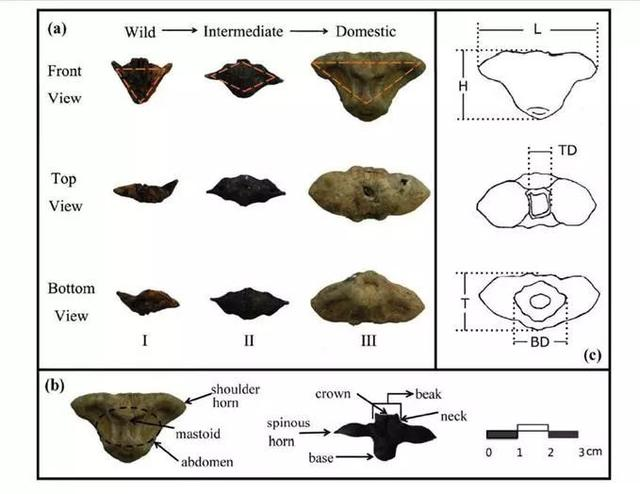
Water chestnuts were a kind of edible vegetable. Proof concerning the consumption of water chestnuts in China can date back to 8,000 years ago. In archaeological terms, water chestnuts are excavated from the Neolithic archaeological site in the middle and lower reaches of the Yangtze River. They are an indispensable ingredient of the prehistoric diet.
What do wild water chestnuts look like? They are marked by long thorns and small sizes. These features enable them to take roots in soil for better proliferation. In this way, they will not be washed away by water and be decimated by animals.
GUO Yi et al. measured the length, width, angle and diameter of more than 400 water chestnuts unearthed in the Yuyao Tiaoluoshan archaeological site. They found that they were very similar to cultivated water chestnuts. Without sophisticated management, water chestnuts could not have taken on the shape of the highly domesticated one. “According to statistics, although no direct evidence reveals that ancestors in Tianluoshan domesticated and cultivated water chestnuts, there is no denying the fact that human intervention existed,” said GUO.
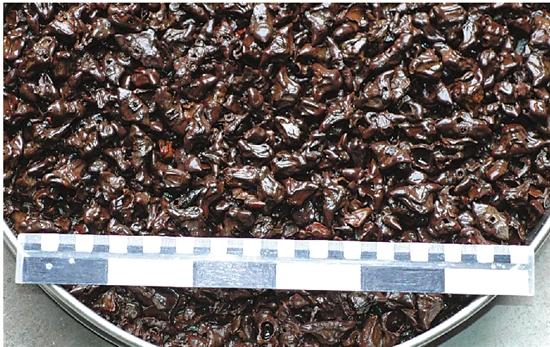
Water chestnuts found in Yuyao Tiaoluoshan archaeological site
“The method and conclusion of this research are very simple, but it is exceptionally meaningful in two aspects.”
Little attention is paid to water chestnuts and most people think that they are a complement to rice. “Ancestors ate water chestnuts because they grew in water.”
“This research crosses conventional boundaries. It has shifted from the focus on staple food to other previously ignored crops. We cannot rule out the possibility that precursors once subsisted primarily on other crops.”
“The advent of agriculture in primitive society must have been a very complicated process. Research into such staples as rice and wheat fails to unfold a whole picture of history. Water chestnuts may have been one of the options,” added GUO.
This research is also significant in that it exerts a positive impact on the process of field archaeological excavations.
Put it differently, during a field archaeological excavation, archaeologists should collect as many samples as possible. Circumscribed by time, funds and manpower, archaeologists tend to excavate and preserve remarkable relics, such as porcelain and bronze tools while things like water chestnuts stand a remote chance of being preserved.
“What you think is of little importance may well be of tremendous importance to future researchers,” concluded GUO. Literature about research into water chestnuts in ancient times is extremely scanty, but after they conducted relevant research, a new direction has emerged.