Scientists reveal cryo-EM structure of human α5β3 GABAA receptor
The lab headed by Prof. YE Sheng and the Center of Cryo Electron Microscopy obtained a cryo-EM structure of 3.51 Å by single-particle analysis and published their findings in an article entitled “Cryo-EM structure of the human α5β3 GABAA receptor”in the August 23 issue of Cell Research.
γ-aminobutyric acid type A (GABAA) receptors mediate rapid inhibitory neurotransmission by opening a chloride selective pore in response to binding of γ-aminobutyric acid (GABA), and thus are vital for controlling excitability in the brain. Dysfunctional GABAA receptors are directly involved in the pathogenesis of many neurologic diseases and psychiatric disorders. Moreover, GABAA receptors are modulated, directly activated or inhibited by over hundreds of pharmacologically and clinically important compounds of different structural classes.
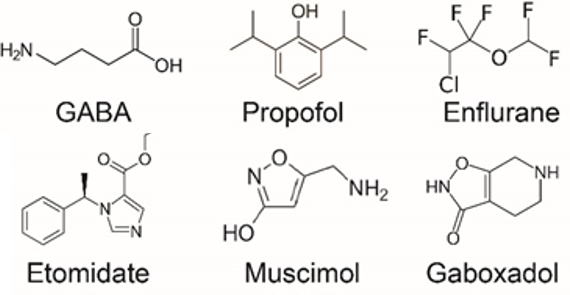
However, how GABA selectively binds at the extracellular β(+)/α(−) interface, and how the binding signal is transmitted quickly and efficiently to open an integral ion channel remains elusive, significantly limiting our understanding of the ligand-gating mechanism of the GABAA receptors.
YE Sheng et al. used single particle cryo-EM coupled with nanobody to determine the structure of a heteropentameric α5β3 GABAA receptor. The structure shows an unexpected subunit stoichiometry of one α and four β subunits. In agreement with the observation of a GABA binding at a canonical ligand-binding “aromatic cage” at the β(+)/α(−) interface, the receptor adopts a conductive, open channel conformation. Structural comparisons reveal a quaternary activation mechanism arising from rigid-body movements between the extracellular and transmembrane domains. The α5β3 receptor contains only one GABA-binding site, represents the simplest heteropentameric GABAA receptor, and provides us a unique opportunity for further biophysical analysis of the channel gating mechanism.
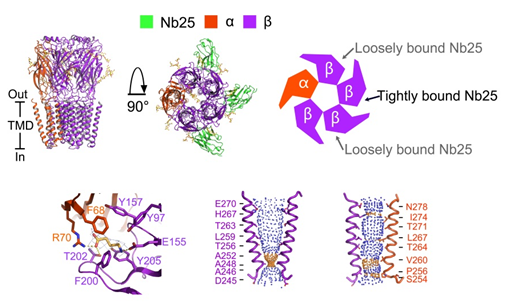
This analysis of the cryo-EM structure of the human α5β3 GABAA receptor lays a solid foundation for follow-up biophysical and pharmacological research and offers crucial information about pharmaceutical production and clinical therapies.