Programmable plastics: Encoding the “color” of the colorless
Just as Auguste Rodin famously remarked, “Beauty is everywhere. It is not that she is lacking to our eye, but our eyes which fail to perceive her.” If you place a mineral water bottle under a polarizer, you may find a polychromatic pattern. For these random and free colors, scientists propose a precise encoding method. They invented a kind of programmable plastics in which a precise “invisible” pattern can be inserted via digitalized modulation of internal stresses.
The research team led by Prof. XIE Tao from the College of Chemical and Biological Engineering displayed to members of the public QR codes, galloping horses and even Mona Lisa’s smile through plastic sheets. “We haven’t added any pigment to materials or altered the micro structure of their surface. It is due to stress that the patterns are created,” observes ZHANG Guogao, a member of the research team, “Mechanical stresses are ubiquitous in plastics. They will be released by curving, deforming or cracking in the future, which is one of the reasons why plastic items are not endurable.”
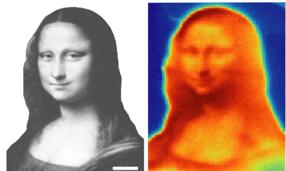
Gray scale photo of Mona Lisa and its infrared thermal image (the scale bar is 1cm)
The research team reported a material concept that allows stress management in a highly efficient digital manner while decoupling the stress and the geometric shape. This is realized in a dynamic covalent shape memory polymer network, for which the elastic shape memory sets the baseline stress level and maintains the geometric shape while the plasticity enabled by the dynamic bond exchange allows stress tuning.
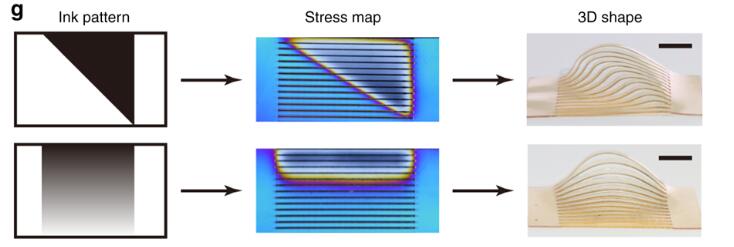
Controlled formation of three-dimensional shapes via heating-induced release (60 °C) of digital stress patterns in two-dimensional free-standing films (black lines in the stress maps represent laser-cut through patterns)
With a digital gray scale photothermal mechanism, any arbitrarily defined stress distribution can be created in a free-standing polymer film. The naturally invisible stresses can be further visualized as mechanical colors under polarized light, revealing its potential for encoding hidden information.
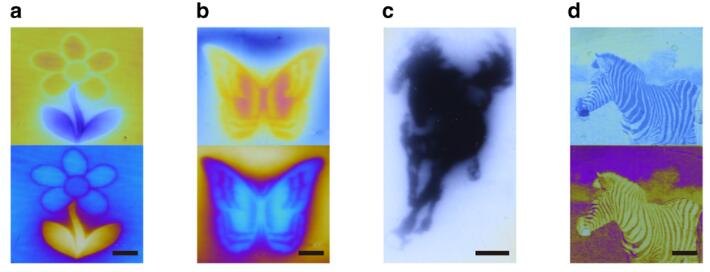
a, b Flower and butterfly painting in bright (upper) and dark field (lower).
c Horse painting in Chinese traditional style.
d Images of zebra created via laser direct writing in bright (upper) and dark field (lower).
According to the researchers, any arbitrary stress distribution can be programmed into a dynamically cross-linked shape memory polymer using mask free digital printing. “Currently known 4D printing based on stress-induced 2D to 3D transformation relies heavily on the creation of a non-uniform stress during a liquid-to-solid transition, whereas our work generates stress patterns in a solid state which will open the door for solid 4D printing,” says XIE Tao. Mankind may create a 3D printer capable of working in space someday, which will “eat” plastic biscuits and “spit out” complicated parts. The research team led by XIE Tao has made initial endeavors in this regard.
More information on this project is available in the original article published in Nature Communications.
Edited by: Ian Chew