On reading: A conversation with Nobel laureate MO Yan
As "fragmented reading" becomes the norm, how should traditional literature adapt? This April, Nobel laureate MO Yan visited Hangzhou for the "National Reading Week" series. At the Zhejiang University Alumni Enterprise Headquarters Economic Park, MO Yan engaged in a profound dialogue with LUO Weidong, Director of the Academic Committee at the Institute for Advanced Study in Humanities and Social Sciences at ZJU.
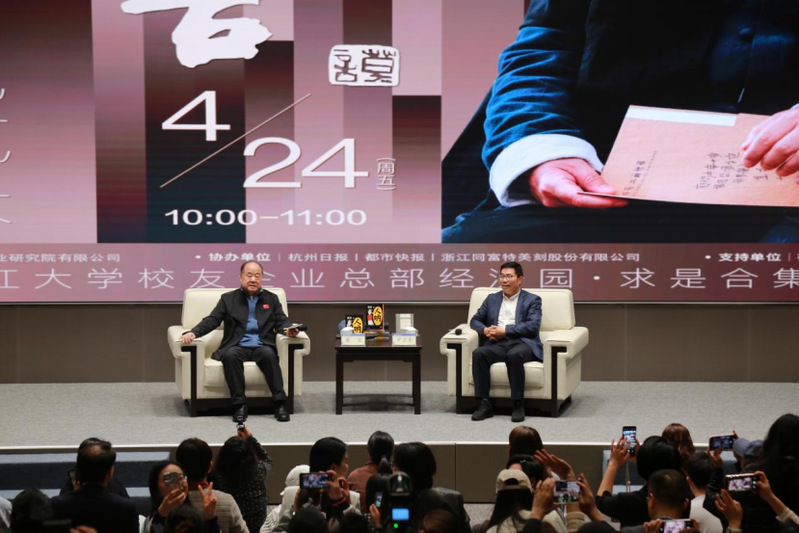
Facing the global surge of short-form video content, MO Yan refrained from taking a critical stance. Instead, he humorously labeled himself a "victim" of the trend. "I watch short videos too, and sometimes I find it hard to stop," he admitted, acknowledging that this fragmented cultural landscape has become an unavoidable reality.
However, MO Yan has chosen to leverage the benefits of the medium. Transforming instant stimulation into creative inspiration, he recently released his new collection, Human Beings, which features 81 pieces. The shortest entry consists of just 71 characters. MO Yan noted that while the barrier to entry for long-form epics has risen, excellent short stories can provide readers with space for imagination and secondary creation within a minimal volume.
"It takes the same amount of time to read a short story as it does to watch a video," he said with a smile. "When you're tired of scrolling, pick up a book."
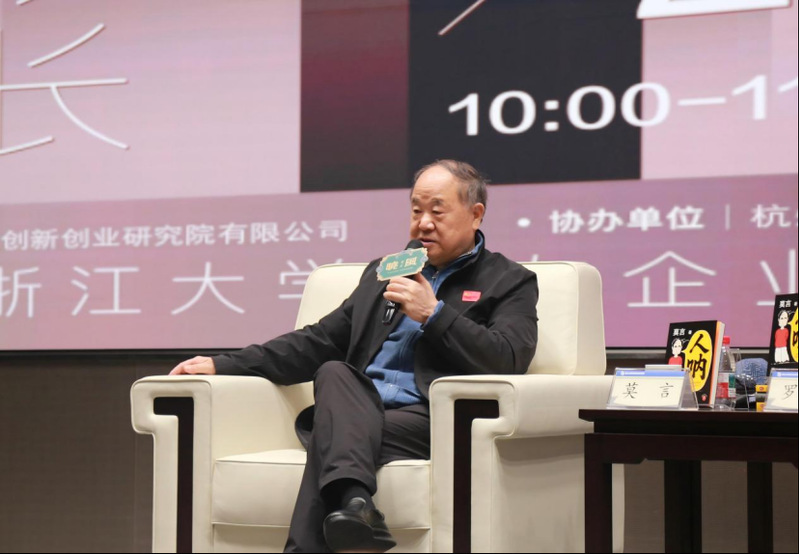
With his works translated into over 50 languages, MO Yan emphasized the pivotal role of translators, asserting that "translation is, in itself, a form of creation."
Recalling a foreign reader who felt the lingering echoes of opera after finishing Sandalwood Death, MO Yan expressed his gratification at such cross-cultural resonance. He argued that for Chinese literature to truly go global, it must move beyond mere text transfer. It requires translators who understand the cultural pulse of China and can convey the nuances between the lines. Only by finding the right cultural touchpoints can literature transcend regional dialects and barriers to present a profound image of China to the world.
Addressing the hot topic of AI writing, MO Yan shared his own experiments. He once tasked AI with composing traditional poetry; while the results were polished and structurally perfect, he felt they lacked thought and soul. MO Yan asserted that while AI excels at rule-based creation, its ability to reflect the complexities of real life remains inferior to human originality for the foreseeable future.
In a previous livestream, MO Yan remarked, "If there is a next life, I want to be a scientist." He maintains that literature and science are not opposites but are both rooted in imagination. He encouraged writers to actively explore modern scientific fields—such as astronomy, geography, and biology—to broaden their creative horizons. Conversely, he suggested that scientists read science fiction like The Three Body Problem for inspiration.
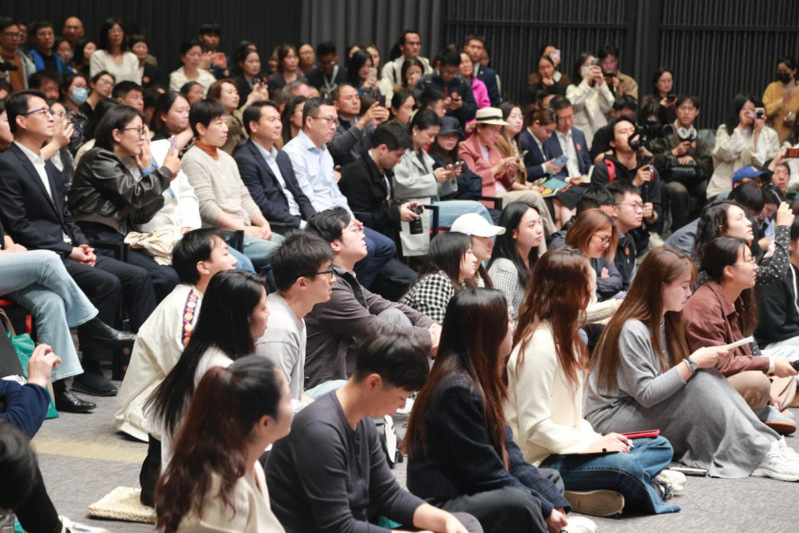
The dialogue concluded amidst enthusiastic discussion. In an era dominated by instrumental rationality, MO Yan maintains a clear-eyed, self-deprecating perspective, seeking to rebuild humanistic values within the cracks of a fragmented world. The significance of reading may not lie in immediate gains, but in the reshaping of perception and empathy. In the digital age, every line read is a step toward better understanding the narrative of our lives.
Adapted and translated from the article written by HOU Jiyuan
Translator: LU Yihsuan ('28, Literature)
Editor: JIANG Chenqi ('27, Structural Engineering), HAN Xiao