XY or ZW? Geckos Reveal Evolution's Hidden Playbook
Why do humans rely on XY chromosomes to determine sex, while birds use ZW — and many reptiles use neither, letting temperature decide instead? Sex determination is remarkably diverse across the animal kingdom. In genotypic sex determination (GSD), sex is encoded in the genome: XX individuals are female and XY males in humans and most mammals, while in the ZW system, found in birds and some reptiles, males are ZZ and females ZW. Many reptiles instead use environment-dependent sex determination (ESD), most commonly temperature-dependent sex determination (TSD). In leatherback turtles, higher incubation temperatures produce females, and in American alligators, males emerge only within intermediate temperatures. Remarkably, XY and ZW systems have evolved independently many times from different ancestral chromosomes, raising the question of what drived evolution down one path rather than the other.
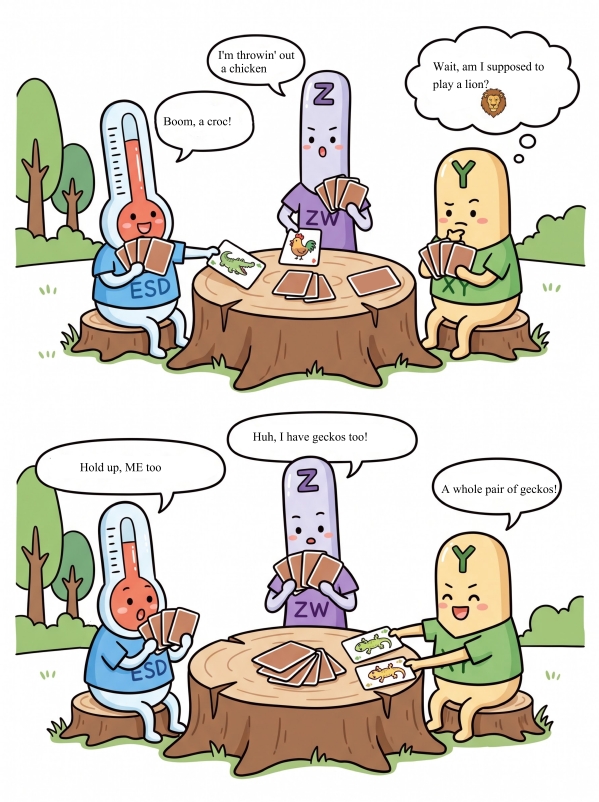
Geckos: An Ideal Study Group
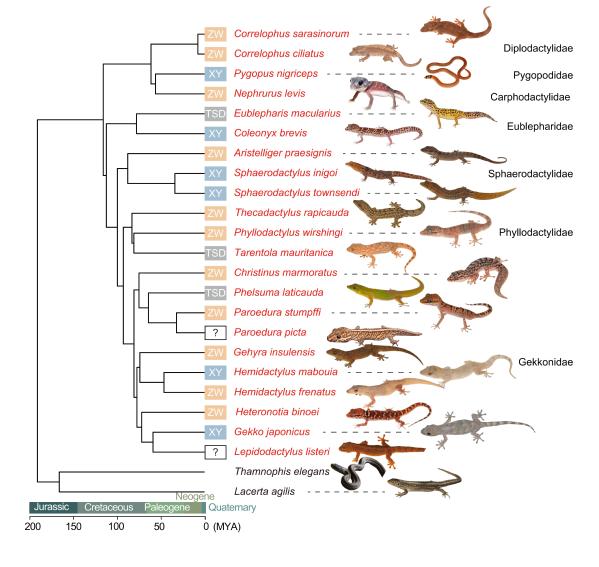
Geckos are an ideal model for studying sex chromosome evolution because they exhibit TSD, XY-GSD, and ZW-GSD, and their sex chromosomes span the full spectrum of differentiation, from young, nearly identical (homomorphic) pairs to ancient, highly distinct (heteromorphic) ones. Geckos have also switched between ESD and GSD at least 23 times, making them a natural laboratory for tracking sex chromosome origins in real time. To capture this diversity, Professor ZHANG Guojie's team at the Centre for Evolutionary & Organismal Biology, Zhejiang University School of Medicine, analyzed 22 gecko species—3 TSD, 6 XY-GSD, and 11 ZW-GSD—together with two outgroups, collectively covering about 70% of known independent sex chromosome origins in geckos.
A “Mosaic” of Sex Chromosomes
Geckos diverged from other lizards and snakes about 191 million years ago and their common ancestor carried 38 chromosomes (2n=38), none of which were dedicated sex chromosomes. By comparing genomes across species, the team traced the 22 distinct sex chromosome systems found in 20 gecko species with GSD back to just 17 ancestral chromosomes. Some ancestral chromosomes were recruited independently as sex chromosome multiple times; ancestral chromosome 16, for example, evolved into a Z/W pair in four separate gecko lineages. Yet, even sex chromosomes sharing the same ancestral origin often differ in exactly which regions became sex-differentiated (the sex-differentiated regions or SDRs), and the genes classically known to trigger sex-determination in other vertebrates are usually absent from these SDR, hinting that geckos may rely on entirely novel molecular switches to determine sex.
A Synchronized “Birth Cohort” of Sex Chromosomes
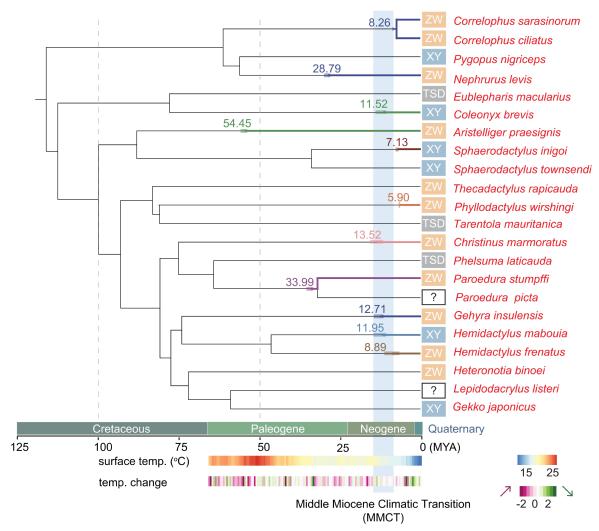
To find out when these sex chromosomes arose, the researchers estimated their ages from patterns of DNA sequence divergence. The results ranged widely, from under 6 million years in some species to more than 54 million years in others. Remarkably, five of 11 dated GSD species began differentiating their sex chromosomes within a narrow 7–12-million-year window, clustering around 9.6 million years ago. This timing coincides with the Middle Miocene Climatic Transition (MMCT), a period of dramatic global cooling, aridification, and habitat fragmentation. The convergence hints that climatic disruption may have repeatedly pushed unrelated gecko lineages away from temperature-sensitive TSD and toward more climate-proof, genetically fixed GSD, a sharedevolutionary response the authors call a “sex chromosome birth pulse.”
XY or ZW: What Tips the Balance?
But what determines whether a newly forming sex chromosome becomes an X or a Z? The answer, it turns out, may already be written into the chromosome before it ever becomes a sex chromosome at all. The ancestral chromosome rich in genes preferentially expressed in the testis were more likely to evolved into Z chromosomes (paired with the female-limited W), whereas those with fewer such genes tend to become X chromosomes (paired with the male-limited Y). This pattern held up not just in geckos, but across 39 vertebrate species spanning mammals, birds, reptiles, amphibians, and fish — and it was strongest among amniotes with internal fertilization, such as mammals, birds, and reptiles, hinting that intense sexual selection on sperm may help steer this evolutionary decision..
Chromosome Differentiation, Gene Loss, and Dosage Balance
Once a sex chromosome pair stops recombining, the Y or W chromosome begins to lose genes, a slow process of genetic erosion. This creates an imbalance: an individual with only one functional copy of a gene (for example, a male with a degenerated Y) risks having too little of its product compared with an individual carrying two copies. To compensate, most gecko species with genetic sex determination partially restore this balance by boosting gene expression in the sex carrying the degenerated chromosome. Meanwhile, the genes that do survive on Y/W chromosomes are not necessarily link to reproductive or sex-specific traits, instead, they tend to be genes essential for basic cellular functions, indicating that a gene's chances of survival depend less on what it does for reproduction and more on how costly it would be to lose a working copy.
A Four-Stage Model of Sex Chromosome Evolution
Bringing these findings together, the team proposes a four-stage model for how a new sex-determination system is born and stabilized: first, climate disruption favors a shift from temperature-dependent to genetically fixed GSD; second, the ancestral gene content of the chromosome involved biases the outcome toward either an X or a Z system; third, recombination suppression drives the two sex chromosome to differentiate from one another; and fourth, gene loss on the Y/W is offset by dosage compensation, locking the new system in place. Taken together, the findings suggest that the dazzling diversity of sex-determination system across vertebrates is not the product of evolutionary chance, but the outcome of predictable interplay between climate, genomic predisposition, and long-term selective pressure.
Adapted and translated from the article written by RAN Hao
Translator: DING Chenwei