A beautiful reunion with enigmatic Liangzhu civilization


Located in Hangzhou, China, the Archaeological Ruins of Liangzhu City stands as a sacred testament to the rich history of Chinese civilization, spanning an impressive five millennia. The site showcases the world’s earliest flood control dam system, China’s earliest palace city, and China’s earliest triple-structure layout. It also holds significance as the place of collecting the flame for the Hangzhou Asian Games.
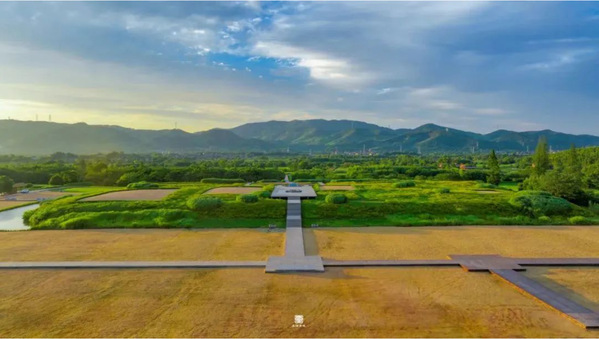
Recently, the “ZJU Campus Experience Officers” embarked on a journey to this historical site, seeking to relive the memories of our ancestors and gain profound insights into the depth of Chinese culture and civilization.
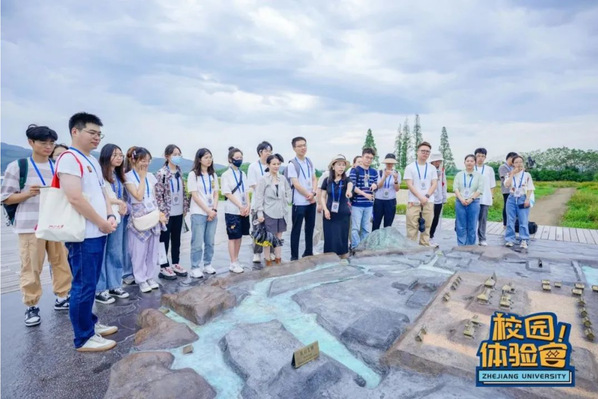
Nestled against the Tianmu Mountain Range and gracefully intersected by the Dongtiaoxi River and the Liangzhugang River, Liangzhu Ancient City remains harmoniously tucked away amidst the picturesque landscapes of mountains and rivers. The grand and majestic Liangzhu civilization has left a treasure trove of relics, eagerly waiting to be unearthed and studied by dedicated archaeologists who have painstakingly traced the progress of this national heritage.
The exploration of Liangzhu’s significance commenced in 1936 when SHI Xineng, a former student of Zhejiang Provincial Advanced Industrial School (administered by Zhejiang University), made the groundbreaking discovery of Liangzhu ruins in Liangzhu Town (now Yuhang District, Hangzhou) while working at the West Lake Museum. This momentous event marked the prelude to the academic exploration of Liangzhu civilization.
In 1959, archaeologist XIA Nai, who had once taught at Zhejiang University, named the prehistoric ruins represented by the Liangzhu site as the “Liangzhu Culture,” thus opening a new chapter in relevant research.
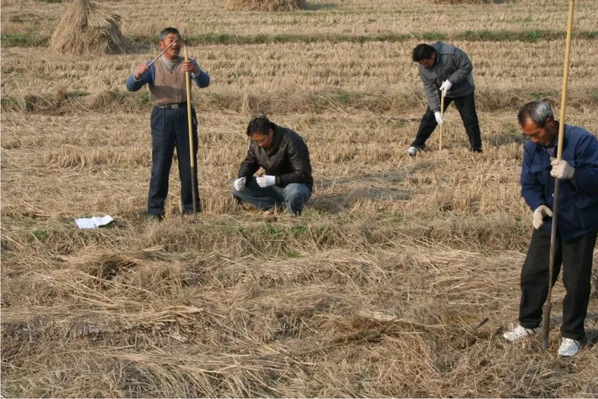
In 2007, LIU Bin, then director of the Archaeology Department at the Zhejiang Provincial Institute of Cultural Relics and Archaeology, found traces of Liangzhu Ancient City, dating back over 4,000 years. In 2010, LIU Bin and his team unearthed the outer enclosure of the ancient city. In 2015, they found the peripheral water conservancy system, an achievement hailed as one of the “Top Ten New Archaeological Discoveries in China in 2015.” These findings bear witness the remarkable wisdom of Liangzhu ancestors.
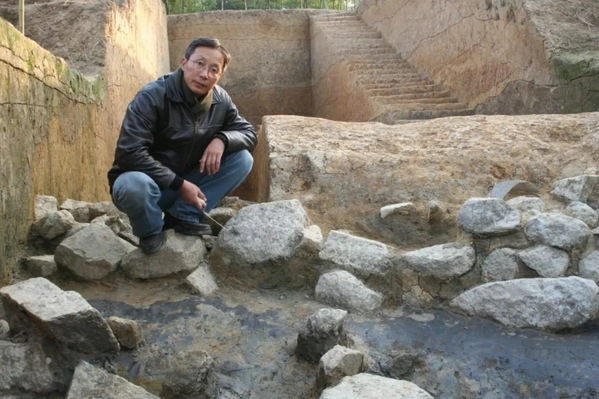
In July 2019, Liangzhu Ancient City achieved a momentous milestone by being inscribed on the UNESCO World Heritage List, securing its status as an internationally recognized site of immense cultural and historical significance. Around the same time, LIU Bin joined the Zhejiang University School of Arts and Archaeology, injecting fresh vitality into the future development of archaeology and paving the way for the launch of an undergraduate program in archaeology at Zhejiang University.
“I hope to propel the development of the archaeology discipline to a new level at Zhejiang University and nurture more talents for this field,” said LIU Bin.
Understanding the long history of Chinese civilization and appreciating the profundity of Chinese culture is in inextricably associated with archaeology.
In 2023, Zhejiang University's undergraduate program in archaeology gained formal approval from the Ministry of Education, ushering in an era of unprecedented popularity and interest in the subject.
In this edition of the “ZJU Campus Experience Officers” program, students experienced firsthand the diligence and challenges faced by archaeologists during excavations.
“Braving the wind and dew may be the norm for archaeologists, but every line of work has its own sweetness and bitterness,” said LIU Bin. “The overall strength of Zhejiang University is evident, and the students have strong comprehensive abilities. I expect more and more students to engage in the creative transformation and innovative development of Chinese outstanding traditional culture.”
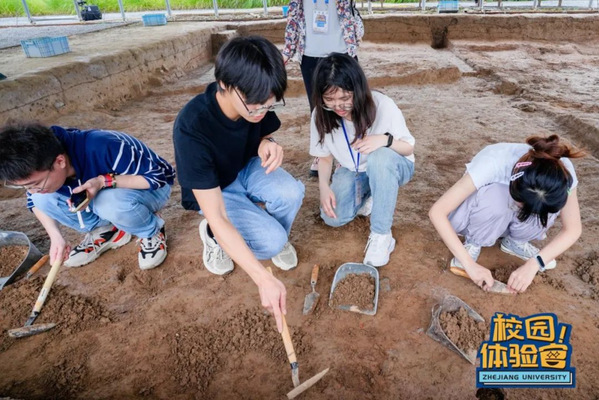
Immersed in archaeological practice, the students delicately excavated soil layers primarily from the Ming and Qing dynasties, meticulously searching for any hidden “gem” within. Their novel experience filled them with vigor and enthusiasm, and occasionally, some students discovered fragments of ceramics, red-hot clay stones, and so on.
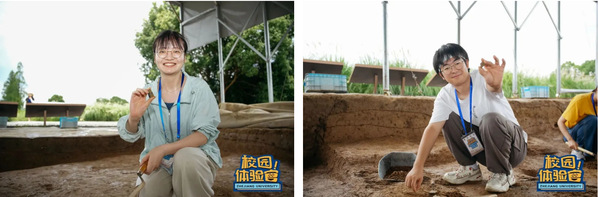
“We experience nothing but a glimpse of the countless moments of hard work that archaeologists put in. This immersive archaeological practice enables me to feel the dedication and hardship of archaeologists. It is thanks to their work that we are able to understand the Chinese civilization from its long history,” said LUO Tianyi, a junior from the College of Media and International Culture.
The Liangzhu Culture stands as a pinnacle of the Neolithic culture in the Taihu Lake area, renowned for polished black pottery and exquisite jade artifacts. Everyone marveled at how the ancient people made these jade artifacts 5,000 years ago.
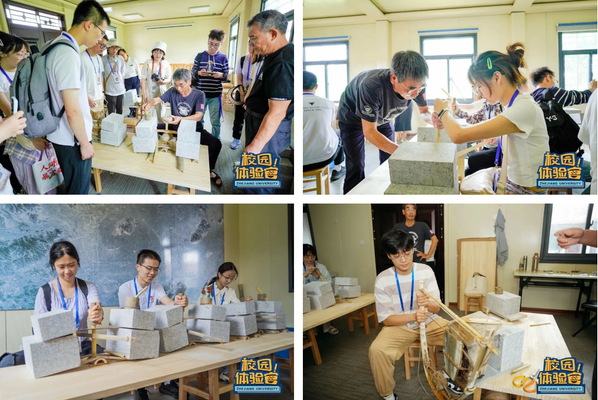
In archeological sites, faculty and students alike experienced the process of of jade artifact production, such as cutting, drilling, grinding, and carving.
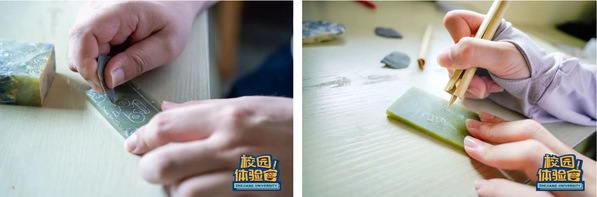
QIU Jie, a postgraduate student from the School of Medicine, commented, “One of the Asian Games mascots is named after the jade cong unearthed from the Archaeological Ruins of Liangzhu City. Learning about the production techniques of jade artifacts from the Liangzhu civilization offers insights into the beliefs and ways of life of their ancestors, creating a profound connection to their cultural heritage.”
In recent years, Zhejiang University and the Liangzhu Site Archaeology and Conservation Center have collaborated in various ways in a bid to further unravel the enigma of Liangzhu Ancient City.
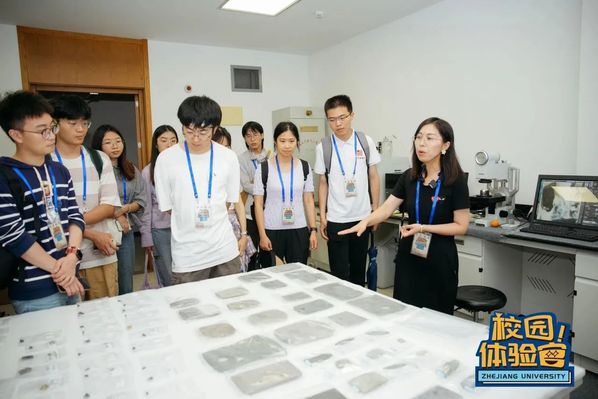
The team led by Prof. CHEN Hong from the School of Arts and Archaeology at Zhejiang University is like the “pioneer of forensic evidence” in archaeology. By analyzing microscopic traces and residues on jade artifacts, they reveal a series of important issues related to ancient human behavior, resources and environment, livelihood patterns, and social conditions.
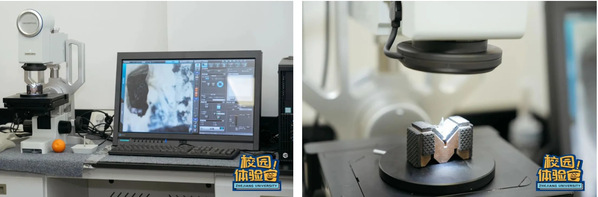
For example, we used to view freshly excavated stone knives as a general tool. However, through the observation and analysis of microscopic traces with a three-dimensional scanning microscope, we discovered residual starch grains of Poaceae plants on the stone knives, which led us to determine that they were actually an agricultural tool,” CHEN Hong explained.
Over the past decade, the team has been dedicated to analyzing the traces of jade artifacts. They have conducted research on more than 20 archaeological sites, analyzed over 2,500 archaeological samples, captured more than 22,000 photos of microscopic traces, and stored nearly 500GB of archaeological data. Their lab is, so to speak, China’s largest lab on microscopic traces.
The tidy and bright lab is complete with experimental equipment, jade samples, electronic instruments. Thanks to cutting-edge technology, archaeology is constantly evolving into an inter-disciplinary field of study.
“The scientific mindset of archaeologists is awe-inspiring. The light of the Liangzhu civilization, representing China’s 5,000-year history, ignites the flame of the Asian Games in the new era, allowing Chinese civilization to survive and thrive,” said WANG Haiyue, a postgraduate student from the College of Education.

In this scorching summer, the encounter with cultural relics has turned out to be a beautiful reunion with Chinese civilization, sparking a newfound appreciation for the enduring legacy of the past.
Translated from the article written by ZHOU Yiying, HAN Mingzheng, FANG Neng, KE Yineng
Photo credit: OUYANG Yuxuan, CAO Zhijun, Watchman Media