Zhejiang University’s innovation turns Shunba Village’s barren land into a strawberry oasis


As you step into the greenhouse, the biting chill of February in Hangzhou fades away. Sunlight streams through the translucent roof, casting a warm glow over lush green leaves dotted with small white flowers. Among them, plump, ruby-red strawberries emerge like hidden treasures, their sweet fragrance filling the air.
Nestled in Shunba Village, Xiaoshan District, Hangzhou, this strawberry greenhouse has become a must-visit destination for families during the Spring Festival. Children laugh and adults smile as they wander through the rows, baskets in hand, plucking ripe strawberries.
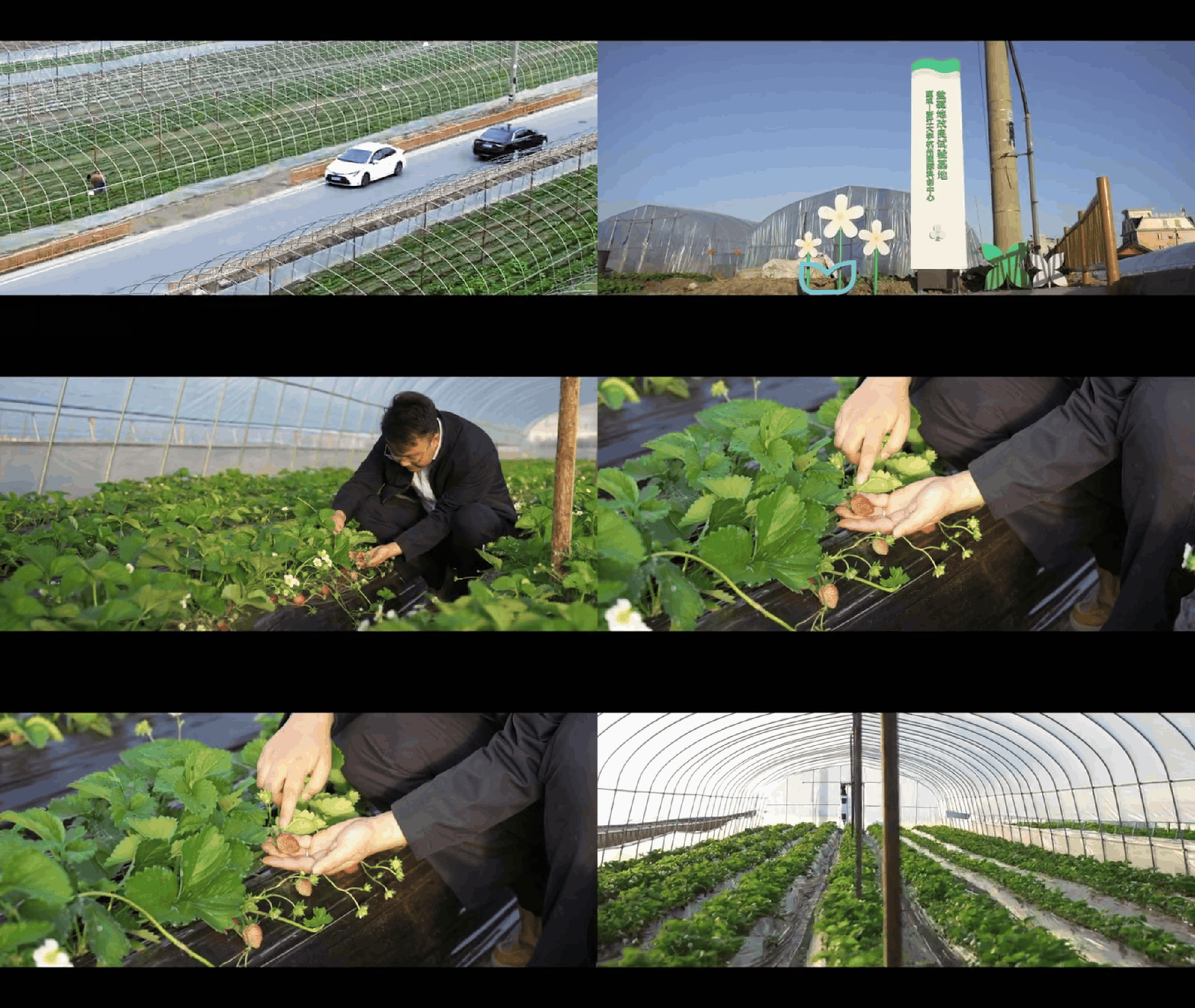
But just months ago, this same land was a barren expanse of saline soil, its surface marred by white salt patches. Crops withered, leaving farmers in frustration and despair.
What transformed this barren ground into a thriving oasis? The answer lies in the arrival of Shunba Village’s “good neighbor” — the ZJU-Hangzhou Global Scientific and Technological Innovation Center, or simply, the Innovation Center.
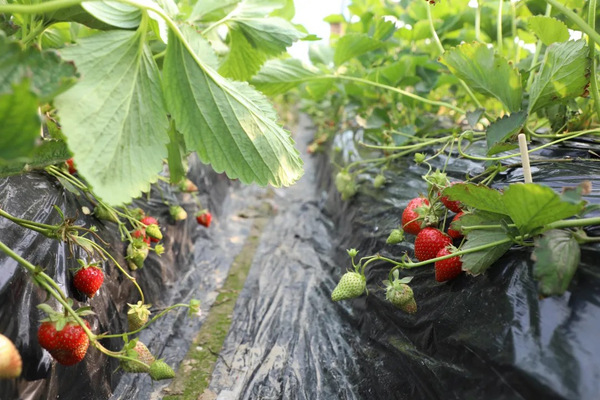
Fresh and delicious strawberries cultivated in the greenhouse after soil remediation
In October 2023, as the first phase of the Innovation Center was completed, a wave of researchers arrived, their minds buzzing with ideas. To the villagers of Shunba Village, just two kilometers away, these young scientists seemed like alchemists of the modern age, tinkering with technologies as they were promising. What the villagers didn’t yet realize was that their work would soon breath vitality into the very soil beneath their feet.
That winter, the connection between Shunba Village and the Innovation Center quietly took root.
As a major scientific and technological innovation hub jointly established by Zhejiang University and the Hangzhou municipal government, the Innovation Center has always been committed to driving local economic and social development. A chance encounter set things in motion. SHI Huajun, deputy director of the Innovation Center, introduced the Soil Pollution Control and Remediation Innovation Workshop, referred to as the Soil Workshop, to Shunba Village.
Shunba Village, located near the Qiantang River, was built on reclaimed land, but the very soil that sustained it had turned against the farmers. Severe salinization had choked crop yields, and despite years of effort, neither local officials nor villagers had found a solution.
Then came CAO Lifeng, a young researcher at the Soil Workshop. Upon completing his post-doc studies at Tsinghua University, he joined the Innovation Center to develop green remediation technologies for soil and groundwater. When he learned of Shunba Village’s plight, he saw more than a problem; he saw potential.
In April 2024, Cao and his team set out to identify the causes of the soil salinization. They walked the fields, visited villagers, sifted through soil data, and reviewed years of precipitation records. Their investigation revealed the hidden culprit: high salinity in groundwater, combined with rising water levels due to rainfall, caused salt to rise to the topsoil through capillary action, leading to severe soil salinization.
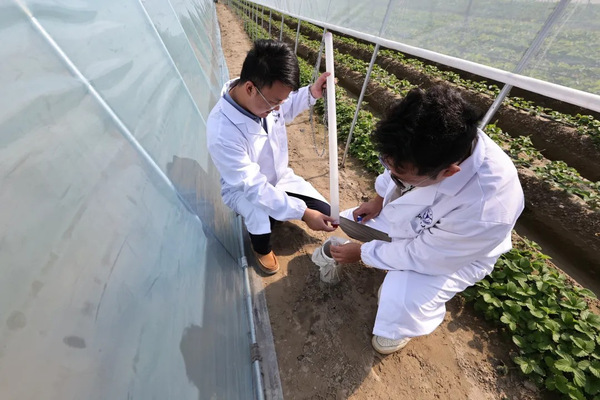
Research team collecting groundwater samples
After diagnosing the problem, Cao wasted no time in devising a treatment plan. That summer, he immersed himself in the village’s saline fields, working tirelessly under the sun.
To the villagers, he was more than “Professor Cao” or “Dr. Cao”, but also a “soil doctor,” a healer of the land.
The plan hinged on two key strategies: subsurface pipe drainage and chemical soil improvement.
“Subsurface pipe drainage follows a simple principle: ‘salt comes with water and salt goes with water.’ By controlling the groundwater level, we can flush out the salt. At the same time, we use desulfurized gypsum to improve the soil, replacing sodium ions and enhancing soil fertility,” Cao explained.
In the scorching heat of July, the team faced a critical phase: installing subsurface drainage pipes within a tight two-week window. However, the sandy soil in Shunba Village posed a challenge, as trenches dug by excavators kept collapsing, preventing the pipes from reaching the required depth. Cao and his team widened the trenches and added steps to complete what they called a “surgery” on the land.
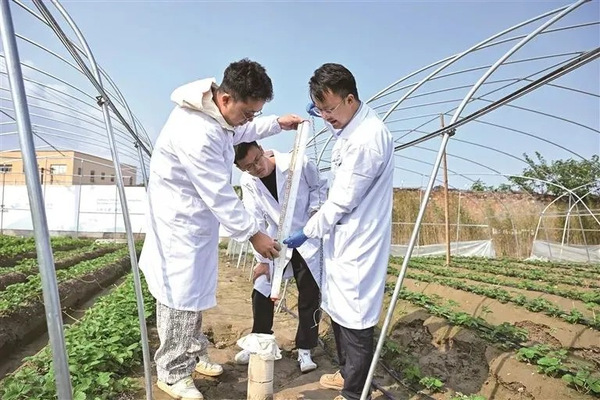
Groundwater sampling
By September, nature threw another challenge their way. The Qiantang River’s mighty tides pushed the groundwater level higher, sending a fresh surge of saline water into the fields. Crops suffered. In an emergency “second treatment”, the team installed an HDPE barrier layer to reinforce their remediation efforts.
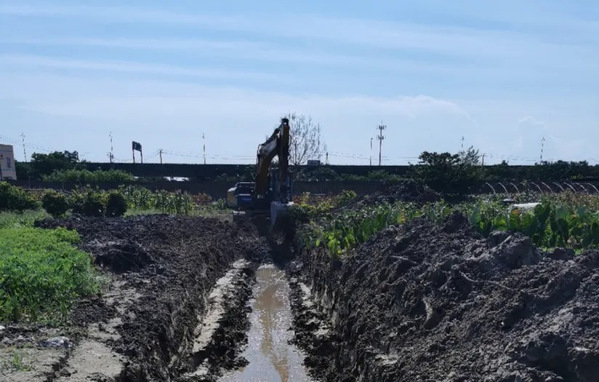
Excavating trenches for subsurface drainage pipes
The results spoke for themselves. Soil tests showed a dramatic drop in salinity, with pH levels falling below 8.0.
But could crops truly take root in this once-barren land? For years, the villagers had dreamed of reviving their fields, yet doubts lingered.
Then, in June 2024, CHENG Shan, a strawberry grower, took a leap of faith and leased the rehabilitated land. “I believe in Professor Cao’s technology and the power of science,” she said. Cao, in turn, made a bold promise: his team would provide “lifetime after-sales service” for the soil.
With the fields plowed, ridged, and mulched, the first strawberry seedlings were planted. Weeks passed, then came blossoms, then fruit. Experimental data confirmed what the villagers had scarcely dared to hope: salinity and pH levels had stabilized, making the soil viable for crops. Two strawberry varieties were planted, with an astonishing 90% survival rate.
“The strawberries grown on this saline soil are pesticide-free, sweet, and of high quality. We use natural farming — no chemical fertilizers, no pesticides. Bees pollinate the plants, and we rely on fermented organic fertilizers to enrich the soil. The result? Vibrant, naturally ripened strawberries,” said CHENG Shan.
Shunba Village’s transformation did not go unnoticed. The village head called the collaboration with Zhejiang University a milestone, with the newly established Saline Soil Remediation Experimental Base becoming a beacon for future rural development.
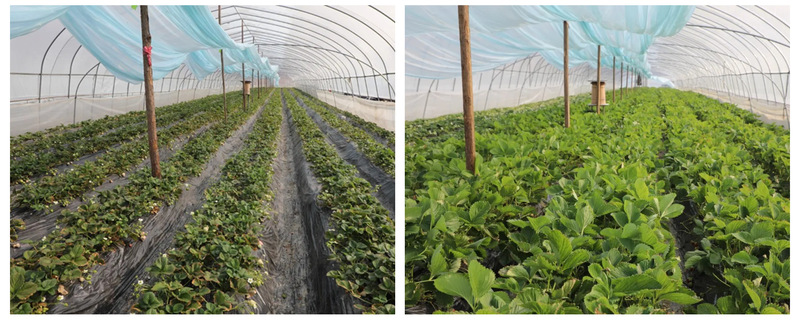
Control strawberry garden (left) vs. remediated strawberry garden (right)
Now, as the strawberry fields thrive, Cao and his team have turned their attention to another set of numbers: technology and economics. “Technology must do more than solve problems; it must generate benefits,” he said. “After all, only technology that farmers can afford is truly transformative.”
Looking ahead, Cao envisions refining saline soil remediation techniques, cutting costs, and awakening more “sleeping” land. His mission is clear: to turn innovation into impact and make science the driving force behind rural revitalization.
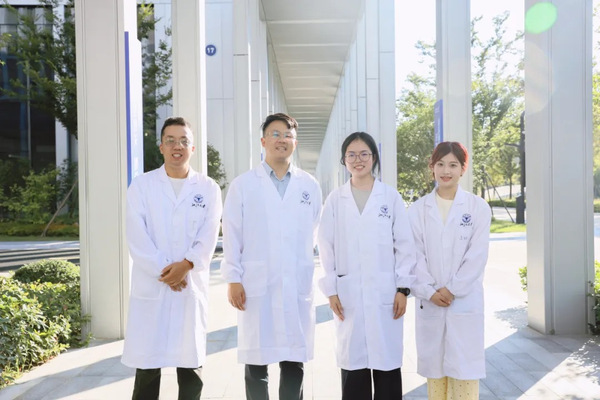
Dr. Lifeng Cao and his research team
Adapted and translated from the article by TAN Shuai, KONG Xiaorui
Translator: FANG Fumin
Photo: the interviewees
Editor: TIAN Minjie