“Director Hao” raises sheep — and he’s serious about it!


Today, let’s meet HAO Kunjie, a shepherd with a mission to bring high-tech, eco-friendly innovation to China’s agricultural heartland.
Over a decade ago, Hao made a bold decision. As a freshman at the Chu Kochen Honors College at Zhejiang University, he bucked the trend. While his classmates gravitated toward hot-ticket majors like computer science, electrical engineering, and civil engineering, Hao was the only one in his cohort to declare his major in animal science, a path that pointed squarely toward agriculture.
“I enjoy strolling by the river or hiking up in the hills, spacing out or reading,” Hao said. Immersed in the tranquility and pristine beauty of the outdoors, he felt a natural pull toward fields connected to the environment, ecology, and farming. “Choosing agriculture boiled down to two simple things: it’s the closest I can get to nature, and it’s part of a real industry — so even if I wanted to start a business someday, I’d have something solid to build on.”
Zhejiang University’s practical and truth-seeking academic aura only reinforced his decision. Rather than chasing the crowd, he chose what felt right to him.
“Back then, people said working in agriculture was interesting but tough,” Hao recalled with a laugh. And tough it was. During his college years, he dove headfirst into hands-on experience: “One day, I helped care for 40 piglets, mixed cattle feed until I had blisters on my palms, and hauled hundreds of kilos of manure for lab experiments. It was exhausting — but incredibly rewarding.”
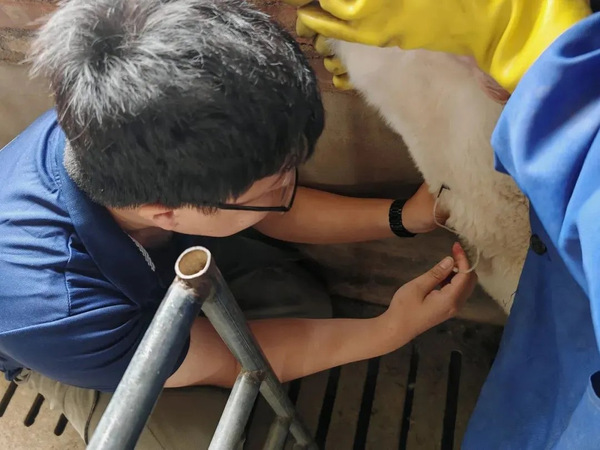
HAO Kunjie gives an injection to a sheep.
When it came time to choose a research focus for graduate school, Hao once again took a practical route, shaped in part by his modest upbringing. Faced with the choice between pigs, chickens, cattle, and sheep, he zeroed in on sheep: a sector with relatively low startup costs, faster production cycles, and less cutthroat competition.
To this end, he turned to Professor LIU Jianxin at the Zhejiang University College of Animal Science and asked bluntly: “Which expert in China is leading the sheep industry?” The reply was equally direct: “Go to Lanzhou University and find Professor LI Fadi. His work in the sheep sector is remarkable.”
“He was a very thoughtful student,” said Professor WANG Jiakun, Hao’s undergraduate thesis advisor. “What’s truly admirable is that his passion for the field has never wavered. His senior thesis, which I supervised, focused on sheep. Gansu Province, where Lanzhou University is located, is a major hub for sheep farming, and that means real, on-the-ground challenges to learn from.”
Without hesitation, Hao packed his bags for Lanzhou and enrolled in graduate school, eager to position himself at the forefront of China’s livestock industry.
“If animal science graduates don’t step into the field, who’s going to produce high-quality livestock products? What does the field hold for the future?” Hao asked. Driven by that conviction, he joined a livestock company in Tianjin after completing his master’s degree in 2019, determined to sharpen his skills in real-world settings.
“To make great products, you have to get your hands dirty and understand every step of the process,” he said. He started at the bottom, volunteering as a farmhand — assisting in lambing, bottle-feeding newborns, administering care, and treating illnesses. From there, he worked his way through several roles, including technician and lab supervisor.
“That period gave me a full taste of what life on the frontlines is really like — the good, the bad, and everything in between,” Hao reflected. He’s convinced that without firsthand experience, it’s impossible to truly grasp the realities of the industry or appreciate the hard work of those who keep it running.
He drew energy from the rhythm of hands-on work. A compliment from a farm worker that “You’ve really improved since last year” or a remark from the factory director that “I didn’t expect a grad student to stick with it this long on the production line” helped quiet the doubts that sometimes crept in.
The desire to give back had been with him for years. In his junior year, Hao volunteered as a teacher in a rural village in Wenzhou. “The challenges facing left-behind children and elderly people living alone really struck a chord with me,” he recalled. That experience planted the seed of a long-term goal: to return to his hometown and start a business.
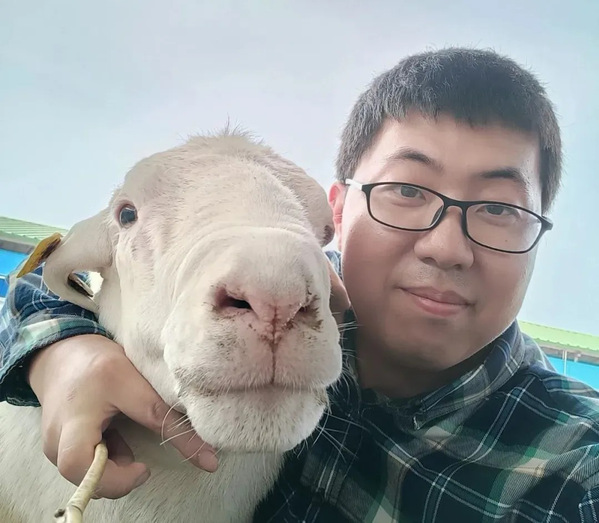
HAO Kunjie works closely with sheep.
For Hao, rural revitalization isn’t just about policy or slogans, but it depends on developing local industries and retaining young talent. Inspired by Zhejiang University’s guiding ethos of “seeking truth,” he felt a strong personal responsibility to be part of that change.
In March 2023, after three years of work, Hao returned to his hometown of Taiyuan in Shanxi Province to start his own agricultural venture. He leased a small piece of land and, by May, had secured startup funding. He named his company something relatable and down-to-earth: “A Good Sheep” (a clever pun on his surname “Hao”, which means “good” in Chinese).
But behind the lighthearted name was a clear vision. When registering the company, Hao made a deliberate choice to include three core principles: ecology, agriculture, technology. “I spent a whole night debating whether to drop one,” he said. “But in the end, I kept all three. Each represents a pillar of sustainable development. If we want to do this right, we have to commit ourselves to balancing environmental stewardship with scientific progress and practical farming. It’s not the easy path, but it’s the right one.”
Rather than focusing on building a flashy brand, Hao has been striving to develop a replicable model for modern, small-scale agriculture. His approach is rooted in agro-ecological integration: using local grasses and crop residues to feed sheep, and turning the resulting manure into organic fertilizer. This closed-loop system not only protects the environment but also creates flexible, local job opportunities, which is a modest but meaningful step toward revitalizing rural communities.
It’s a vision that echoes the advice of his former professor, WANG Jiakun: “Raising sheep is one of the best ways to adapt to local conditions and help farmers thrive.”
“I want to apply what I’ve learned to explore a new model for rural development in my hometown,” Hao said. These days, he has spent most of his time on the farm, working alongside his sheep — earning him the affectionate nickname “Director Hao”. By 2025, he expects to sell around 1,400 sheep, “We’re not chasing scale for its own sake. Quality and staying true to our model will always come first.”
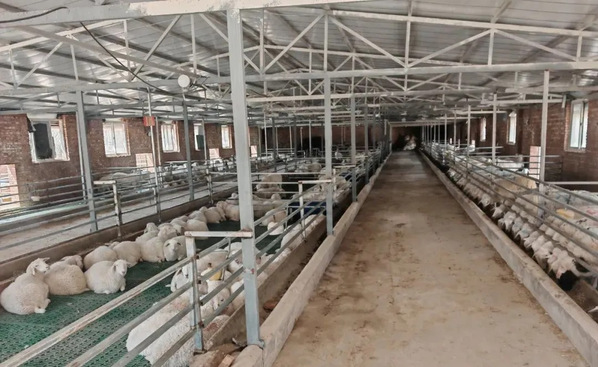
The new sheepfold built by HAO Kunjie.
Professor Wang has been following his progress with pride. “He dove headfirst into the realities of livestock farming. That takes courage and a strong sense of mission,” she said. Hao remains in close contact with his former research team at Zhejiang University, and his former mentors continue to cheer him on. “With modern logistics and social media, his ideas from selling premium lamb to educating the public about sheep farming are genuinely innovative,” Wang added. “Whatever the outcome, his dedication is something I deeply admire.”
Despite the demands of running a farm, Hao often makes time to return to Hangzhou and visit Zhejiang University. Standing before the statue of the university’s former president, CHU Kochen, he reflects on two simple, enduring questions engraved there.
From his days as an idealistic student to his work as a grassroots entrepreneur, Hao has held fast to his convictions. With every choice, he honors a quiet but powerful belief: “Everyone has a heart that refuses to settle for mediocrity. Do what you can. Be brave enough to go first. No matter what outcome, it will be worth it.”
Adapted and translated from the article by LIN Qianxu, OUYANG Yuxuan, and JIN Lina
Translator: FANG Fumin
Photo: The interviewee
Editor: TIAN Minjie