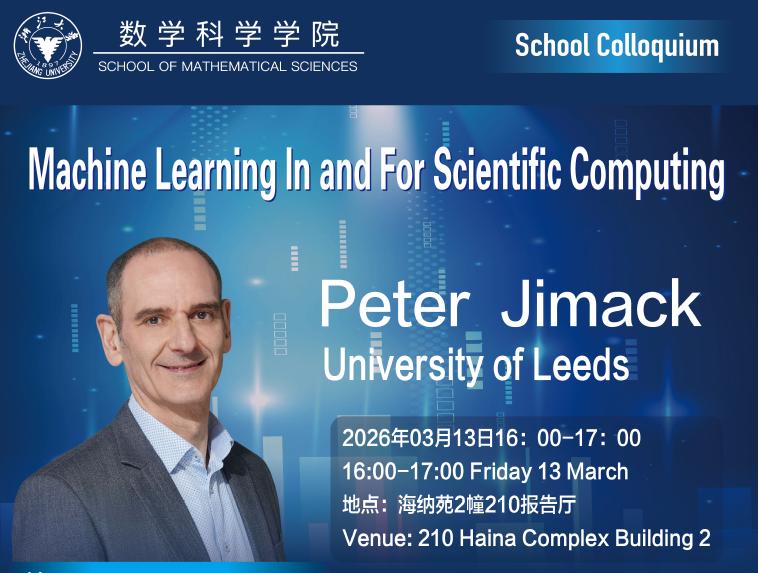
Machine learning in and for scientific computing


Time: 16:00
Venue: Zijingang Campus
Speaker: Peter Jimack
Category: Talk & Lecture
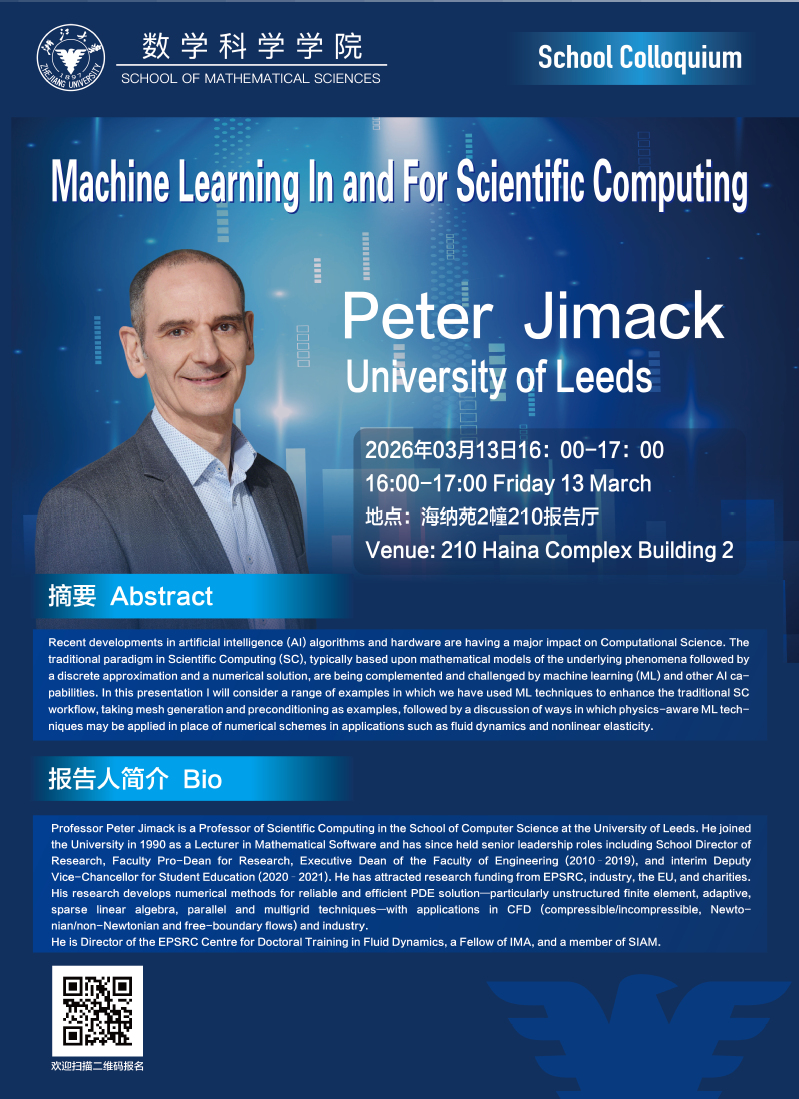
Speaker: Peter Jimack
Venue: Lecture Hall 210, Haina Complex Building 3, Zijingang Campus
Abstract: Recent developments in artificial intelligence (AI) algorithms and hardware are having a major impact on Computational Science. The traditional paradigm in Scientific Computing (SC), typically based upon mathematical models of the underlying phenomena followed by discrete approximation and a numerical solution, are being complemented and challenged by machine learning (ML) and other AI capabilities. In this presentation, I will consider a range of examples in which we have used ML techniques to enhance the traditional SC workflow, taking mesh generation and preconditioning as examples, followed by a discussion of ways in which physics-aware ML techniques may be applied in place of numerical schemes in applications such as fluid dynamics and nonlinear elasticity.