ZJU researchers uncover a chiral dance of electron spins


The mesmerizing formations of birds swirling across the sky and the rippling waves of spectators in a World Cup stadium share a striking quality: order emerging from the coordinated movements of many individuals. Something remarkably similar happens in the microscopic world, where thousands of particles can move in concert, giving rise to phenomena physicists call collective excitations.
Now, a research team led by Tang Yanhao at the School of Physics, Zhejiang University, working with Research Fellow Xu Yuanfeng, Professor Zhu Shiyao, and collaborators in Japan, has observed a rare form of collective excitation known as a chiral spin mode (CSM) in a two-dimensional moiré superlattice for the first time.
Driven by the interplay between many-body interactions and spin-orbit coupling, electrons exhibit coordinated spin motion with a distinct handedness, much like a wave of spectators rising and falling in a stadium.
Published in Science on October 16, the findings highlight the potential of moiré superlattices for exploring unusual electronic excitations and could open new avenues for quantum technologies.
Hold out your hands. No matter how you turn them, your left and right hands cannot be made to overlap perfectly. This property, known as chirality or handedness, is found throughout nature, from the spiral arms of galaxies and atmospheric vortices to mineral crystals and DNA molecules.
“Chirality in geometric structures is relatively easy to visualize,” Tang Yanhao explained. “What we have observed, however, is chirality in a collective excitation of electrons. Understanding it requires quantum mechanics at the microscopic scale.”

Tang Yanhao’s group has long studied moiré superlattices made from transition-metal dichalcogenide (TMD) semiconductors. Created by stacking two atomically thin layers with almost no rotational misalignment, these structures form triangular moiré lattices with periodicities much larger than those of ordinary atomic crystals.
Within these materials, spin-orbit coupling links an electron’s momentum to the orientation of its spin.“Imagine an unusual scene: runners moving to the left have their arms raised, while those moving to the right keep their arms lowered,” said Shan Zhexu, the paper’s lead author. “The position of their arms represents the direction of their spins. A chiral spin excitation would be like these runners moving their arms in a coordinated pattern.”

Chiral spin modes are notoriously difficult to detect. Previously, they had been observed in only two material systems: Bi₂Se₃ and manganese-doped CdTe quantum wells. Moiré superlattices offer a new, highly tunable platform for investigating these elusive excitations.
Together with co-lead author Su Wenjian, Shan Zhexu fabricated exceptionally clean samples approximately one nanometer thick and 10 micrometers wide. The two atomically thin layers were brought into close contact, creating a moiré structure with a periodicity of about eight nanometers, compared with the underlying atomic lattice constant of just 0.3 nanometers.
“The much larger moiré period makes it easier for us to study and manipulate these unusual collective electronic modes,” Shan Zhexu explained.
Detecting chiral spin modes requires a technique known as resonant Raman spectroscopy. Tang Yanhao often compares the technique to experiments at particle colliders. While large accelerators smash high-energy protons together to probe their internal structure, resonant Raman spectroscopy uses laser light to investigate excitations within solids.
“We shine a laser onto the material, creating high-energy excitons,” Tang Yanhao explained. “These excitons then interact with other microscopic particles, producing lower-energy excitations that may involve either individual particles or collective motion.” He likens the process to tossing a soccer ball into a crowded stadium. As spectators scramble for the ball, the disturbance can spread through the crowd, setting off a collective wave of movement.

To capture these subtle signals, Tang Yanhao’s team developed a low-wavenumber Raman spectroscopy system operating at low temperatures and under strong magnetic fields. The challenge was maintaining a precisely focused laser beam over long periods without disturbing the fragile electronic excitations.
“To obtain a reliable set of data, the laser spot must remain stable for at least 12 hours,” Shan Zhexu said. “Commercial instruments can typically maintain that stability for only three or four hours.”
The breakthrough came in the summer of 2023, when the team detected an unusual Raman signal.“Our original goal was to investigate phonons in moiré lattices,” Tang Yanhao recalled. “For the first few months, we assumed the signal came from some unusual form of electron-phonon coupling.”
As the experiments progressed, however, the researchers discovered that the signal exhibited distinctive polarization characteristics. Improvements in sample quality caused the initially broad Raman feature to narrow into a sharp peak, with its linewidth shrinking to roughly one-sixth of its original value. When the team applied a magnetic field perpendicular to the sample, the excitation frequency shifted in response, providing further evidence of its spin-flip character. Together, these observations confirmed that the researchers had detected a collective chiral spin excitation.
Chiral spin modes were theoretically predicted in the early 2000s, but experimental progress has remained limited because their signals are so difficult to detect. The work from Zhejiang University researchers marks the first observation of such a mode in a moiré superlattice. The researchers also found that it could be efficiently tuned by changing the electron filling and exhibited exceptionally strong Raman scattering. These discoveries raised a deeper question: Why do chiral spin modes behave so differently in moiré lattices?
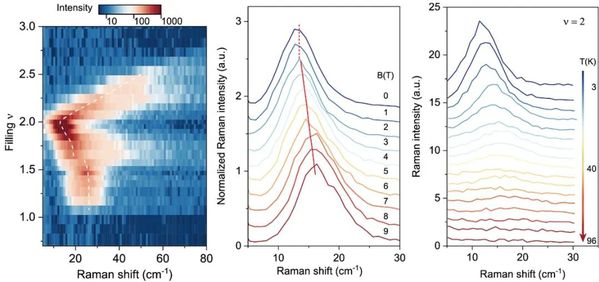
“Think of a moiré superlattice as a series of regularly arranged private boxes in a stadium,” Tang Yanhao explained. “We can fill the seats with electrons or use a laser to introduce excitons. When an electron and an exciton occupy the same site, their strong interaction allows chiral spin modes to be generated efficiently.” The mode can also act as a spatially localized probe, revealing how electrons are distributed within the lattice.
Theoretical calculations by Xu Yuanfeng provided a clearer picture of this distribution. Electrons added successively to the moiré lattice tend to occupy different sites within each unit cell, much like spectators entering the same stadium box but choosing seats in different sections. Together, the experimental findings and theoretical calculations shed light on the microscopic nature of the system's ground state, helping resolve a longstanding scientific debate.
The discovery illustrates how strongly interacting particles in two-dimensional materials can give rise to remarkable collective phenomena. One particularly striking feature of the chiral spin mode is its enormous Raman scattering efficiency, approximately three orders of magnitude greater than that of conventional phonon modes. The excitation can also be effectively controlled through an applied voltage. These properties suggest potential applications in a new generation of spin-flip Raman lasers.
“Conventional spin-flip Raman lasers require very strong magnetic fields to tune their wavelengths,” Tang Yanhao explained. “In our moiré system, however, the chiral spin mode can be efficiently controlled with a voltage of just one volt. This could make it possible to develop much more compact Raman lasers.”
Tang Yanhao cautioned that such applications remain a long-term prospect.“Of course, this is still just an idea. There is a long way to go before it becomes a reality.” The mode also forms a spatially localized two-level spin system, raising the possibility of its use in quantum information processing.“Perhaps it could be used to create spin qubits,” Tang Yanhao suggested.
For now, the discovery offers a new window into the collective behavior of electrons and establishes moiré superlattices as a promising platform for investigating exotic quantum phenomena, an intricate dance of electron spins that scientists are only beginning to understand.

Adapted and translated from the article written by Zhou Wei
Photo: Zhu Yuanzhi
Translator: Fang Fumin
Editor: Ding Chenwei