Zhejiang University launches new school to turn research into real-world impact


Zhejiang University has launched the School of Tech Entrepreneurship to accelerate the translation of scientific discoveries into real-world applications and equip a new generation of innovators and entrepreneurs with the skills to bring emerging technologies to market.
The school was officially inaugurated on October 25 on Zijingang Campus during a forum that brought together nearly 500 researchers, industry leaders, entrepreneurs, and investors to explore new approaches to technology transfer and research commercialization.
It seeks to bridge the gap between scientific discovery and commercial application by bringing together education, research, industry, and investment in an integrated model of innovation. Its work will focus on three areas: cultivating entrepreneurial talent, facilitating technology transfer and commercialization, and fostering collaboration between academia and industry.

Ren Shaobo, Chairman of the Zhejiang University Council, described the establishment of the school as both a response to national strategic priorities and an important step toward reimagining how the University nurtures talent. He emphasized its significance for the University’s long-term development, educational innovation, and cultivation of talent in emerging fields.
Ren Shaobo outlined three priorities for the new school. First, it should align its development with national strategic goals and regional industrial needs,fostering closer integration between technological and industrial innovation while building a globally competitive ecosystem for innovation and entrepreneurship.
Second, it should pioneer new approaches to education and research commercialization, exploring models in which technological innovation drives talent development and strengthens Zhejiang University’s growing community of innovators and entrepreneurs.
Third, it should harness the power of collaboration to develop an integrated ecosystem encompassing original research, proof-of-concept validation, industrial incubation, and financial support. Together, these efforts would help translate scientific advances into economic and social benefits.
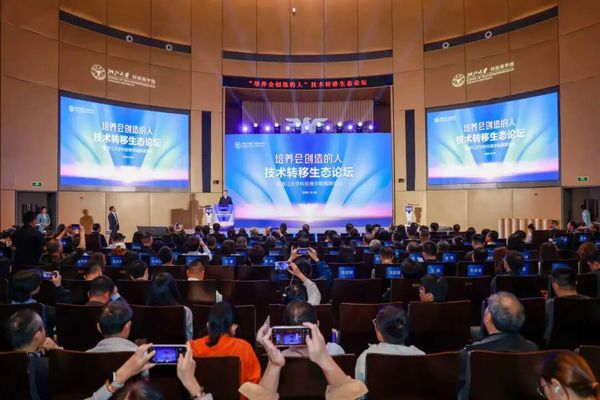
“We will redesign our talent development system around the central goal of turning research into real-world applications,” said Xie Xiaoyun, Dean of the School of Tech Entrepreneurship.
Xie Xiaoyun explained that the school will introduce interdisciplinary curricula, place greater emphasis on practical experience in student assessment, and bring together mentors from business, technology, and industry.
One of the school’s first major initiatives is its Master of Technology Transfer (MTT) program, which has already begun recruiting students.As the first professional master’s program of its kind in China, the MTT places business value validation at the center of its curriculum and offers an integrated approach to the entire technology commercialization process.
The program aims to prepare professionals who can work at the intersection of science, business, and finance, combining interdisciplinary expertise with skills in intellectual property management, commercial opportunity assessment, and investment. Graduates will be equipped to pursue careers as technology entrepreneurs, innovation partners, investors, and technology transfer specialists.
Students will also have access to resources across Zhejiang University’s wider innovation ecosystem, gaining opportunities to engage with researchers, businesses, investors, and organizations involved in bringing new technologies to market.
The launch also marked an expansion of partnerships designed to strengthen connections between academic research and industry.
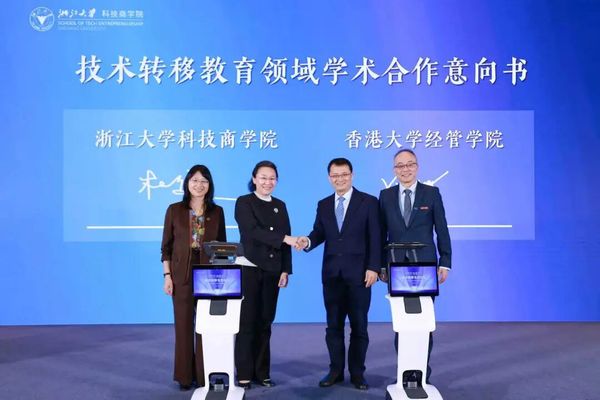
During the ceremony, the school signed a letter of intent with the University of Hong Kong’s Faculty of Business and Economics to explore academic cooperation in technology transfer education. It also joined representatives from national key laboratories, venture capital firms, pilot-scale testing facilities, proof-of-concept centers, and university-affiliated innovation organizations to launch a collaborative initiative supporting research commercialization. By connecting resources and expertise across the innovation process, the initiative seeks to help promising discoveries move from laboratory research through technical validation and industrial development to commercial success.

The accompanying forum featured keynote presentations on bridging the gap between scientific discovery and commercialization, developing entrepreneurial talent, emerging trends in technology investment, and bringing advances in embodied artificial intelligence and robotics into industrial applications.
Among the speakers were Ren Qilong, a member of the Chinese Academy of Engineering and Dean of Zhejiang University’s Quzhou Institute; Wang Hongwei, Managing Director of Shenzhen Capital Group; Chen Dingjiang, Dean of Zhejiang University’s Institute of Technology Transfer; and Xiong Rong, Director of the Robotics Laboratory at Zhejiang University’s Institute of Cyber-Systems and Control.
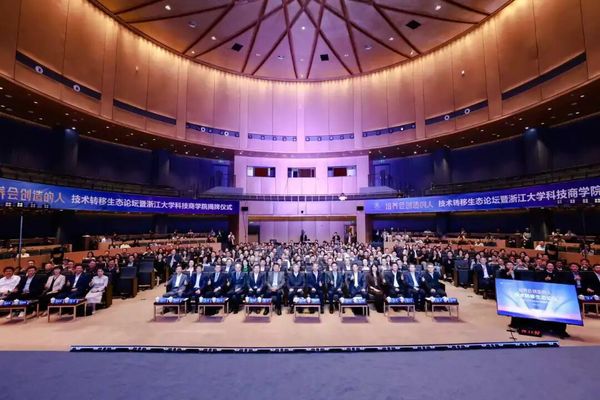
By bringing scientific expertise, entrepreneurial education, and industry partnerships together, the School of Tech Entrepreneurship aims to create a more direct pathway from discovery to application, preparing graduates not only to generate new ideas but also to transform them into innovations that make a meaningful difference.
Adapted and translated from the article written by Zhou yiying, Chen Xiangxiang
Photo: Ting Guang
Translator: Fang Fumin
Editor: Ding Chenwei