Journal of Zhejiang University-Science Nominated for Academic and Professional Publisher Award


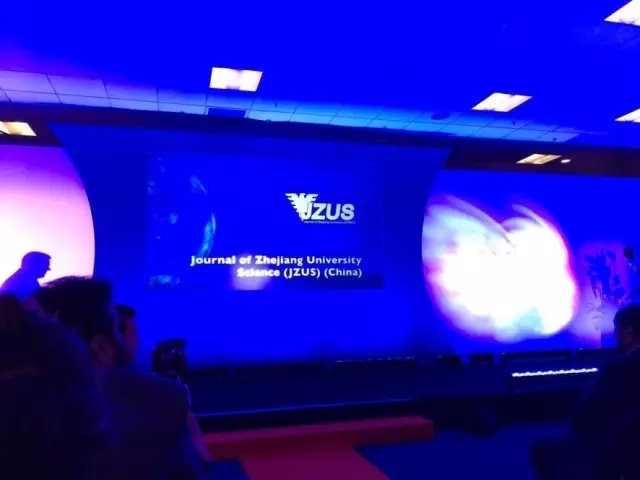
Editor's note: The winners of the London Book Fair International Excellence Awards were announced at a prestigious awards ceremony held on March 14, 2017 at Olympia, UK. In its 16 Awards Categories, the Academic and Professional Publisher Award went to OECD Publishing (France) while Journal of Zhejiang University-Science (JZUS) and CSIRO Publishing (Australia) were nominated for this award. It is the first time that an academic journal has been shortlisted since the establishment of this award in 2014.
The Academic and Professional Publisher Award was set up in 2014 by the London Book Fair International Excellence Awards with a view to recognizing outstanding practitioners in the publishing industry and awarding eminent enterprises and individuals in the international publishing market.
There are roughly 1,000 ‘campus’ journals that mostly publish papers from Chinese universities. Why can JZUS stand out and make crowning achievements in globalization? The news report by China Publishing Business Weekly may offer us its unique and insightful analysis and reflection.
A Voice of Chinese Academic Journal
The winners of The London Book Fair International Excellence Awards were announced at a prestigious awards ceremony held on Tuesday 14 March 2017 at Olympia, UK. In its 16 Awards Categories, The Academic and Professional Publisher Award’s winner is OECD Publishing (France); the shortlisted publishers include CSIRO Publishing(Australia) and Journal of Zhejiang University-Science (JZUS)(China).
Not Just a Campus Journal
As Zhang Yuehong (Helen), Chief Editor of JZUS introduced, there are roughly 5,000 STM periodicals in China, including more than 300 published in English. Around 1,000 are 'campus' journals that mostly publish papers from Chinese universities. Zhang has had a dream that to run an international scientific journal that meets international standards. So in 2008,JZUS started using CrossCheck. Zhang says, it is inaccurate to describe JZUS as a 'campus' journal. In fact, it is an international publication with a pool of some 26,000 referees from more than 67 countries. On average, 64.4% of its contributions come from outside Zhejiang University, Hangzhou, China, of which 50% are from more than 46 countries and regions. The editorial board is international too.
JZUS publishes articles in-press to avoid publishing delays, and identifies the 'hot topic' or most downloaded articles to help readers identify trends and the best articles published. It allows post-publication comments, and has added Power Point summaries of each article to help readers use its content in their own presentations and ensure correct citation.
Rather than aiming for anonymous 'international' status, JZUS is conscious of its roots, and celebrates the cultural heritage of China. Chinese cultural tokens are used to reward its reviewers, wherever in the world they are, in addition to the recent addition of Chinese language abstracts to increase usability to Chinese researchers.
Enhancing Text and Data Mining Tech
Since 2014, JZUS has collected and deposited CrossMark, ORCID(a persistent digital identifier for a researcher), and FundRef(funder information)metadata for every paper, and displays them both in the web and PDF version.
JZUS recognizes that text and data mining (TDM) is increasingly seen as a useful method for analyzing large volumes of unstructured documents, which can meet the needs of researchers and support the innovation and development of new knowledge. Because of its participation in Crossref Text and Data Mining Services, researchers are able to text mine subscription content since 2015 accessed via Crossref and Springer's Metadata API, provided the purpose is noncommercial research.
In 2015, aiming at persisting in anti-plagiarism and its high international peer review standards, Zhang Yuehong, worked with her two colleagues, posted a 2015 JZUS-policy online. The Policy, based on the ethical code and flow charts of the Committee on Publication Ethics(COPE)and their experience at Journals of Zhejiang University-SCIENCE A/B & FITEE, includes three sections: Forms of Plagiarism, Anti-Plagiarism Policy, and CrossCheck Workflow. This policy is available free at the official website of JZUS, noting that JZUS will strictly follow its anti-plagiarism policy, while CrossCheck will be used to check authors' submitted papers in order to identify unduly high levels of similar text, which gives rise to the possibility of plagiarism.
In 2016, Springer and Zhejiang University Press published two new books about JZUS respectively, one is Against plagiarism: a guide for editors and authors, which published by Springer, and supported by COPE(Committee on Publication Ethics), the other one is Chinese Cultural Kaleidoscope, which published in Zhejiang University Press. Both books mark the academic achievements of JZUS in these years.
Focus on Service Rather Than Innovation
In the report of The Association of Learning and Professional Society Publishers, it commended that a good journal is the one focusing its activities on authors and readers. While it may not be developing truly innovative services, it is thinking about what they need and developing new ways of providing them.
Being nominated and shortlisted for LBF International Excellence Awards 2017 is a new progress of JZUS, Zhang Yuehong shows her gratitudes, saying “We are very appreciated international nominators who recognize JZUS in academic publishing area!”
(China Publishing Business Weekly)