ZJU scientists solve a three-decade challenge in synthesizing chirality-controlled nanotubes


For more than three decades, one of the biggest obstacles to unlocking the potential of transition-metal dichalcogenide (TMDC) nanotubes has remained unresolved: how to precisely control their chirality during synthesis.
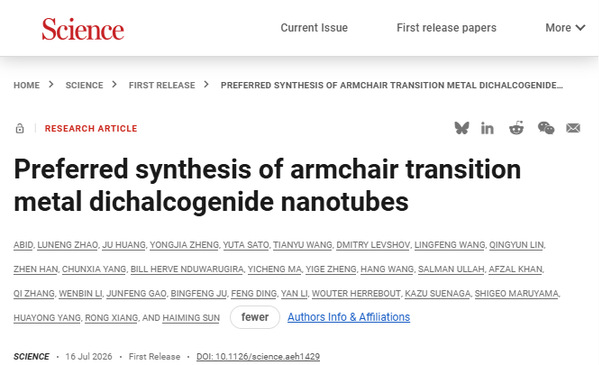
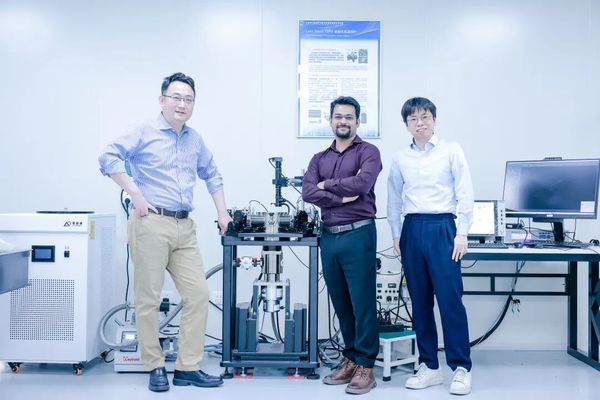
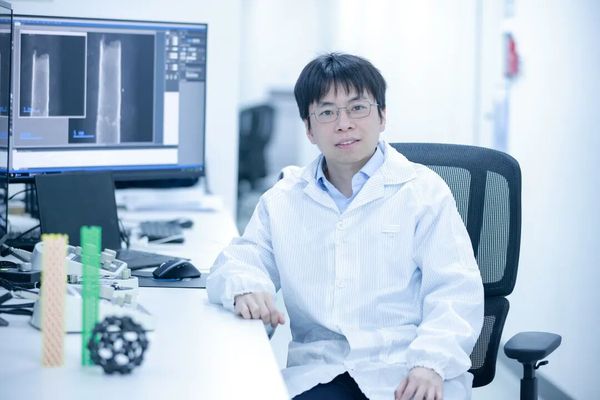
Now, an international research team led by XIANG Rong from the School of Mechanical Engineering at Zhejiang University has achieved the first preferred synthesis of TMDC nanotubes with a well-defined armchair configuration, overcoming a longstanding challenge that has limited the field since the materials were first discovered.
The study, carried out in collaboration with researchers from Dalian University of Technology, Westlake University, Suzhou Laboratory, Peking University, Osaka University and the University of Tokyo, has been published as a First Release article in Science.
One-dimensional materials exhibit extraordinary quantum phenomena, including one-dimensional quantum confinement and van Hove singularities, which give rise to remarkable mechanical, optical and electronic properties. Carbon nanotubes, discovered in 1991, quickly became one of the most celebrated nanomaterials because they are stronger than steel, possess exceptional electrical and thermal conductivity, and display dramatically different physical properties depending solely on how a graphene sheet is rolled. A slight change in the rolling angle can determine whether a nanotube behaves as a metal or as a semiconductor.
Yet despite their remarkable properties, carbon nanotubes have yet to fulfill their technological promise. Early synthesis methods produced nanotubes with essentially random chiral structures. Semiconductor nanotubes were inevitably mixed with metallic ones, making it nearly impossible to manufacture reliable electronic devices at scale. More than thirty years later, chirality-controlled synthesis remains one of the most enduring challenges in nanotechnology.
TMDC nanotubes, first reported in 1992, represent an even more versatile family of one-dimensional materials, including compounds such as molybdenum disulfide (MoS2), tungsten disulfide (WS2) and tin disulfide (SnS2).Compared with carbon nanotubes, TMDC nanotubes offer a much broader range of electronic bandgaps, stronger nonlinear optical responses, and entirely new quantum phenomena such as valleytronics. These characteristics make them attractive candidates for next-generation optoelectronics, quantum information technologies and catalysis.
“If carbon nanotubes are the benchmark for one-dimensional nanomaterials, TMDC nanotubes could be regarded as their ‘Pro Max’ version,” the researchers said.
But their superior functionality comes at a price. TMDCs possess sandwich-like atomic layers that are considerably more rigid and far more difficult to bend into tubular structures. Their growth mechanisms are also substantially more complex. As a result, little progress has been made toward controlling their chirality since TMDC nanotubes were first discovered more than three decades ago. Simply achieving successful synthesis has itself been regarded as an advance, leaving many anticipated applications beyond reach.
The breakthrough began with an observation that initially seemed ordinary. While examining electron diffraction data, postdoctoral researcher Abid noticed that one batch of newly synthesized TMDC nanotubes consistently produced nearly identical diffraction patterns under the transmission electron microscope.
“Professor XIANG Rong asked me why this happened,” Abid recalled. “At the time, I had no idea. I assumed this was simply what the material should look like.”Yet, the research team thought otherwise. The unusually uniform diffraction patterns suggested that something fundamentally different was occurring during crystal growth. Rather than dismissing the anomaly, the researchers decided to investigate the phenomenon in depth.

Their study ultimately revealed an entirely new growth mechanism. Instead of allowing TMDC nanotubes to form freely, the team used boron nitride nanotubes (BNNTs) as nanoscale templates, guiding TMDC crystals to grow inside their hollow channels. The strategy achieved something that had never before been demonstrated: the preferred synthesis of nanotubes with a specific chirality.
For tin disulfide, armchair nanotubes accounted for as much as 84% of the products. Similar armchair preferences were also observed for molybdenum disulfide and tungsten disulfide nanotubes, suggesting that the approach may be broadly applicable across the TMDC family.
“The discovery fundamentally changes how we think about this class of materials,” said ZHENG Yongjia, a young professor at the School of Mechanical Engineering. Yet convincing reviewers proved almost as challenging as making the discovery itself.
“When we first submitted the manuscript, we included data from 50 samples,” ZHENG Yongjia said. “The result was so unexpected that the reviewers were not fully convinced.”
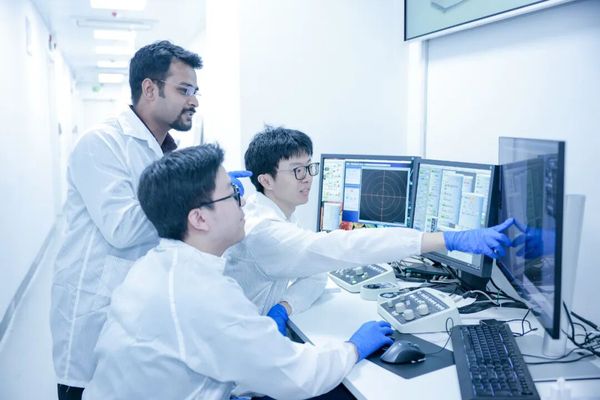
For the next 72 hours, three researchers worked in rotating shifts, keeping the instruments running around the clock. By the end of the marathon effort, they had collected diffraction data from 300 nanotubes.Every additional measurement told the same story. The expanded dataset confirmed the original observation.
Combining thermodynamic and kinetic analyses, the researchers discovered that TMDC crystalsfirst form zigzag nanoribbons that adhere to the inner walls of the boron nitride nanotube template. Under nanoscale confinement, the ribbons undergo repeated deformation driven by the BNNT’s breathing-mode vibrations. As neighboring layers slide against one another and the ribbon edges gradually heal and close, the flat nanoribbons ultimately roll into armchair nanotubes.
To verify the proposed mechanism, the team combined advanced computational modeling with in situ transmission electron microscopy, capturing the entire transformation from the nanoribbon to the nanotube in real time. The direct observations closely matched the simulations, providing a rare closed-loop validation that bridged theory and experimentation at the atomic scale.
The implications extend well beyond solving a long-standing synthesis problem. Compared with nanotubes of other chiralities, armchair TMDC nanotubes possess lower effective electron masses and therefore potentially much higher carrier mobility, making them particularly suitable for nanoscale transistors, high-speed electronic devices and other next-generation nanoelectronic applications.
More broadly, the researchers believe that the newly uncovered nanoribbon-to-nanotube transformation mechanism could provide a general framework for chirality-controlled synthesis of a wide range of nanotube materials.
For XIANG Rong, this study also marked a personal milestone.
“This project was carried out entirely in China after I returned from the University of Tokyo in 2022,” he said. “From the team’s first observation of the unusual diffraction pattern to uncovering the underlying mechanism and finally publishing the work, the entire journey took four years.”
He attributed the breakthrough to a combination of scientific curiosity and world-class research infrastructure. “Noticing an unexpected phenomenon always involves a measure of serendipity,” XIANG Rong said. But being able to systematically explain it and verify the mechanism requires something much more fundamental: access to world-class experimental facilities.”
The laboratory’s capabilities have also become a magnet for international talent. Today, more than one-third of the laboratory’s researchers comes from outside China, with members from Japan, Europe, the United States, India and Africa.
“China has reached a stage where we can and must attract outstanding researchers from around the world at every career stage,” XIANG Rong said. “Young researchers like Abid have played indispensable roles in this breakthrough.”
He believes the benefits extend beyond scientific productivity. “When researchers from different cultural backgrounds work together, they often generate ideas that none of us would have arrived at alone,” he said. “That not only drives scientific innovation, but also gives our students invaluable exposure to an international research culture early in their careers.”
Looking ahead, the researchers believe the newly uncovered nanoribbon-to-nanotube transformation mechanism could provide a general blueprint for the chirality-controlled synthesis of a wide range of nanotube materials. Beyond TMDC nanotubes, the strategy may accelerate the development of next-generation nanoelectronic, optoelectronic and quantum devices built with atomically precise architectures.
Adapted and translated from the article written by YUE Sicong
Photos: TING Guang
Translator: FANG Fumin
Editor: DING Chenwei