ZJU Scientists Discover Homologous Recombination Repair Pathway to DNA Double-strand Breaks


DNA double-strand breaks (DSBs) are the most deleterious form of DNA damage, which if unrepaired or repaired incorrectly, can contribute to various genetic disorders including cancer, neurodegeneration, and immunodeficiency. There are two types of DSBs: Two-ended DSBs and replication-associated one-ended DSBs. DSBs are mainly repaired by either homologous recombination (HR) or non-homologous end-joining (NHEJ).
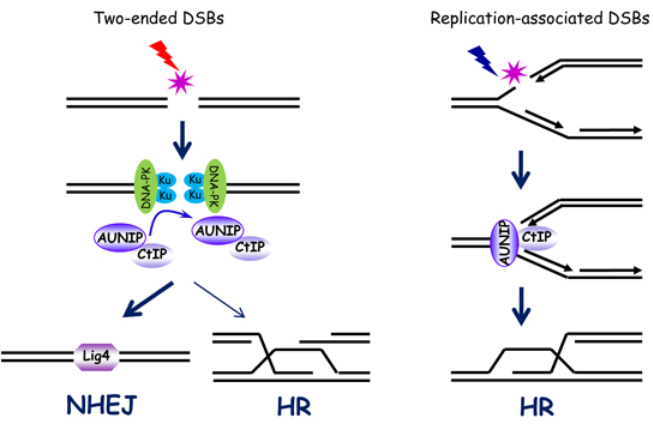
Molecular mechanism of AUNIP to identify different DSBs and route to proper repair pathway
The research team, headed by Prof. HUANG Jun from the Life Sciences Institute and Innovation Center for Cell Signaling Network, Zhejiang University, identifies AUNIP/C1orf135, a largely uncharacterized protein, as a key determinant of DSB repair pathway choice. AUNIP physically interacts with CtIP and is required for efficient CtIP accumulation at DSBs. AUNIP possesses intrinsic DNA-binding ability with a strong preference for DNA substrates that mimic structures generated at stalled replication forks. This ability to bind DNA is necessary for the recruitment of AUNIP and its binding partner CtIP to DSBs, which in turn drives CtIP-dependent DNA-end resection and HR repair. Accordingly, loss of AUNIP or ablation of its ability to bind to DNA results in cell hypersensitivity toward a variety of DSB-inducing agents, particularly those that induce replication-associated DSBs. These findings provide new insights into the molecular mechanism by which DSBs are recognized and channeled to the HR repair pathway.
The findings of this study are published in Nature Communications (https://www.nature.com/articles/s41467-017-01151-w).