Researchers solve visual correspondence between two eyes


Stereoscopic vision depends on the correct matching of corresponding features between the two eyes. It remains obscure where the brain solves this binocular correspondence problem. Although our visual system is able to make correct global matches, there are many possible false matches between any two images.
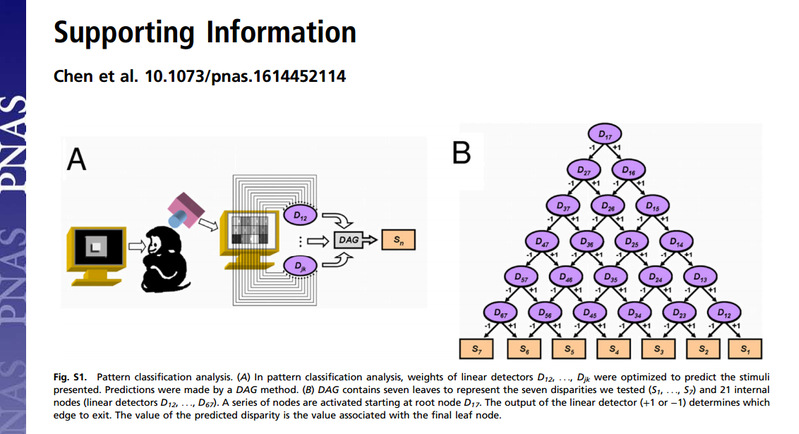
A research team led by Professor CHEN Gang with ZJU’s Qiushi Academy for Advanced Studies has offered a novel solution. By using optical imaging data of binocular disparity response in the visual cortex of awake and anesthetized monkeys, they demonstrated that the second visual cortical area (V2) is the first cortical stage that correctly discards false matches and robustly encodes correct matches. The findings indicate that a key transformation for achieving depth perception lies in early stages of extrastriate visual cortex and is achieved by population coding.
The information indispensable for binocular depth perception may result via emergent properties of ensemble behavior. Researchers demonstrated, with direct experimental evidence from both awake and anesthetized monkeys, that the integration of neuronal signals across a population may help to achieve binocular correspondence. They showed that V2 could be a critical stage for solving the binocular correspondence problem. According to their research, the transformation from physical stimulus to perception begins to happen in V2 and might be inherited by higher cortical areas in both the dorsal and ventral pathways where complex 3D percepts are generated.
Relevant findings appeared on the November issue of PNAS.