Hepatic neoplasm kinetics revealed by Holo-Seq


The research team headed by JIA Junling at the Life Sciences Institute and the research team led by ZHENG Min in the First Affiliated Hospital of Zhejiang University co-published a research article entitled “Holo-Seq: single-cell sequencing of holo-transcriptome” in the October 17 issue of Genome Biology, a top journal in genomics.
Researchers used the single-cell holo-transcriptome sequencing (Holo-Seq) to simultaneously observe small RNAs and mRNAs in a single cell for the first time. The miRNA-mRNA dual-transcriptomes identified three Exp-subpopulations and three SE-subpopulations of HCC cells and helped tp decipher the hepatic neoplasm kinetics. Moreover, they filtered out a batch of tumor suppressor miRNA candidates with their potential targets and super-enhancers with significant activity change during malignant transformation. They are all potential biomarkers for the diagnosis or therapy of HCCs.
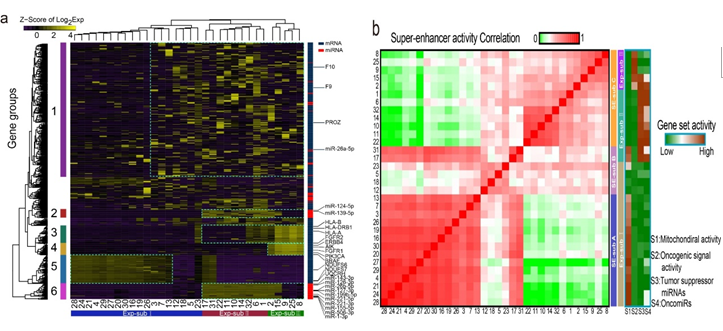
Fig. a: miRNA-mRNA dual transcriptome analyses of hepatocellular carcinoma (HCC) single cells.
Fig. b: The correlation heat map of the genome-wide super-enhancer activity of six differential expressed gene groups and 32 HCC single cells (Left panel). The right panel is the relative expression heat map of the gene sets related to mitochondrial activity, oncogenic signals pathways, tumor suppressor miRNAs, and oncomiRs of 32 HCC single cells.
Single-cell RNA-Seq has become an effective approach to demonstrating the differences across cells and promoted a series of major developments in developmental biology and cancer biology. However, it is hindered by preamplification bias, losses of strands of origin information, and the inability to observe small-RNA and mRNA dual transcriptomes. Holo-Seq method overcomes all three hurdles. Holo-Seq has the same quantitative accuracy and uniform coverage with a complete strand of origin information as bulk RNA-seq.
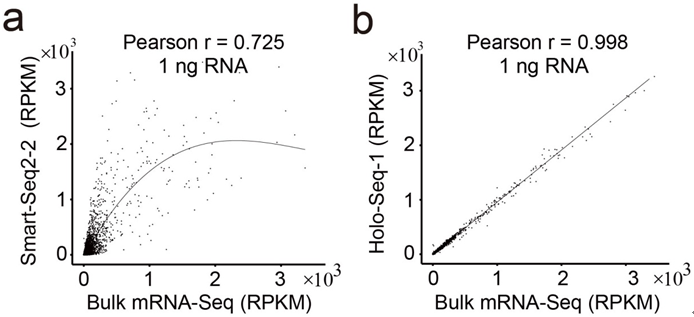
Fig. a: An RPKM scatterplot of expressed genes between Smart-Seq2 and bulk mRNA-Seq.
Fig. b: An RPKM scatterplot of expressed genes between Holo-Seq (mRNA) and bulk mRNA-Seq.
Featured by high accuracy and low costs, Holo-Seq can be exceedingly feasible and practical. Meanwhile, it can lay a safe and effective technological basis for the quality system for clinical research into stem cells.