Sino-US cooperation for creative ideas on campus lifestyle


【Editor’s Note: What will it be like if students from both ZJUI and UIUC work together on a human-centered engineering project? And what creative solution will they work out for the campus sustainability? In the following essay, ZHAO Zhiju from ZJUI, ’25, Electronics and Computer Engineering, shared his experiences and reflections in the international cooperative project.】

When walking around the campus, one can often see students interviewing our peers, faculty members, or campus staff workers. You may wonder what they are doing and why they are doing this. Are these students journalists for the campus newspaper or are they taking part in some campus-wide activities? Actually, they are our freshmen students from ZJUI who are preparing for their Engineering Orientation course project.
How about an international cooperative project? (Intro)
This project, unlike any other usual homework assigned to us, is a Sino-US collaborative project. All freshmen from ZJUI are randomly divided into groups of two or three and would team up with freshmen from UIUC to work together and complete an engineering design. The general topic for the project this year is “Human-centered Engineering and Global Collaboration,” and the word “human-centered” makes me really believe that some of our final designs could actually come true and benefit people who live and work in the two campuses, since we were specifically required to find improvements for current situation based on our real needs.
There are four topics to choose from in terms of design: online communication, learning management systems (e.g., Blackboard, Canvas), transportation and cafeteria sustainability. My group decided to choose the fourth topic.
The project is divided into two sessions. In the first session, students from ZJUI and students from UIUC would sit together, I mean, sit together in front of their computers, and talk a little bit about the topic they had chosen. Then they would do some interviews to find current setbacks or problems about the topic and get back together again to debrief what they had found and come up with some prototype solutions. From all these brainstormed solutions, a group would decide on one method and explore further on it. They would do some interviews again and test the feasibility of that method. At the end of the first session, the group would do a small presentation and share the research results. The second session, due to the different schedules the two campuses have, would be done only by the ZJUI students. We are required to write a paper about what we have found and the best groups will be invited to a “Shark Tank” and present our designs directly to our professors-as-referees.
Never Let Insecurity Get in Your Way (Before the event)
Sitting at Professor Hu Huan’s lecture, listening to his introduction to this project, I felt both nervous and excited. I was nervous because I knew that this project was going to require long-term efforts and I had to work with foreign students, which I have never experienced before this project. There could be many difficulties when communicating with them, such as language barriers and jet lag. However, this was also the reason why I was excited, because I know that opportunities and fun come along with challenges. During the process, I can learn more about how American students study and do their research and this could provide great help to me adjusting myself to the American learning style in my junior exchange year and long-term personal development. Also, I would get to know how engineering works and how real-life engineers solve problems and how to turn a technology innovation into business success (ENG100 Fall 2021). Knowing that I can gain so much after this project, my excitement and confidence beat my anxiety.
One problem at a time (During the event)
First online meeting was held on September 30. Before the first online meet-up, the facilitator from UIUC, Liam, continued on Professor Hu Huan’s lecture and Lucas O’Bryan’s online course to talk on “human-centered design”. Human-centered design is an approach to satisfy unmet needs starting with interviewing people about their experience and is iterated by gaining feedback about the prototypes from people we are designing for. After enough upgrading the prototypes would become useful and innovative tools that can help people. This approach of innovating requires one to be compassionate and feel for the people who might need this design. There are a few stages in human-centered design. First, come up with choices after trying to understand what the unmet needs are or what unmet needs are on the market; second, we use a way called “synthesis” to reorganize all our messy information obtained from interviews and try to find patterns or similarities in that information; then we will diverge again and come up with as many ideas as we can about how to solve that unmet need; finally we converge again and choose one most feasible solution to work on and improve (Hu). So, as you can see, the human- centered design is a periodic approach, using several divergences and convergences, to polish our design or solution, until it’s good enough to be implemented.
At the first meeting everyone was a bit shy of course. We briefly introduced ourselves to each other. It was a pity that not every team member arrived for it could have been a very good chance for us to learn more about each other. After that, we talked about who we could interview to get the information we want. After the first meet-up we started interviewing people to gather information about the current status of sustainability in our cafeterias. My ZJUI teammate and I interviewed a freshmen student and a worker at the campus drop-off site, while our American teammates interviewed a residential assistant (RA). It turns out that there are several patterns in our results. First, all our interviewees emphasized the seriousness of food waste and agreed that a lot of food is wasted every day in our cafeterias; all our interviewees believed that bad food quality and unawareness of food waste are some of the major reasons why a lot of food gets thrown away. We brainstormed upon these understandings to find some possible solutions to improve sustainability and shared them on our second online meeting. This time everyone was there, which was great. However, due to the jet lag and that the meeting was held 7 in the morning in Illinois, we chose not to talk to each other in case we woke up our roommates. Some of our proposals include improving food quality, having the incoming freshmen complete an exam on food waste and putting up posters. We brought these solutions to a second round of interviews. We still interviewed a freshman, an RA, but change the third target from a worker at drop-off site to a worker at the cafeteria, to understand the ideas of an insider. We finally agreed on the last one because we acknowledged that one to be the most feasible one. To serve thousands of people, it could be very hard to prepare the food very carefully and make them delicate according to a cook at ZJUI cafeteria. Having students take an extra exam sounds just a bit cruel, and it’s hard to ensure that everyone has actually prepared for the exam according to the RA. However, putting up poster is very practical, since it’s very easy and cheap to make posters and they can be put everywhere in the campus so that most of the students or staff would be able to see them.
We were also aware of the disadvantages of putting up posters. In our second interview, we asked different people about their opinions to our suggested methods, and all three interviewees said that it could be hard for the cafeteria users to notice the posters or to enforce it. Many people may just ignore them, only those who were already taking actions in saving up food or had the wish to do so would have the patience or interest to look at them. Or people may just forget the information and tips on the poster very easily. So first, we agreed that our poster must be attractive enough. There should be some lovely illustrations on our poster to make it more appealing and some useful tips to make it more educational. But that’s only the first step. Our American teammates then came up with another brilliant idea. We would not only make “put-on-the-wall” posters, but also print our posters on napkins and paper tray mats provided by the cafeteria, like what they are doing in KFCs or other fast-food chain stores. In this way, cafeteria users are forced to have more “eye contacts” with our posters. This method could also have a warning effect. When cafeteria users are looking at both their plates with quite some left- over food and a poster that teaches them to save up food, they may feel guilty and continue finishing their food or remember to order less the next time they use the cafeteria. And similarly, both napkins and paper tray mats are easy to fabricate in a massive scale, so this method is feasible and economic. To make it even more eco-friendly, since some of our interviewee also told us that the use of plastic tableware is a sabotaging the sustainability of our cafeterias, we can even use recycled material to make our posters, napkins, and mats.
On the night of November 16, the time of our presentation came. Due to some problems, I was only informed of that on the morning of November 16. Seven in the morning, I woke up, my head still a bit fuzzy, I noticed Paz’s email with the notification of our presentation and his slideshow. My Chinese partner and I made a few adjustments to the slideshow later in the afternoon of that day and send the slideshow back to Paz at like 4 p.m. in Haining and 3 a.m. in Illinois, only to find that he was still awake, waiting for us to adjust. We felt very sorry and admired him a lot. To surprised me more, they even had completed an example of the poster. It mainly used the green color, had some illustrations and tips that show people how to reduce food waste.
Clock hit nine and our presentation should begin. We were the fourth group to present and Paz and I were still communicating through email about the order of appearance and some details before we actually began. We finally agreed that my ZJUI teammate and I would cover the introduction and conclusion while our American teammates would cover the results of our interview and our design. I must admit that when I was up there doing my part of the presentation, I was a bit tongue-tied because I had never made a public speech in English, not to mention that half of my audience were native speakers. I was the first one to speak, then it was our teammate Paz talking about the results of our interviews, our teammate Paige talking about the solutions we thought of but could not apply, and our teammate Samantha talking about the poster method. The presentation was very quick and eventually, everything went well. Judging from the facial expression of our facilitator, we did a quite excellent job. Below is our first draft poster (Linares):
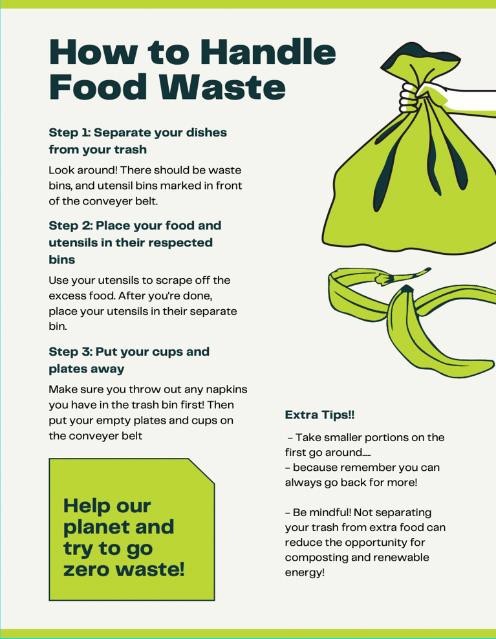
“How to Handle Food Waste” by Samantha Linares
Farewell, friends from UIUC… (After the event)
I would like to share some of my thoughts and reflections during the project in this section. During the time I spent working on this project, I learned a lot about both the ZJUI and UIUC students community, the food service community, and the engineers community. In terms of students community, I realized that there are a lot of students who consider the food served in the cafeterias bad just like me; I learned about what RAs on UIUC campus are and what they do every day. I also learned that the stereotypes for American students to be lazy and outgoing are not true. They can be very efficient and hard-working, just look at Paz and Paige who worked until late night and Samantha who made a beautiful poster in such a short time and the rumor breaks itself. In terms of the food service community, I realize that the food waste problem is far more serious than what I think it is. According to a UN report there are about 931 million tons of food wasted every year, and that is a huge number (Forbes, 8). We are wasting a tremendous amount of food every day while there are people in the remote areas dying of hunger. It is really time for us to do something to turn the situation around. In terms of engineering community, I learned a common way of working for engineers. Engineers are like the backbones of the society, they make people’s lives easier and more comfortable by improving, inventing, and innovating, so engineers must do field research to find the actual needs of the people they’re designing for to build something that is beneficial instead of invalid designs. And this is where I believe I’m going to in the future: finding the needs, learning about the needs, and meeting the needs.
Work Cited
1. ENG100 Fall 2021 - Introduction to Engineering Students Projects: Human-centered Engineering and Global Collaboration. ZJU-UIUC Institute.
2. Forbes, H., T. Quested, and C. O’Connor. Food Waste Index Report 2021. United Nations Environment Programme: Nairobi, Kenya (2021).
3. Hu, Huan, Bots, Liam, O’Bryan, Lucas. “Human-Centered Design.” ZJU-UIUC Institute. Linares, Samantha, et al., editors. How to Handle Food Waste.
Writer: Zhao Zhijun (’25, Electronics and Computer Engineering)
Source: Zhejiang University-University of Illinois at Urbana-Champaign Institute (the ZJU-UIUC Institute, ZJUI)