Dialogue@ZJU: With YANG Zihan, student leader of the Zhejiang University Supercomputing Team


[Editor’s Note: On our march into an era of big data and artificial intelligence, there is hardly anything as exciting as a computer with such “brainpower” as to perform trillions of floating-point operations within the twinkling of an eye. A sci-fi as it sounds to be, what is described above has been realized by supercomputers applied to fields of weather forecasting, probabilistic analysis, nuclear test, and molecular dynamics simulation. Supercomputers are super-powerful. Fascinated by its great potential, a group of students gathered to make Zhejiang University Supercomputing Team (ZJUSCT), and has been devoted to better architecture and systems in supercomputing. Their efforts paid off, winning them the third place in the Student Cluster Competition (SCC) on Supercomputing Conference, 2022. In this issue of Dialogue@ZJU, YANG Zihan as the student leader shares the story of the competition, the team, and himself.]
1. We are glad to know that your team has claimed the third place in Student Cluster Competition last year. As the leader, how do you comment on the performance of your team?
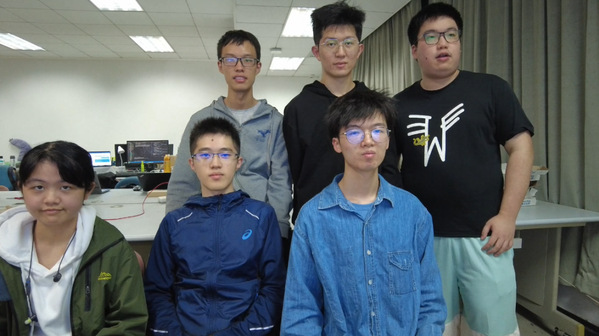
We are thrilled with the outcome of this competition. As new participants in SCC, we stepped into many unfamiliar areas and encountered some difficulties. So we had hardly expected to achieve such a high ranking and all the impressive results. With the experience gained from this competition, we are confident that we will be able to do even better next year.
2. You have mentioned about the difficulties you encountered during the competition. What are the main challenges according to you, and how did your team overcome them?
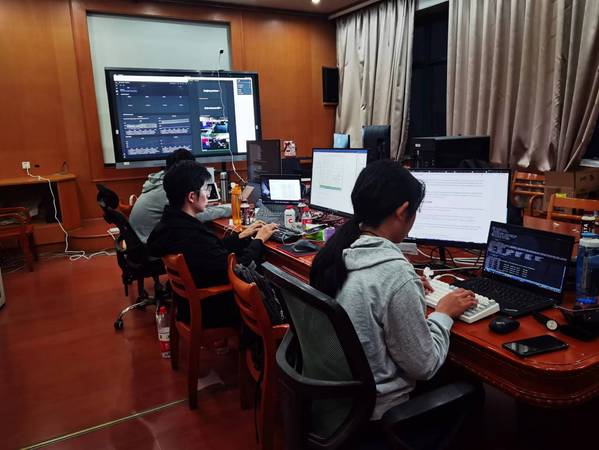
We confronted two main challenges during the competition. Firstly, as SCC was held in the US, we had but to compete online with other teams by working midnight against the jet lag. Plus, the protracted and intensive schedule added to the challenge. Secondly, during the competition, the actual progress of the experiment went off our expected track. For sure, we had foreseen the jet lag and intensity before the competition, and had thus made arrangements to mitigate their impact. We rented a meeting room, purchased living supplies for night-time competitions, and arranged a rotating rest schedule. Thanks to those arrangements, jet lag did not make trouble for our performance. The main problem lay in the cloud server provided by the organizer which is almost alien to us. It brought along obstacles in environment configuration and hardware topology understanding. That resulted in slower experimental progress than expected, and we were unable to complete all competition content before the end. Fortunately, we adjusted our strategy in time, gave up some time-consuming and less-important parts of the problem, and instead ensured the scoring of key parts.
3. Those difficulties make your success even more valuable. Now, please name three factors to which you attribute such an achievement.
We were able to achieve these results due to three main reasons: the close cooperation of the team members, the strong support from the guiding teachers and the school information center, and the proper strategy we established ahead of the competition. Our team members have known each other for more than two years. During the competition, everyone made great efforts in fulfilling their tasks respectively. The guiding teachers offered us ideas to solve the problems encountered in the preparation stage, and the school information center provided us with meeting rooms and high quality network. Before the competition, we made plans for the division of tasks among the team members and the expected progress of each subtask, while reserving some flexibility to deal with emergencies.
4. I suppose the competition was exciting and would remain unforgettable for you. Did you draw any lessons or sweet memories from it?
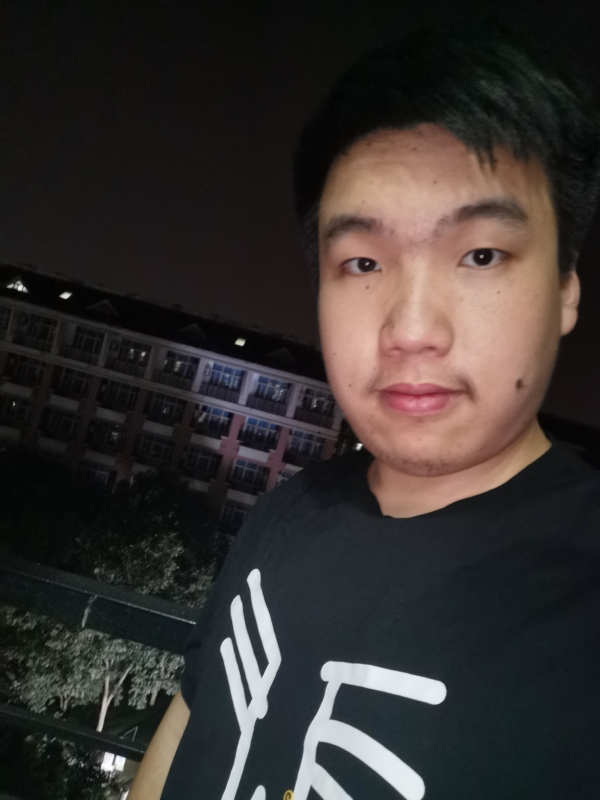
Sure. The competition ended in a dawn. I won’t forget the scene of the silent campus when I looked out from the top of the library after staying up with my friends fighting for the same goal. It was a pleasure to talk to the author of the paper we reproduced and also to chat with the other teams.
Indeed, we have also drawn some lessons from this competition, ranging from arranging the tasks to some technical hands-on experience. We found some drawbacks in the overall design of our computer cluster and are investigating how to refine the architecture. Moreover, we’ve learned much about how to better present our work to others, especially in English. The lessons we got during this contest have been listed in a document for our successors. I hope that we will generate a systematic methodology eventually.
5. It seems that you enjoyed the competition very much. Before the very start of all those stories, what drove you into supercomputing?
I’ve been interested in improving programs’ performance when I was competing in Olympiad in Informatics during high school. The computer was invented in order to automate mathematical calculations that were previously completed by people. But functionally replacing humankind is not enough, for effectiveness is also an essential goal. In order to better achieve the goal, we have to build computer systems that have increased capabilities and fully utilized their ability. This is what high-performance computing does, and it highly matches my interests.
6. Do you have any plans, in terms of the team as well as your own career, for the future?
As for the team, obviously, we want to achieve more in those worldwide SCCs, while making more friends and showing the excellency of students from Zhejiang University. Additionally, we also want to make some academic progress. It would be amazing if we could turn competition content into academic output. In terms of myself, I would pursue a master’s degree in the following years. I will try my best to make my contribution to the field of computer architecture. And I believe my experience of being a member of the Supercomputing Team will help me a lot along this journey.
Interviewer: CAI Zhengwu, graduate student, Translation Studies
Interviewee: YANG Zihan, '23, Computer Science and Technology