Retrace the ancient Silk Road


During their summer vacation, the “ZJU Campus Experience Officers” and the research team from the School of Earth Sciences retraced an epic journey. They crossed the Hexi Corridor, an essential segment of the ancient Silk Road, traversed the Qilian Mountains, and ventured deep into the Qinghai-Tibet Plateau. Following the footsteps of time, they endeavored to decode the intricate climate changes spanning the last 30 millennia.
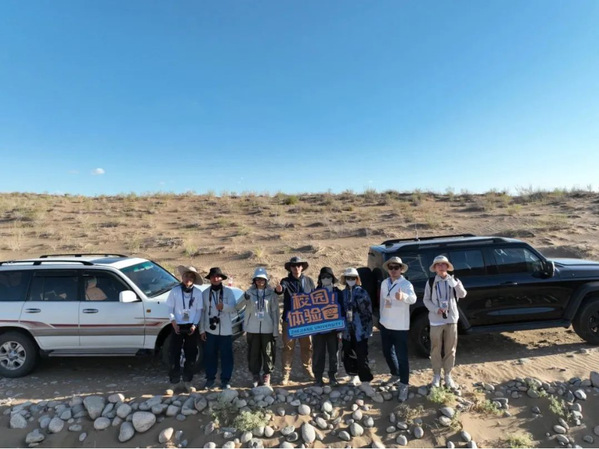
Why did the once-flourishing ancient civilizations that graced this ancient trade route vanish?
For over two decades, Prof. YANG Xiaoping and Dr. ZHANG Deguo have been searching for answers for understanding the history and mechanisms of climate changes in deserts.
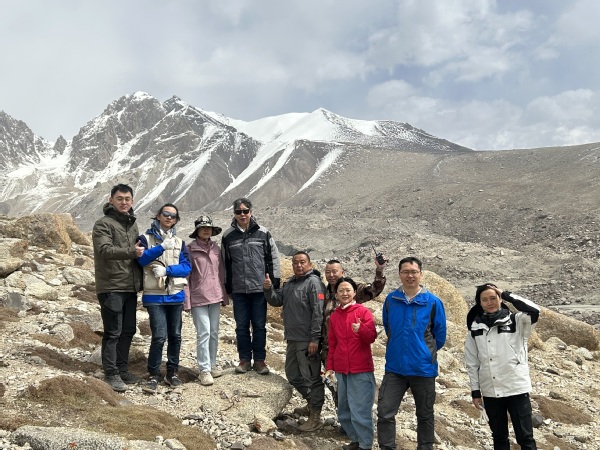
Prof. YANG Xiaoping (fourth from the left) and his colleagues.
Delving into the annals of history, they have followed the intellectual footsteps of Prof. CHU Kochen, the visionary former president of Zhejiang University, who established the Department of History and Geography and devoted himself to studying the palaeoclimatic changes in China. His work titled “A Preliminary Study of Climate Changes in China over the Past 5,000 Years” remains as an important contribution in the realm of climate research until today.
The essence of physical geography and quaternary geology lies in the personal experience of fieldwork, and the key to successful fieldwork lies in the thrill of discovery. The ZJU team including Prof. YANG Xiaoping, Dr. ZHANG Deguo and some other scholars has been deciphering enigmas from the sedimentary sequences in deserts, analyzing the changing history of desert climates, and assessing their future trends.
“In the global context, arid regions are the cradles of ancient civilizations,” says Prof. YANG Xiaoping. “China’s deserts, located at the heart of the arid region in Asia, are rich in relics that offer invaluable insights into the evolution of human civilizations.”
Over the past few decades, the team led by Prof. YANG Xiaoping has painstakingly established the framework for environmental changes in China’s deserts since the Late Pleistocene. By obtaining more accurate data on annual average evaporation rates in desert areas, they have unraveled the mysteries behind desert lake formation and revealed the patterns of wetter environments and water resources in desert regions. Their findings have intrinsically challenged established notions about evaporation in Chinese deserts, heralding a paradigm shift.
If you were to compress the Earth’s 4.6 billion-year history into a mere duration of 24 hours, the Quaternary Period, spanning approximately 2.6 million years ago to the present, would appear as a fleeting moment. Yet, this seemingly short period has produced an indelible mark on the present-day environment.
As the most recent chapter in the Earth’s history, the Quaternary Period is the primary focus of the fieldwork for the “ZJU Campus Experience Officers”. With shovels, trowels, and measuring instruments, they ventured into the Tengger Desert, China’s fourth-largest desert.
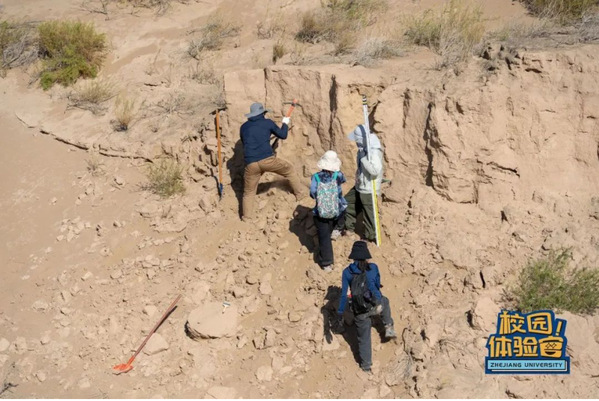
After identifying their sampling sites amid the vast expanse of sand, Dr. ZHANG Deguo wielded a shovel to expose well-defined layers buried beneath the swirling dust. “This 2-meter profile records thousands of years of history, from which you can decipher local climate changes.” With various tools at their disposal, the team members meticulously cleaned the profile, marked scales, and executed recording and sampling work with great precision.
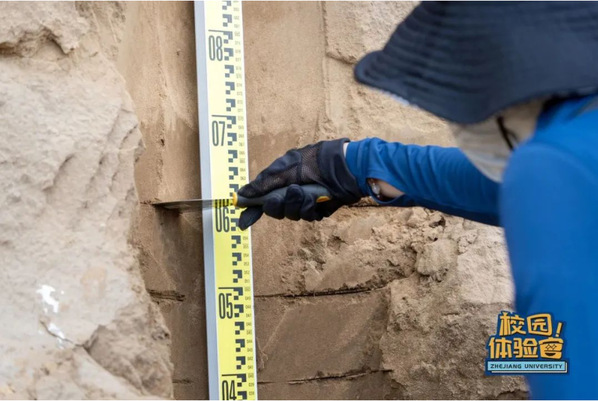
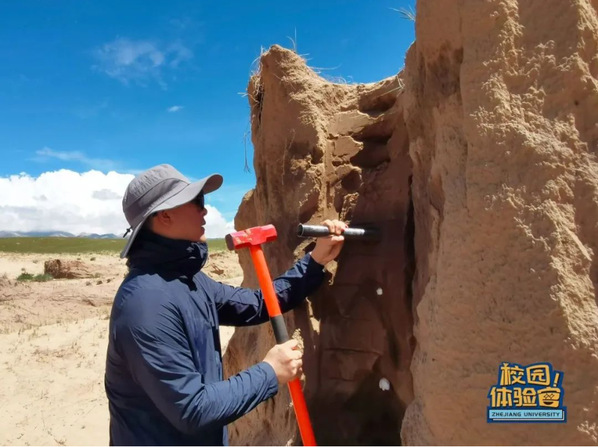
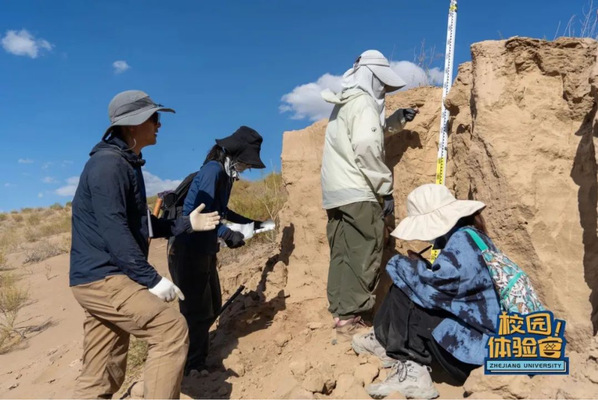
Collecting luminescence dating samples from sediments proved to be the most strenuous task. Through the insertion of luminescence sampling tubes, the team could extract the “film” of sediments that record geological information, revealing the past and the present of the desert. This treasure trove of information forms the basis for predicting future climate changes based on long-term geological analysis.
Such sampling had to be conducted at 1-2 sites each day, putting their physical endurance to the test.
“Fieldwork is a bittersweet experience. It allows us to explore the uncharted territory and gain a more insightful understanding of our planet,” remarks ZHENG Junguo, a second-year doctoral student at the School of Earth Sciences.
To unravel the defining features of a geographical region and reveal the pattern of change in its development, the team needed to accumulate knowledge from various perspectives.
“Without venturing into the field, we can’t secure first-hand research materials or appreciate the social value of desert research,” Dr. ZHANG Deguo explains.
“Textbooks often contain typical cases, but the reality is far more complex. Practice is the sole avenue to progress,” says LIU Liyun, a second-year graduate student at the School of Earth Sciences.
In his quest to expand the scope of desert studies, Dr. ZHANG Deguo transitions from a two-dimensional to a three-dimensional approach. He contemplates the vertical dimension as an additional factor influencing desert formation.
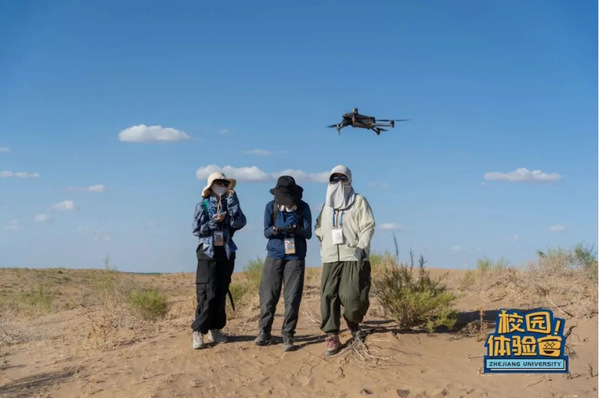
During their scientific expeditions, Dr. ZHANG Deguo mentors the students in establishing three-dimensional images using drones and conducting interdisciplinary research with the help of big data and deep learning. “Our generation must innovate on the basis of what has worked in the past and discover climate changes from the explosive growth of data in a larger space and with more precise chronology,” he says.
This year marks the 10th anniversary of the “Belt and Road” Initiative, and international cooperation and exchange have become increasingly close. Dr. ZHANG Deguo looks forward to more collaborative scientific endeavors between China and other countries in order to unravel the mysteries of climate and revitalize the ancient Silk Road, a timeless testament to human resilience and interconnectedness that spans millennia.
Translated from the article written by KE Yineng and FANG Neng
Photo: YANG Xiaoping,OUYANG Yuxuan, FANG Neng, YU Dajian