ZJU scientists explore global potential for Blue Carbon Ecosystems


Recently, YE Guanqiong, an associate professor from the Ocean College of Zhejiang University, has made waves with the release of a research paper titled “Sustainably developing global blue carbon for climate change mitigation and economic benefits through international cooperation” in the journal Nature Communications.
Blue Carbon Ecosystems, encompassing vital components such as mangroves, seagrass beds, and salt marshes, have gained increasing attention worldwide for their remarkable efficiency in capturing and storing carbon. They are now hailed as an indispensable nature-based solution to mitigating climate change. However, the status of the sustainable development level of blue carbon has yet to be extensively assessed.
In light of this, YE Guanqiong’s research team engaged in collaborative research with scientists from the University of Hong Kong, the Second Institute of Oceanography under the Ministry of Natural Resources, and Zhejiang Institute of Hydraulics & Estuary. Their collective focus was on the evaluation of coastal blue carbon ecosystems. To this end, they constructed a blue carbon development index (BCDI), comprising three subsystems: driving forces, resource endowment, and development capacity. This index served as a tool to assess the sustainable development level of 136 coastal countries across the global. Furthermore, the researchers proposed a cooperation model aimed at exploring the viability of global blue carbon cooperation and quantify benefit allocation to specific countries
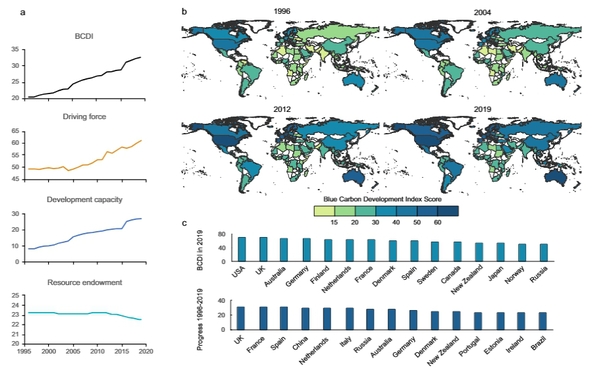
Fig. 1: Blue carbon development index score from 1996 to 2019.
Results from their study revealed a consistent upward trend in BCDI scores over the past two decades. Of particular significance was the discovery of a positive correlation between development capacity and blue carbon resource endowment. Through scenario simulations of global cooperation, the researchers found that coastal countries, under the Global Deep Cooperation scenario, have the potential to improve the global average BCDI score, contribute an impressive annual of carbon sequestration of 2.96 metric tons, and generate more than 100 million dollars in 2030. This remarkable outcome was juxtaposed against the Business-as-Usual scenario, a testament to the urgency of international cooperation in the quest for sustainable blue carbon development.
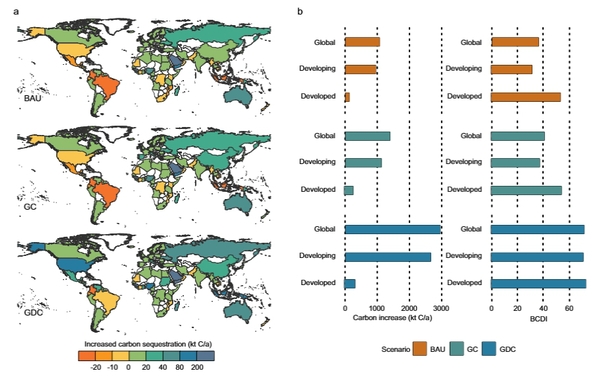
Fig. 2: Analysis of carbon sequestration increase and BCDI under cooperation scenarios.
As the world grapples with the impending climate crisis, this work offers a beacon of hope and an actionable path forward for governments, organizations, and researchers alike, demonstrating that a sustainable future can be attained through strategic global cooperation in harnessing the power of blue carbon.