Why can eating fish make us smarter?


When we speak of fat in food, we will easily associate it with its negative effect of “gaining weight”. However, one type of fat has a “weight-losing” effect – it is omega-3 fatty acids. Not only can omega-3 fatty acids reduce fat, but they can also strengthen the brain, regulate the blood pressure, and ease inflammation. Therefore, they can be found in many health products and infant formula powder.
What has led to these substantial differences? Recently, Prof. ZHANG Yan from the Zhejiang University School of Medicine and Liangzhu Laboratory teamed up with Prof. SUN Jinpeng, Prof. FENG Shiqing and Prof. YU Xiao from Shandong University to unravel this enigma. Their research findings were published in the journal Science on March 2.
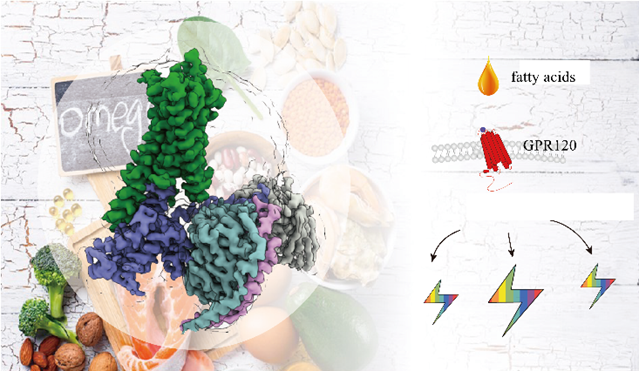
Scientists have been intrigued by the magical function of omega-3 fatty acids. Previous studies reveal that the chemical signals that omega-3 fatty acids send should first be encoded by a G protein-coupled receptor (GPCR) called GPR120. Nevertheless, GPR120 can activate both saturate and unsaturated long-chain fatty acids.
Therefore, it is essential to understand the physiological responses triggered by different long-chain fatty acids after the activation of GPR120 if we want to know why some fatty acids are beneficial while others are not.
“This is an extremely tough task,” said Prof. Zhang. “Long-chain fatty acids are remarkably similar to each other in chemical structure, and there may be a subtle difference only in double-bond position. Moreover, the encoding of fatty acid signals is also a dynamic process, during which various configurations and states may emerge, thus making it difficult for researchers to make some stable observation of the samples.
The introduction of cryo-electron microscopy has made it possible to observe the 3D structure of cells in a quick, efficient and meticulous manner. Prof. Zhang has been committed to research into the mechanisms for cellular transmembrane signal transduction and relevant precise regulation approaches. As early as 2017, Prof. Zhang led his team to obtain the high-resolution structure of GPCR using cryo-electron microscopy, which was hailed as a milestone study in the field of structural biology by the journal Nature.
“Thanks to the cutting-edge cryo-electron microscopy facility in Liangzhu Laboratory, we were able to put the samples in a stable state activated by a certain signaling molecule and observe how the receptor regulates cellular signals at the atomic resolution level,” said Prof. Zhang. “It reached a precision of 0.3 nanometers, 10 times higher than photolithography.”
In the study, the researchers selected five different types and long-chain fatty acids and synthetic compounds as ligands to send signals to GPR120.
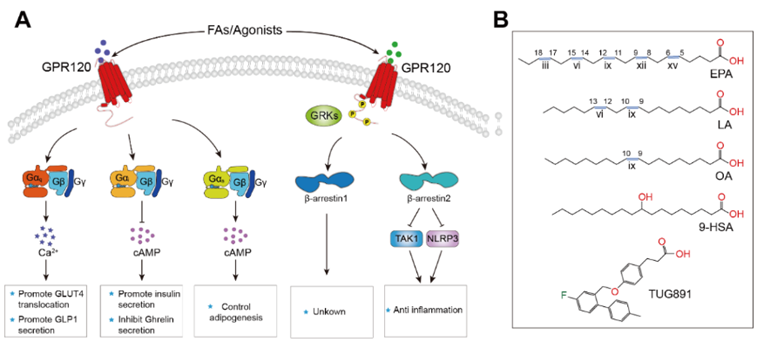
(A) Schematic overview of G protein and arrestin mediated GPR120 signaling and related functions. (B) Chemical structures of fatty acid ligands and synthetic ligand TUG891.
“We found that in response to signaling stimuli from different ligands, GPR120 could mediate the signaling pathways of multiple downstream effectors and that different G proteins could play a crucial role in mediating different physiological functions,” said Dr. MAO Chunyou, the lead author of the study from Sir Run Run Shaw Hospital, Zhejiang University School of Medicine.
Through structural determination, molecular dynamics simulations and mutant screening, the researchers discovered the transmission ties connecting ligand pockets with downstream physiological responses. They demonstrated that omega-3 fatty acids were beneficial because they added an instruction to their receptor, allowing the signals that might otherwise go in other direction to “turn around” and take a pathway beneficial for metabolism.
“GPR120 is like a lock cylinder, and the single bonds and multiple bonds on fatty acids are like the teeth of different keys. The way to open the lock cylinder varies. Although the same lock is turned, it may lead to different words,” Prof. Zhang explained with a vivid analogy.
The understanding of the mechanisms for fatty acids can pave the way for scientists to engage in precise molecular design and develop fatty acid supplements or drugs that are beneficial to human health.

Prof. ZHANG Yan (right) and his colleagues in the lab
To Prof. Zhang, the inspiration for this research is very simple, but it will open up promising vistas. “In my childhood, my elders would always say that eating fish could make one smart. This word holds true, for fish is rich in omega-3 fatty acids. As a researcher, I have been driven by my insatiable curiosity about the story behind their positive effects on human health.”
“Our vision is that everyone can live to the age of 120 years healthily and happily,” To Prof. Zhang said. “In the future, we will continue to decipher the ‘key’ that regulates life functions and help humanity open the door to a long and healthy life.”
Image: LU Shaoqing, the research team led by Prof. ZHANG Yan
Translated from the article published in http://chinazj.com.cn/