The lasting legacy of Zhejiang University’s ‘Report Tree’


At the crossroads of Zheda Road and Yugu Road, just beyond the main gate of Zhejiang University’s Yuquan Campus stands a cedar that has captured the hearts of students and faculty alike. Affectionately known as the “Report Tree” or “BG Tree,” it has become a symbol of tradition and nostalgia for the university community.
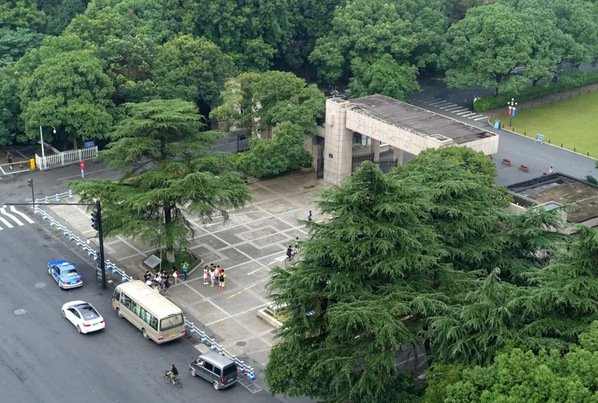
The main gate and the cedar before its replacement in 2016
Yet, since 2021, the “Report Tree” has been showing signs of age. Despite numerous efforts to restore it, experts have concluded that the tree’s condition is irreversibly deteriorating due to aging. Sparse new leaf growth, thinning needles, and limited root expansion point to a harsh truth: the tree’s aging process has outpaced its ability to recover.
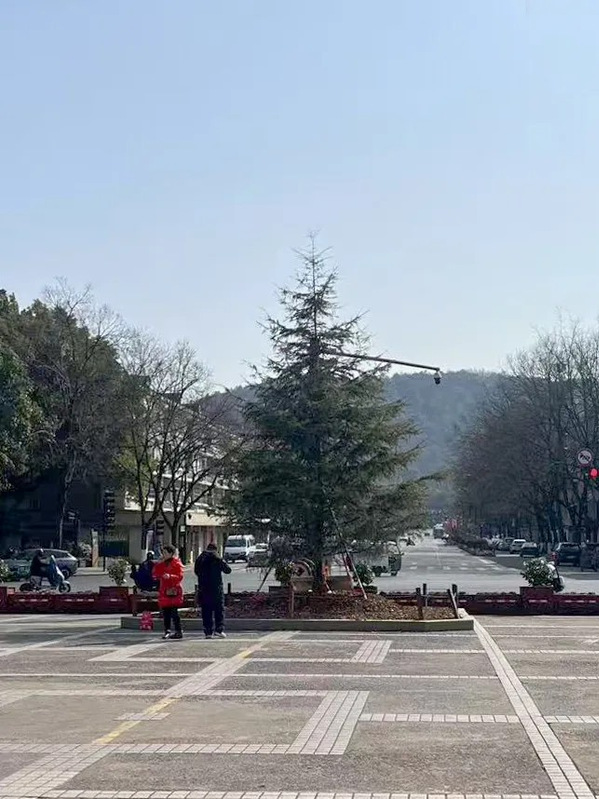
Newly planted cedar following replacement in January 2025
On January 19, 2025, Zhejiang University announced the decision to replace the iconic cedar. Just days later, on January 23, a new tree of the same species was planted in its place. But as the familiar cedar fades into history, questions linger: Where did the original cedar come from? What gave it the name “Report Tree”? Why was transplantation chosen as the solution? And where has become of the old tree?
Cedars are known for their longevity, but this particular tree faced a series of challenges that hastened its decline. Planted in a narrow flower bed, its roots were confined, unable to stretch and grow freely. Over the years, construction work on Yugu and Zheda Roads raised the ground level, burying the roots deeper and restricting its access to air and water. Foot traffic, constant and unrelenting, compacted the soil, further damaging the roots. To make matters worse, Hangzhou’s hot summers and intense sunlight proved too much for the cedar, which thrives in cooler, moister climates.
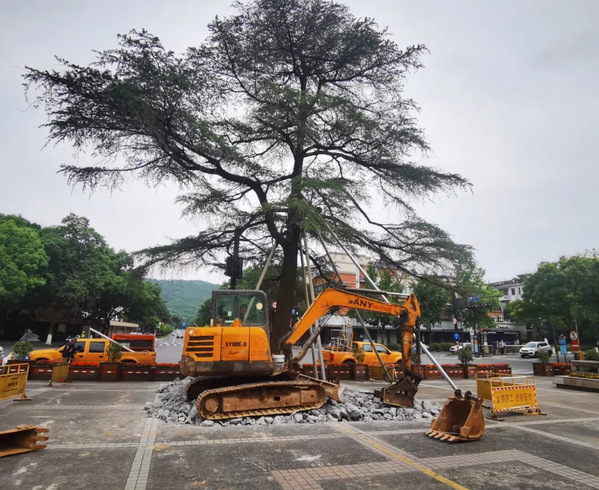
Expanded ground maintenance in June 2022
Given that cedars are less adaptable to the local environment than native species like camphor trees, why was another cedar chosen to replace it? This decision, reportedly, was made to preserve the memories cherished by generations of students and alumni while maintaining the campus gate’s familiar aesthetic. The new cedar preserves the visual harmony of the space, ensuring the campus remains as recognizable as ever.
To mitigate potential issues, the flower bed has been expanded, and the new cedar planted at a higher elevation. Additional measures have been put in place to protect the area from foot traffic, allowing the tree to thrive.
The original “Report Tree,” which stood guard for over six decades, has now been relocated to a hillside southwest of Sir Run Run Shaw Scientific Hall. It will continue to receive regular care, including watering, root sterilization, and growth stimulation, ensuring its lasting health and vitality.
Back in 1952, Zhejiang University chose the Yuquan area for its new campus, drawn to its tranquil beauty and convenient location. Nestled near the suburbs, with Laohe Mountain rising behind and iconic spots like Jade Spring and West Lake nearby, the site offered both serenity and accessibility. Back then, the area was little more than a rural expanse, dotted with rice paddies and devoid of proper roads. In the early days, students and faculty alike built the campus with their own hands, holding lectures in makeshift straw sheds and transforming dormitories into classrooms.
By 1981, the University sought to redesign the campus gate, envisioning a grander entrance. ZHANG Junsheng, then deputy chairman of the University’s Council, recalled in his memoirs that the original gate was flanked by trees, lacking a central entrance. Whilst most cedars were moved to make way for the new design, one towering tree proved too stubborn to relocate. A mechanical engineering professor suggested laying tracks to transplant it, but Zhang had another idea — keeping the tree as a natural “screen” for the gate. His proposal, after a week of observation, was approved.
Even after leaving the University, Zhang often returned to visit the campus, taking a moment to see the cedar. Preserved by chance, the tree became a symbol of Yuquan Campus, standing proudly at its axis and etched into the memories of generations of students.
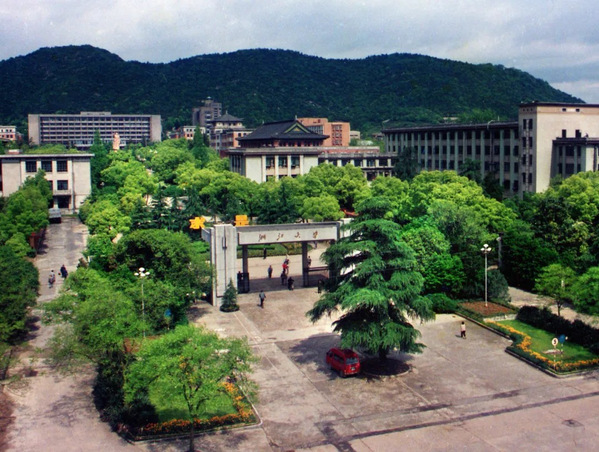
ZJU gate and cedar in the 1990s
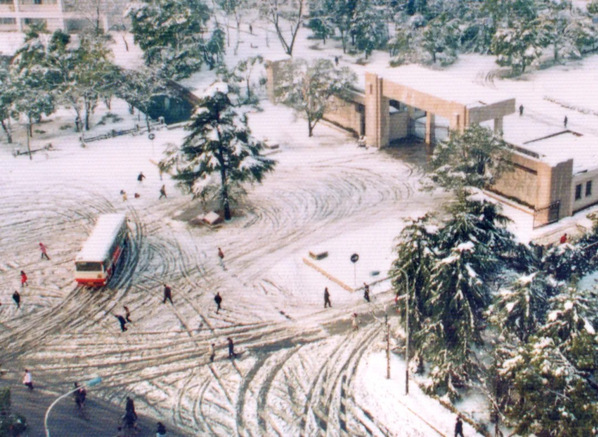
ZJU gate and cedar in the 2000s
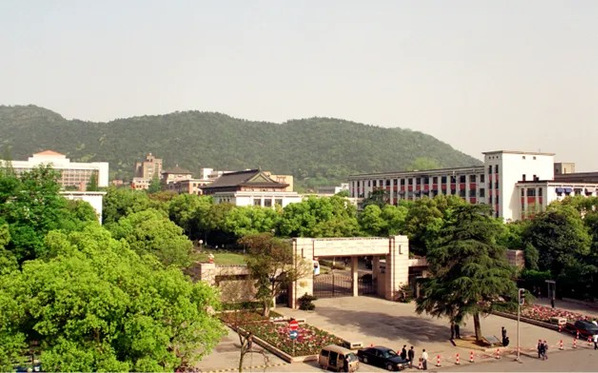
ZJU gate and cedar in 2006
In January 1998, Zhejiang University introduced its bulletin board system (BBS), and in December 2002, the CC98, ZJU’s online community, was born. Around the early 2000s, online communities like CC98 gained widespread popularity across China, giving rise to the term “BG” (Board Gather), which referred to student gatherings. The tree, prominently located at the gate, became a natural meeting point for these gatherings, thereby earning the affectionate and witty nickname. Over time, “BG” evolved to symbolize the tradition of treating others to a meal after a special occasion.
ZHAO Yonghong, a 1993 alumna, fondly recalled her class taking graduation photos under the tree. “Our male classmates even convinced then-President LU Yongxiang to join us,” she recalled.
Her class, known as the “Borderland Class,” was a diverse group of 32 students hailing from all corners of China: Heilongjiang in the north, Hainan in the south, Xinjiang in the west, and Henan in the center. They formed a close-knit, versatile group, bound by a shared sense of camaraderie. “The girls in our class would always meet under this tree, whether for outings or simple get-togethers. This tree was, in a way, with us throughout our entire university journey,” ZHAO Yonghong reminisced with a smile.
In addition to their graduation photos under the tree, one classmate penned an article titled A Group of Dream Chasers Riding on the Road, recounting their cycling adventure during the summer of 2002. Over 11 days, a group of Zhejiang University students cycled through five cities — Hangzhou, Shaoxing, Taizhou, Ningbo, and Zhoushan — covering approximately 900 kilometers. The journey began with the words, “I pedaled my bike quickly toward the school gate,” and concluded with, “When we returned to the school gate, the team circled the tree on our bikes. Our journey through eastern Zhejiang was complete.”
In 2004, during an interview about campus life, students reflected warmly on the tree, speaking of its beauty and significance. One student shared, "Of all the campuses I’ve visited, Zhejiang University is the most beautiful, with the most trees and most stunning flowers. At the intersection stands a towering tree, known as the ‘Report Tree,’ where we gather for meals.”
Now, the new cedar now stands proudly at the campus gate, ready to create fresh memories for future generations. As it grows, its shade will continue to weave the fabric of university life, preserving the legacy of the “Report Tree” for years to come.
Adapted and translated from the article by OUYANG Yuxuan, CAO Zhijun, ZHOU Yiying
Translator: FANG Fumin
Photos by HONG Baoping, XING Dongwen, and LI Lijiao, with additional images sourced from the Zhejiang University Alumni Association and ZJU Mechanical Youth (official WeChat account).
Editor: TIAN Minjie