Zhejiang University launches landmark new institute


On March 15, Zhejiang University officially launched the Institute of Global Development (IGD) on Zijingang Campus, marking a new step in its efforts to support sustainable development and strengthen international cooperation. The IGD was established to help advance the UN 2030 Agenda for Sustainable Development and the Global Development Initiative, address major bottlenecks in global development, bring together insights and resources from a wide range of stakeholders, and promote shared development among all countries.
WANG Wentao, Minister of Commerce; LIU Jie, Governor of Zhejiang Province; DU Jiangfeng, Vice Minister of Education; and MA Yanming, President of Zhejiang University, delivered remarks and jointly unveiled the plaque for the IGD. Amakobe Sande, UNICEF Representative to China, also spoke at the event. Among those present were HU Wei, Vice Governor of Zhejiang Province, and ZHANG Li, Assistant Minister of Commerce. The ceremony was chaired by ZHOU Jianghong, Vice President of Zhejiang University.
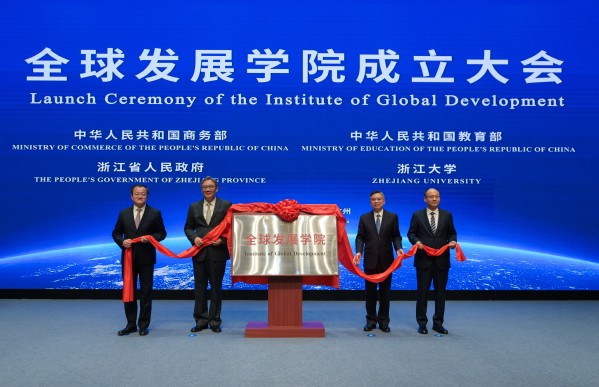
In his remarks, WANG Wentao stressed that development remains central to human progress and people’s well-being. At a time when profound changes unseen in a century are accelerating, the world has entered a new period of turbulence and transformation, and the global development deficit continues to widen, China has remained a committed supporter of and contributor to global development. He noted that President XI Jinping has proposed four major global initiatives, including the Global Development Initiative, providing a clear direction for addressing global changes and promoting shared development.
WANG Wentao also recalled that Premier LI Qiang announced the establishment of the IGD at the G20 Summit last November. He noted that the institute represents both a concrete step in implementing the Global Development Initiative and a proactive effort to advance the UN 2030 Agenda for Sustainable Development. The Ministry of Commerce, he added, will work closely with all parties to support the institute’s development, with the aim of building it into a world-class platform for academic research,a high-level platform for dialogue among government, industry, academia and research communities worldwide, and a leading platform for talent cultivation.
LIU Jie emphasized that in recent years, Zhejiang has fully implemented the Eight-Eight Strategy and steadily expanded high-level opening-up. In doing so, the province has further consolidated its position as a hub for global trade, supported the growth of its globally connected private sector, enhanced its digital innovation capacity with global reach, and promoted broader people-to-people and cultural exchanges with the world. He said that the launch of the IGD is both a concrete move to advance President XI Jinping’s Global Development Initiative and an important step in building Zhejiang into a province with a robust, high-quality open economy. With the support of the Ministry of Commerce, the Ministry of Education, and other national authorities, Zhejiang will develop the institute to the highest standards and quality, accelerate its rise as a world-leading center for talent cultivation and research, deepen reform and innovation in education, and expand exchanges and cooperation with countries around the world, especially those in the Global South, in areas including economy and trade, talent development, cultural exchange, and governance studies. In this way, he said, Zhejiang will make new and greater contributions to building a community with a shared future for mankind.
DU Jiangfeng pointed out that Zhejiang University’s role in establishing the IGD reflects the global responsibility and mission of Chinese universities in the new era. He expressed hope that the institute would pioneer new approaches to talent development, cultivate future leaders for global development, address major global issues through research, and build an international platform for academic exchange and cooperation. He also said that the institute should play a more active role in promoting global governance and shared development.
Ma Yanming framed the IGD’s launch as a pivotal leap for Zhejiang University in advancing its global engagement strategy and speeding up its development into a world-class, innovation-driven university. Looking ahead, he said, the institute will work to become a leading global center for nurturing future leaders in global development and a major hub for global governance research.
Amakobe Sande shared that UNICEF looks forward to exploring cooperation with the IGD to advance sustainable development outcomes that deliver real benefits to children. She noted that platforms such as the IGD can help turn development experience into shared knowledge, strengthen South-South cooperation, and generate practical solutions, thereby supporting more countries in accelerating progress toward the Sustainable Development Goals.
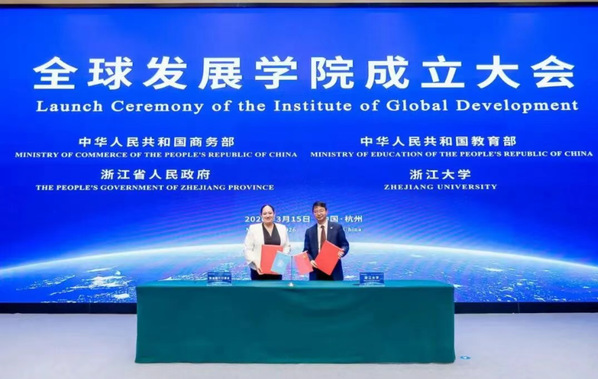
At the global development symposium held alongside the ceremony, Zhejiang University and the UN Population Fund signed a memorandum of understanding. Under the agreement, the two sides will conduct joint research on key issues such as population and development, build a global collaboration platform, deepen academic mutual learning and knowledge sharing, and strengthen resource coordination and practical cooperation.
The IGD is dedicated to enhancing global development capacity through talent and ideas, with the broader aim of promoting shared development across countries. With the implementation of the Global Development Initiative as its core focus, the institute will recruit and train mid- to senior-level government officials and business leaders from around the world, while building an integrated institution for degree education, advanced training, and academic research. It aims to become a world-leading center for cultivating future leaders and a major hub for global development research.
The IGD will operate under the guidance of the Ministry of Commerce, the Ministry of Education, and the People’s Government of Zhejiang Province. It is led by the university’s Institute for National Strategy and Regional Development, a pilot institution for the development of national high-end think tanks. Drawing on Zhejiang University’s abundant educational resources and disciplinary strengths, its broad network for international exchange and cooperation, and its diversified approaches to talent cultivation, the institute will focus on three main areas: high-level degree education, advanced talent training, and high-quality academic research.
“We will build on Zhejiang University’s first-level disciplines in Applied Economics and Public Administration to develop degree programs and provide long-term strategic talent support for global sustainable development,” said HUANG Xianhai, Dean of the IGD. So far, the institute has already opened global admissions for its degree programs, and its first cohort of graduate students will enroll in September 2026.
The IGD will also build on flagship programs such as the China-ASEAN Digital Economy Workshop to offer non-degree programs tailored to the needs of high-end professionals and aimed at empowering frontline practitioners in global development. In addition, it will draw on Zhejiang University’s academic strength and research capacity in strategic fields such as artificial intelligence and the digital economy to build a world-class center for academic and policy research on global development, while creating a full-chain innovation platform that links basic research, applied research, and the real-world translation of research outcomes.
Translator: FANG Fumin
Editor: HAN Xiao