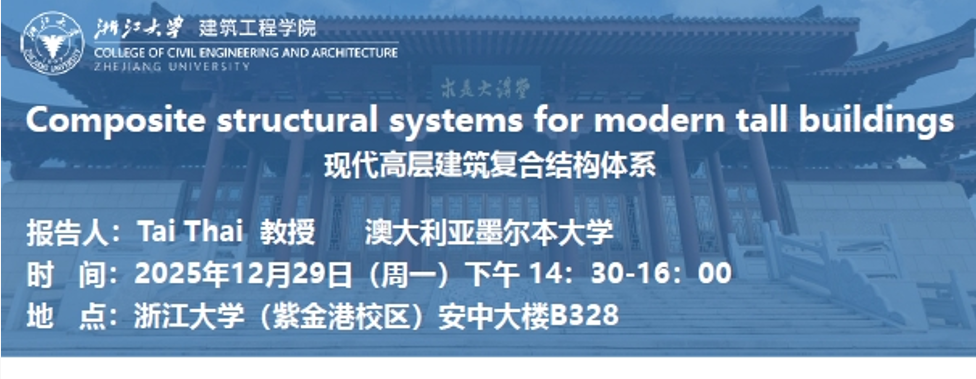
Composite structural systems for modern tall buildings


Time: 14:30
Venue: Zijingang Campus
Speaker: THAI Tai
Category: Talk & Lecture
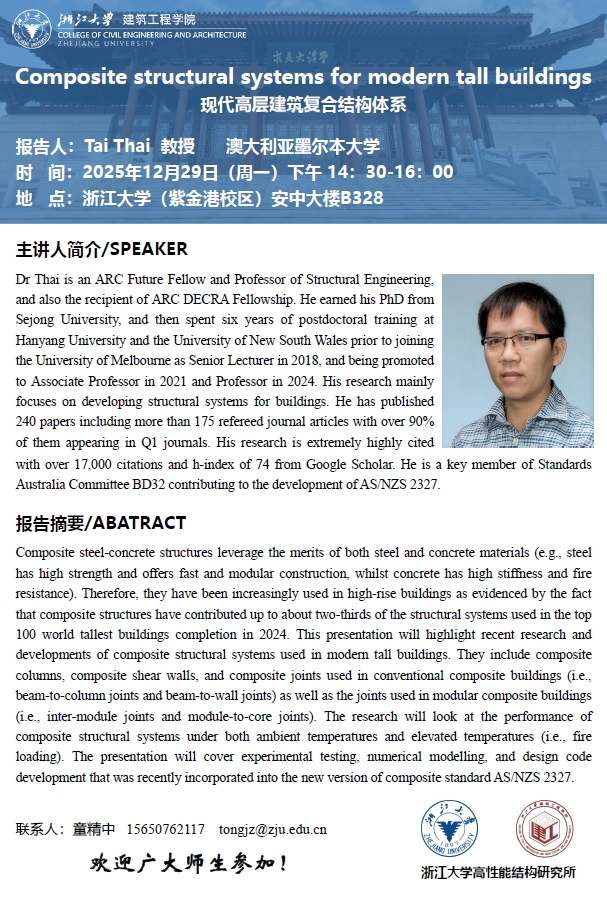
Speaker: Tai Thai
Venue: Room B328, Anzhong Building, Zijingang Campus
Abstract: Composite steel-concrete structures leverage the merits of both steel and concrete materials (e.g., steel has high strength and offers fast and modular construction, whilst concrete has high stiffness and fire resistance). Therefore, they have been increasingly used in high-rise buildings as evidenced by the fact that composite structures have contributed up to about two-thirds of the structural systems used in the top 100 world tallest buildings completion in 2024. This presentation will highlight recent research and developments of composite structural systems used in modern tall buildings. They include composite columns, composite shear walls, and composite joints used in conventional composite buildings (i.e., beam-to-column joints and beam-to-wall joints) as well as the joints used in modular composite buildings (i.e., inter-module joints and module-to-core joints). The research will look at the performance of composite structural systems under both ambient temperatures and elevated temperatures (i.e., fire loading). The presentation will cover experimental testing, numerical modelling, and design code development that was recently incorporated into the new version of composite standard AS/NZS 2327.