Nobel laureate Sir Paul Nurse visits ZJU to discuss “What is Life?”


In January 2026, Sir Paul Nurse, Nobel Laureate and President of the Royal Society, visited Zhejiang University to deliver the inaugural lecture of the Nobel Laureates at ZJU series. Titled "What is Life?", his presentation offered an interdisciplinary perspective on the essence of biology. Professor LI Xiaoming, Vice President of ZJU, attended the event and presented a certificate of appreciation to Sir Paul.
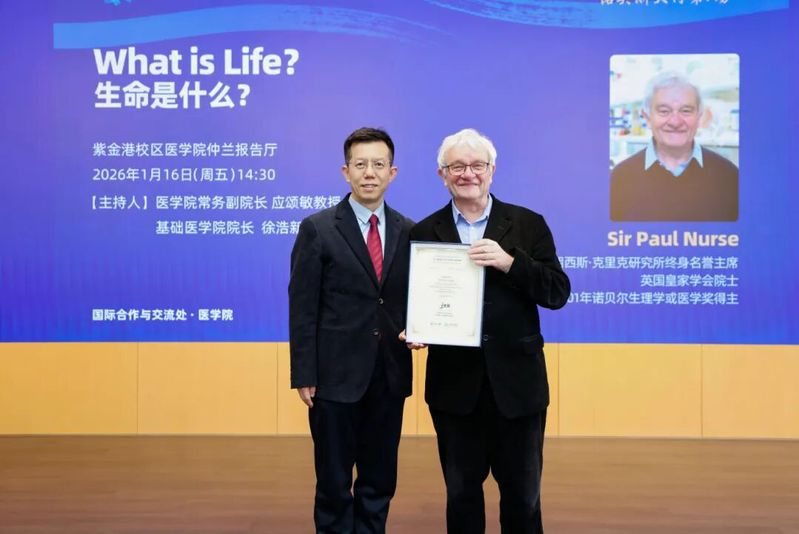
Life on Earth exists in incredibly diverse forms—bacteria, fungi, plants, and animals. “What connects these different life forms? What do they have in common?” This profound curiosity led Sir Paul to delve into cell biology and genetics. His pioneering research on key regulators of the cell cycle earned him the 2001 Nobel Prize in Physiology or Medicine.
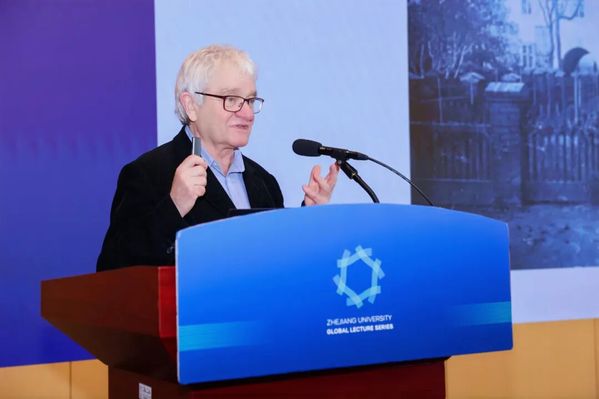
“What is life?” Sir Paul acknowledged that there is no single, definitive answer. Drawing from his eponymous book, he identified five core threads essential to understanding life: the cell, the gene, evolution by natural selection, life as chemistry, and life as information.
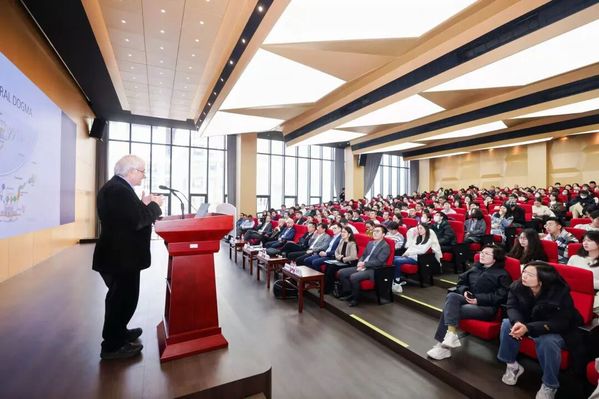
Guided by these threads, he traced the history of scientific discovery—from Robert Hooke's first observation of cells and Charles Darwin's theory of evolution, to the discovery of the DNA double helix. He emphasized that cells are the fundamental physical units of life. Complex organisms, he explained, depend on a "dual code" to function efficiently: a carbon-based chemical system and a linear information coding system. Through natural selection, all life forms trace back to a common ancestor, forming an interconnected web of life.
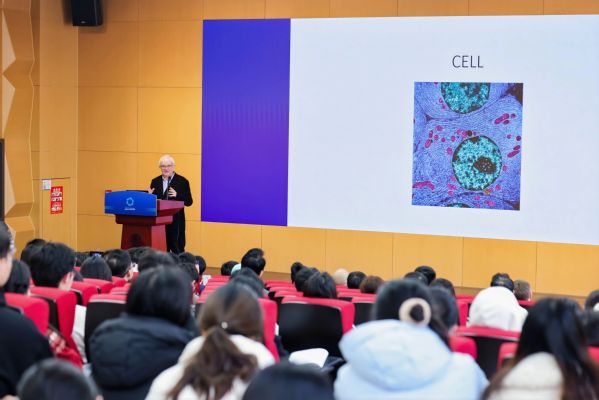
During the Q&A session, Sir Paul shared that a student-like curiosity about how the world operates continues to drive his research. When asked how artificial intelligence might impact the future of cell biology, he encouraged the younger generation to explore the answers themselves: "Instead of asking me, ask yourself—finding the answer on your own will be far more meaningful."
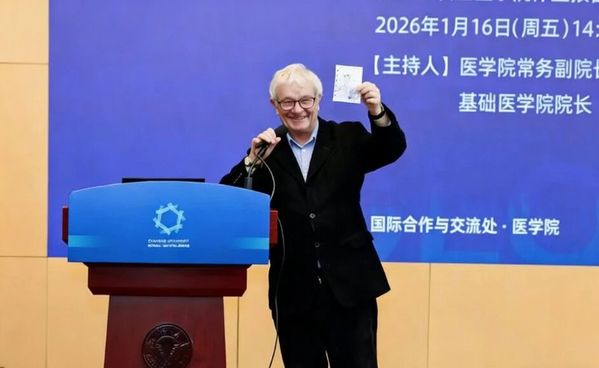
By making complex scientific principles accessible, Sir Paul expanded the academic horizons of the ZJU community, inspiring students and faculty to continue exploring the unknown frontiers of science.
Adapted and translated from the article written by XU Ziqi, WU Wenxuan & ZHA Meng
Translator: JIANG Chenqi ('2027, Structural Engineering)
Photo: School of Basic Medical Sciences
Editor: HAN Xiao