Building blocks of innovation: a ZJU doctoral student’s green approach to industrial ozone treatment


In the global pursuit of environmental sustainability, the efficient and eco-friendly treatment of industrial waste gas remains a critical frontier in chemical engineering. LIAO Jiahong, a doctoral student from the College of Chemical and Biological Engineering, Zhejiang University (ZJU), has focused his research on a promising new direction: electrolysis-based ozone removal and resource utilization. In an emerging field lacking established precedents, he applied an interdisciplinary "building block" strategy to successfully bridge the gap between laboratory research and industrial application.
During the initial stages of his research, LIAO Jiahong faced multiple challenges, including unstable experimental equipment and unmapped technical paths. Unlike those working within mature research systems, he had to invest significant time in exploring from scratch. Under the guidance of his supervisor, Professor ZHANG Xingwang, he developed a unique problem-solving methodology. He treated vast literature and cross-disciplinary knowledge as individual "building blocks". Through persistent trial and error, he drew inspiration from diverse fields to gradually assemble a novel experimental framework tailored to his specific project.
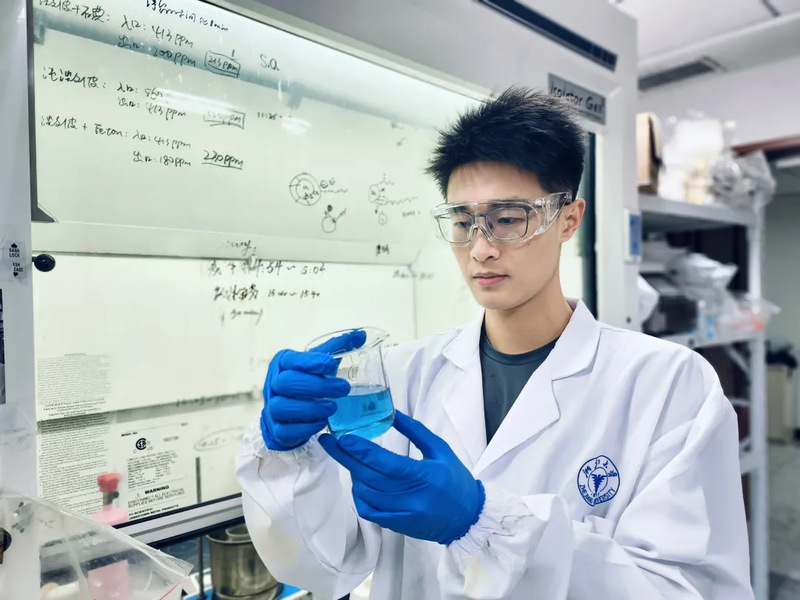
Traditional ozone management relies heavily on costly catalytic decomposition technologies. LIAO Jiahong sought to leverage his team's expertise in electrochemistry to explore a low-energy, high-efficiency green treatment path. This innovative approach presented complex interdisciplinary hurdles. This required him not only to develop high-efficiency electrodes capable of stable operation in ozone systems from a materials science perspective but also to apply engineering design thinking to resolve complicated transport and reaction issues during the transition from laboratory scale to industrial application.
Throughout this process, persistence and communication proved to be decisive factors. He maintained a disciplined research rhythm and engaged in frequent consultations with his supervisor and peers to refine his direction and overcome technical bottlenecks. Meanwhile, the academic exchange platforms provided by the college helped him broaden his vision and perfect his research methodology.
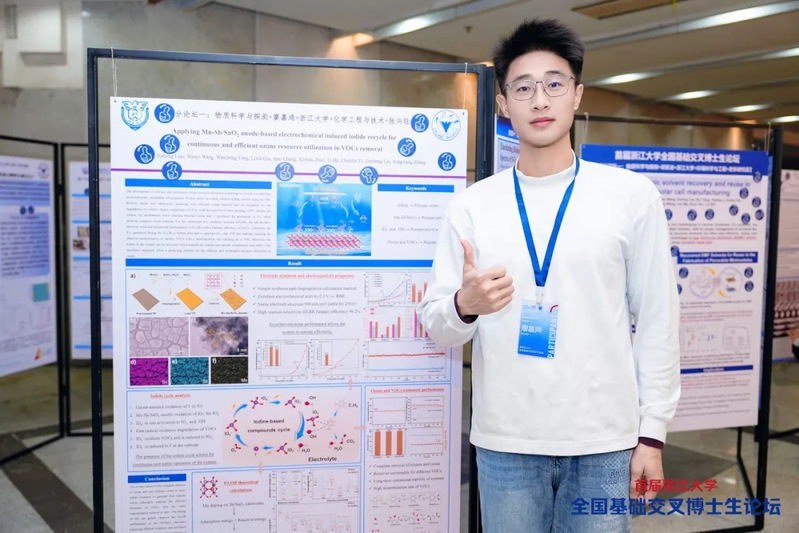
A defining characteristic of his work is its alignment with practical industrial needs. His research is oriented toward solving real-world ozone emission problems, balancing technical application with the exploration of theoretical mechanisms. To date, he has published five SCI academic papers as the lead author. Furthermore, the new electrochemical ozone treatment technology he helped develop has successfully moved into pilot-scale application.
Reflecting on this challenging journey, LIAO Jiahong believes that consistent exploration and effective academic communication are the keys to breaking through research plateaus. His experience demonstrates the role of ZJU's diverse platform in fostering innovation among young scholars and illustrates how a new generation of engineering talent provides practical solutions for industrial sustainability through technological advancement.
Adapted and translated from the article written by MAO Yixuan, LIU Jingchun & ZHANG Shufan
Translator: WU Jingying ('27,Communication)
Photo: the interviewees
Editor: JIANG Chenqi ('27, Structural Engineering), HAN Xiao