Killing two birds with one stone: the dual actions of PLX5622


A research article, entitled “More than microglial depletion: PLX5622 activates the hepatic constitutive androstane receptor to alter anesthesia and addiction” was published online in Neuron. This study was led by Prof. GAO Zhihua’s group at School of Brain Science and Brain Medicine of Zhejiang University.

This study provides the first evidence that PLX5622, a widely used CSF1R inhibitor for depleting microglia, has effects that extend beyond the central nervous system. In addition to inhibiting CSF1R in the brain, PLX5622 directly activates CAR (Constitutive Androstane Receptor), a hepatic xenobiotic sensor. This activation markedly enhances the metabolism of anesthetics and addictive substances, leading to significant changes in anesthetic sensitivity and addiction-related behaviors. These findings suggest that conclusions about microglial function drawn solely from experiments using PLX5622 may need to be carefully interpreted.
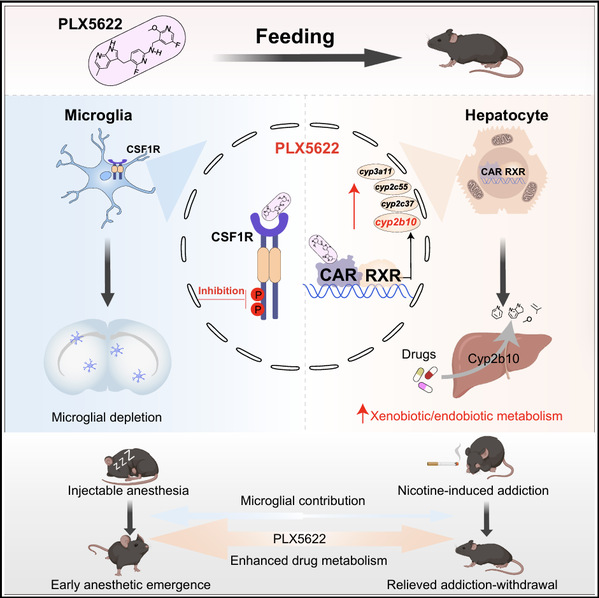
Microglia, the brain’s resident immune cells, are essential for maintaining homeostasis and regulating neural function, including the modulation of neuronal activity, synaptic plasticity, and the pathology of neurological and psychiatric disorders. Pharmacologically depleting microglia by inhibiting CSF1R has become a key strategy for studying their roles and exploring therapies for neurodegenerative diseases. Among available inhibitors, PLX5622 is particularly popular due to its high specificity, oral bioavailability, and ability to cross the blood–brain barrier. Studies using PLX5622 have uncovered a range of unexpected microglial functions, which have generally been attributed to specific CSF1R inhibition and subsequent microglial loss. However, the potential off-target effects of this compound have not been systematically examined.

This study reveals a previously unrecognized central–peripheral dual action of PLX5622: while it inhibits CSF1R in the central nervous system, it also activates a CAR-dependent xenobiotic metabolic program in the liver. This discovery has important implications for interpreting the results of the numerous studies that have relied on PLX5622 to investigate microglial function.
Source: School of Medicine
Editor: HAN Xiao