Pursuing the Impossible: How Prof. HE Xiangning helps redraw China’s energy technology map


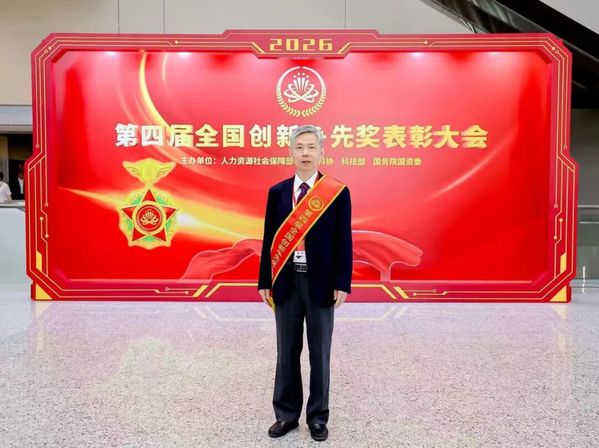
At a ceremony celebrating China’s 10th National Science and Technology Workers Day, Professor HE Xiangning of Zhejiang University stepped onto the stage at Beijing’s National Communication Center for Science and Technology to receive one of China’s top honors: the National Innovation Pioneer Award.
For HE Xiangning, a veteran electrical engineer who has spent four decades in research and teaching, this recognition was both personal and symbolic.
“It is of course a great honor,” he says. “More importantly, it is a responsibility. It marks a new starting point.”
He has spent much of his career in the field of power electronics — a discipline that underpins technologies ranging from high-speed rail and spacecraft to everyday smartphone chargers. Over the years, his work and that of his team have helped push China’s research in power conversion and control closer to the international frontier.
Unraveling the unknown through relentless exploration
Power electronics is rarely visible to the public, yet it quietly structures modern infrastructure. It governs how electricity is converted, regulated, and delivered across systems that range from national power grids to consumer devices.
“It is like a highly skilled electrician for energy,” HE Xiangning says, describing the field in simple terms.
When China’s reform and opening-up began in the 1980s, power electronics was still in its infancy. As one of China’s early doctoral students in the field, HE Xiangning studied under two leading scholars, WANG Yousheng and LIN Weixun, and participated in a national project aimed at developing domestically produced uninterruptible power supply (UPS) systems. This experience marked the beginning of his lifelong pursuit of technological self-reliance.
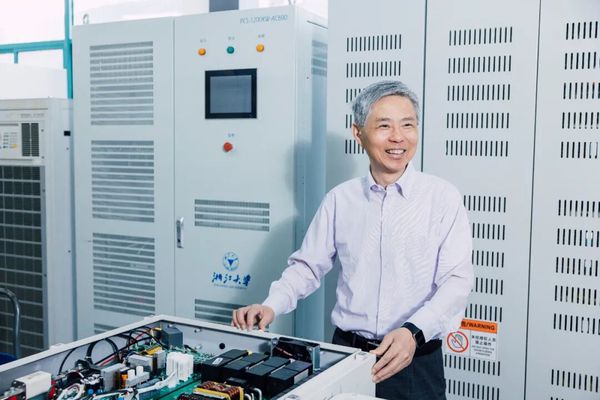
For HE Xiangning, research has never been a matter of endurance alone — it is, above all, the quiet joy of uncovering the unknown.
“Even after I get home, I often find myself thinking about calculations and experimental results,” he says with a smile. “Sometimes the answer doesn’t come for days. That’s probably where all my gray hair comes from.”
He likens scientific research to the three stages described by the renowned Chinese scholar WANG Guowei: searching tirelessly, persevering through hardship, and finally achieving enlightenment after sustained dedication.
Proposing innovative foundational theory
High-gain DC conversion plays a critical role in ensuring the stable operation of renewable energy integration, aerospace power systems, and energy storage technologies. However, achieving both high voltage gain and high efficiency has long remained a fundamental challenge.
As high-end equipment continues to evolve rapidly worldwide, industry demands have increasingly shifted toward converters with higher voltage conversion ratios, greater power density, and superior efficiency. Existing international circuit topologies, however, are constrained by inherent limitations, including restricted voltage gain, bulky system designs, and relatively low efficiency —making it extremely difficult to meet these competing requirements simultaneously.
After years of theoretical research and extensive experimental validation, HE Xiangning team introduced the High-Gain Cell-Based Topology Construction Theory in 2011.
The theory marked a radical departure from conventional international design philosophies by introducing multidimensional topology construction and multi-degree-of-freedom control. It raised the voltage gain of single-stage converters from fewer than ten times to more than thirty, and in some cases even higher, while simultaneously achieving superior overall performance. This breakthrough effectively brought an end to decades of fragmented, experience-driven circuit design in the field.
From circuit-level analysis and physical modeling to mathematical derivation and engineering implementation, HE Xiangning has long stressed that genuine scientific innovation begins with the discovery of universal principles rather than incremental improvements to individual devices.
“Our goal is not simply to build a better device,” he explains. “We aim to distill fundamental theories that can empower an entire field, generating a family of new technologies while expanding the boundaries of both science and engineering.”
Making engineering breakthroughs for national strategic technologies
While the high-gain topology theory addressed the fundamental scientific challenge of efficient voltage conversion, HE Xiangning’s research on multilevel power conversion translated these theoretical advances into practical solutions for high-voltage, high-power engineering applications.
Critical systems such as high-speed railway traction, ship propulsion, and port shore power require power electronic converters capable of operating reliably under extremely demanding conditions. Conventional two-level converters often struggle to meet these requirements, whereas multilevel technologies offer clear advantages in voltage handling capability, reduced harmonic distortion, and improved overall system efficiency.
Building on the framework of topology construction and multi-degree-of-freedom control, HE Xiangning’s team extended these principles to multilevel converters, establishing unified design guidelines and developing new control methodologies that have since become foundational references for next-generation circuit architectures.
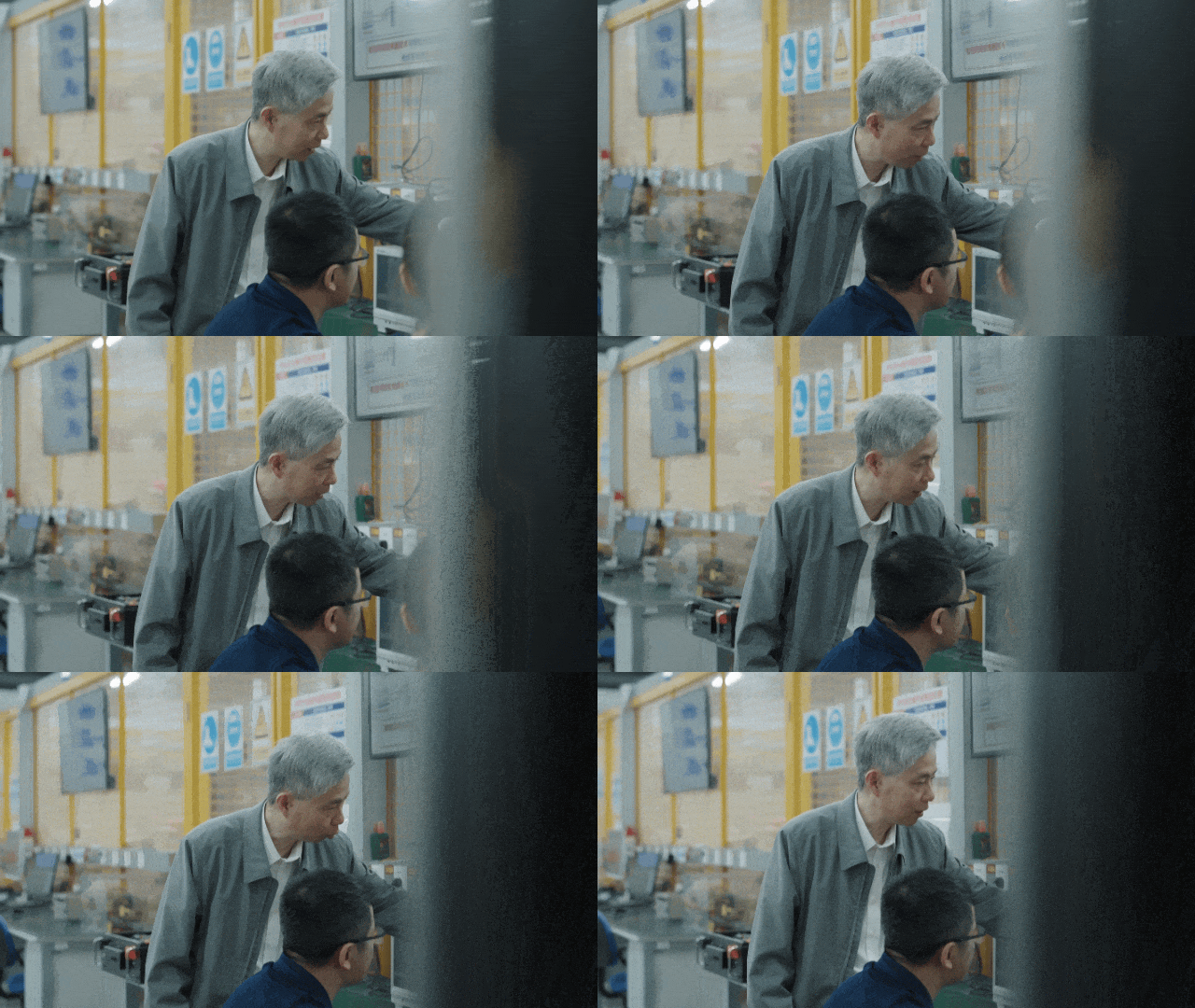
The team also developed an innovative voltage-clamping technique that addresses the long-standing challenge of uneven device stress in high-voltage, high-power operation, significantly enhancing the system’s reliability and operational stability.
Their contributions in multilevel topologies, modulation strategies, and voltage-clamping methods have been widely cited and incorporated into patent portfolios of leading global enterprises, including General Electric, Siemens, and the State Grid Corporation of China.
Together, these advances have supported the evolution of China’s high-power, high-voltage variable-frequency drive systems and medium- to high-voltage electric propulsion technologies from early-stage indigenous innovation toward large-scale industrial upgrading, with successful deployment in mainstream European and North American markets.
Over several decades, HE Xiangning’s team has consistently aligned his research with national strategic priorities. Through sustained foundational innovation, the team has played a significant role in transforming China from a follower in the field into an active global contributor.
Giving electricity a “voice” thorough cross-disciplinary innovation
After addressing the challenge of improving the efficiency of electrical energy conversion, HE Xiangning shifted his attention to a more fundamental question at the intersection of power electronics and information science.
Traditionally, power systems and communication systems have evolved as separate domains: energy is transmitted through electrical networks, while information is carried via dedicated communication channels. This separation, however, adds layers of complexity, cost, and system redundancy.
Against this backdrop, HE Xiangning’s team posed an audacious question: what if electrical energy itself could carry information?
This idea led to the development of “Talkative Power”, an innovative concept that integrates power conversion with coded communication, allowing energy and information to be processed within the same physical framework.
When applied to photovoltaic systems, “Talkative Power” improves operational efficiency, reliability, and safety under varying environmental conditions, while also dramatically reducing installation and maintenance costs. It further enables more precise control of battery charging and discharging processes, providing a new theoretical basis for integrated photovoltaic–energy storage systems.
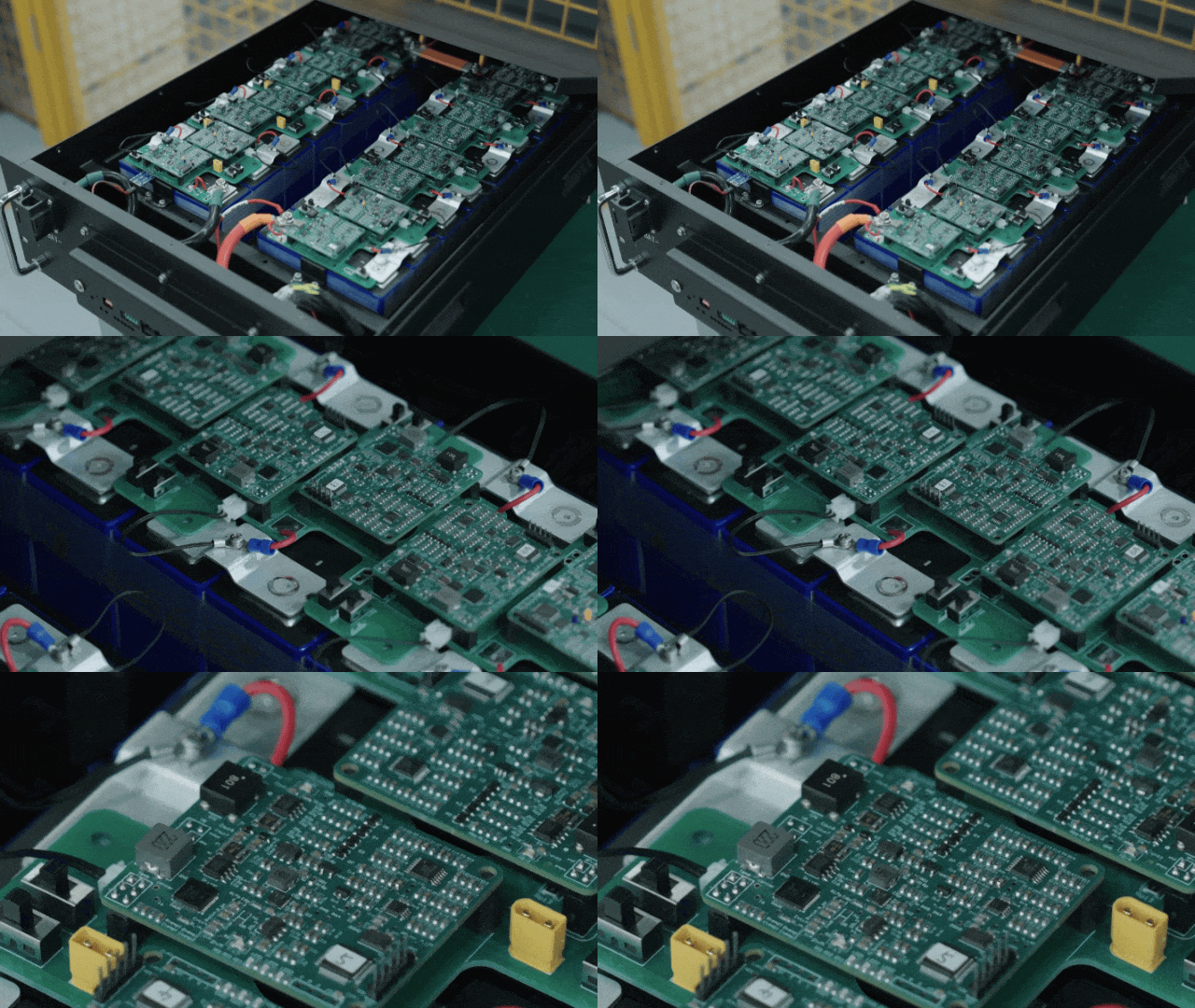
The team is now extending this concept beyond solar energy to broader applications, including intelligent tunnel lighting, battery balancing systems, and wireless electric vehicle charging. Several of these applications have already progressed to engineering demonstration stages.
Cultivating seeds that grow into tall trees
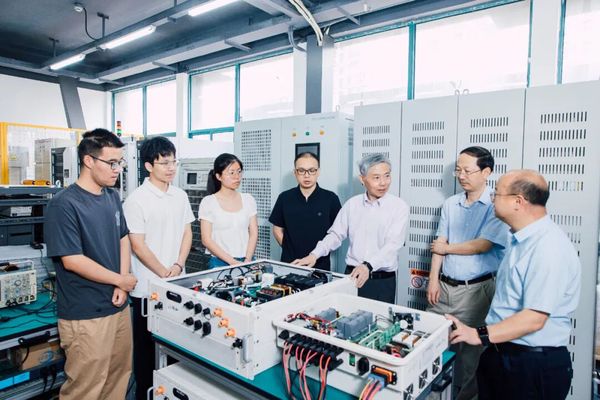
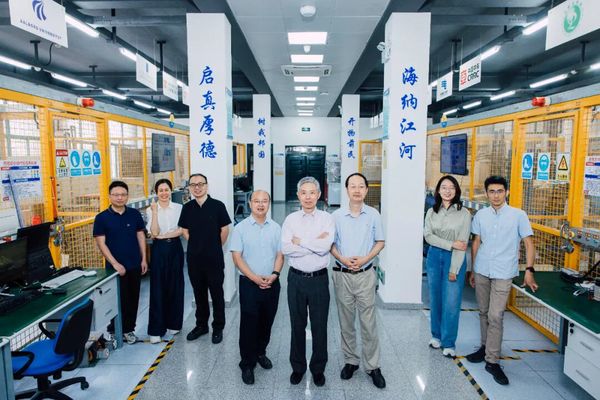
HE Xiangning’s team is named SEEEDS — Sustainable & Efficient Electrical Energy Delivery Systems, a metaphor for ideas that begin as small, carefully planted seeds before gradually taking root and growing into complex, far-reaching systems.
The name also reflects Zhejiang University’s enduring spirit of seeking truth and pursuing innovation, values that HE Xianging has been striving to instill in every student.
At the core of his mentoring philosophy is a respect for individuality and intellectual independence. “If you impose too many restrictions,” he says, “you will end up suppressing creativity.” He urges students to pursue interdisciplinary learning, stressing that outstanding research requires broad intellectual horizons.
The idea behind “Talkative Power”, for example, drew inspiration from communications engineering. As he explains, “In traditional power electronics, harmonics were once treated as unwanted noise to be eliminated. But in communications, they are seen as high-frequency carriers — valuable information-bearing signals.”
Professor LI Wuhua, one of HE Xiangning’s former doctoral students and now a faculty member at Zhejiang University, recalls his supervisor’s extraordinary dedication to mentoring.
“A single paper could go through ten or even twenty rounds of revision,” LI Wuhua says. “When we opened the document, it was covered in red annotations. We used to joke and call it ‘a river of red.’”
It is precisely this combination of exacting standards and intellectual openness that has allowed generations of young researchers to grow into independent scholars.
“There are still many things I don’t understand,” HE Xiangning reflects. “But scientists are supposed to work on problems they do not yet understand. Once you know the answer, there is no point in continuing.”
Simple, literally understated, these words capture the intellectual posture that has guided more than four decades of scientific inquiry.
Adapted and translated from the article written by XU Ziyang, LU Xinghua, WANG Surong
Translator: FANG Fumin
Photo: ZJU College of Electrical Engineering (CEE)
Editor: DING Chenwei