Can water break down plastics? An accidental discovery opens a new route to recycling


For decades, chemists have assumed that breaking down plastics requires powerful catalysts, high temperatures, and energy-intensive processing. A new study suggests otherwise.
A research team led by WANG Yong at Zhejiang University, in collaboration with researchers from Cardiff University (UK), the University of Tokyo (Japan), Zhejiang University of Technology, China Jiliang University and other institutions, has discovered that water and oxygen alone can drive the degradation of common plastics under surprisingly mild conditions, converting waste polyethylene, polypropylene and even discarded tires into valuable chemical building blocks. The work, published in Nature on July 16, points to an unexpected mechanism that could reshape how scientists think about plastic recycling.
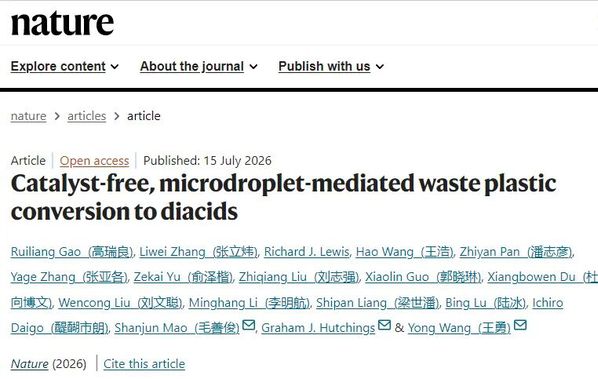
Instead of relying on precious-metal catalysts, the process harnesses an overlooked feature of tiny water droplets to generate highly reactive chemical species capable of cutting apart the stubborn carbon-carbon bonds that make plastics so durable.
More than 400 million tons of plasticare produced worldwide each year, yet only a small fraction is recycled into useful chemicals. Existing chemical recycling technologies generally depend on costly catalysts and harsh operating conditions, limiting their economic and environmental appeal.
Originally, the Zhejiang University team set out to do what many others in the field were attempting: design a better catalyst.
Then a control experiment changed everything.

Doctoral student GAO Ruiliang prepared a routine blank control containing no catalyst at all. By conventional chemical reasoning, nothing significant should have happened. Yet, polyethylene, among the most chemically inert and difficult plastics to degrade, showed clear signs of breakdown.
We first assumed something had gone wrong,” said WANG Yong.
The team suspected contamination, residual catalyst left inside the reactor or simple experimental error. To rule out every possibility, the researchers repeated the experiment dozens of times, replacing reactors, liners, reagents and plastic feedstocks while different researchers independently reproduced the results.
The same degradation was observed each time.
Eventually, the researchers accepted a conclusion that seemed to contradict decades of chemical intuition: polyethylene was degrading without any added catalyst.
Rather than searching for better catalysts, the team shifted to a more fundamental question: How could this reaction happen at all?
“Many important discoveries begin with data that don’t fit our expectations,” WANG Yong said. “If you simply dismiss an anomaly as an experimental error, you may miss an entirely new scientific principle.”
The answer, the researchers found, lies at the interface of microscopic droplets.
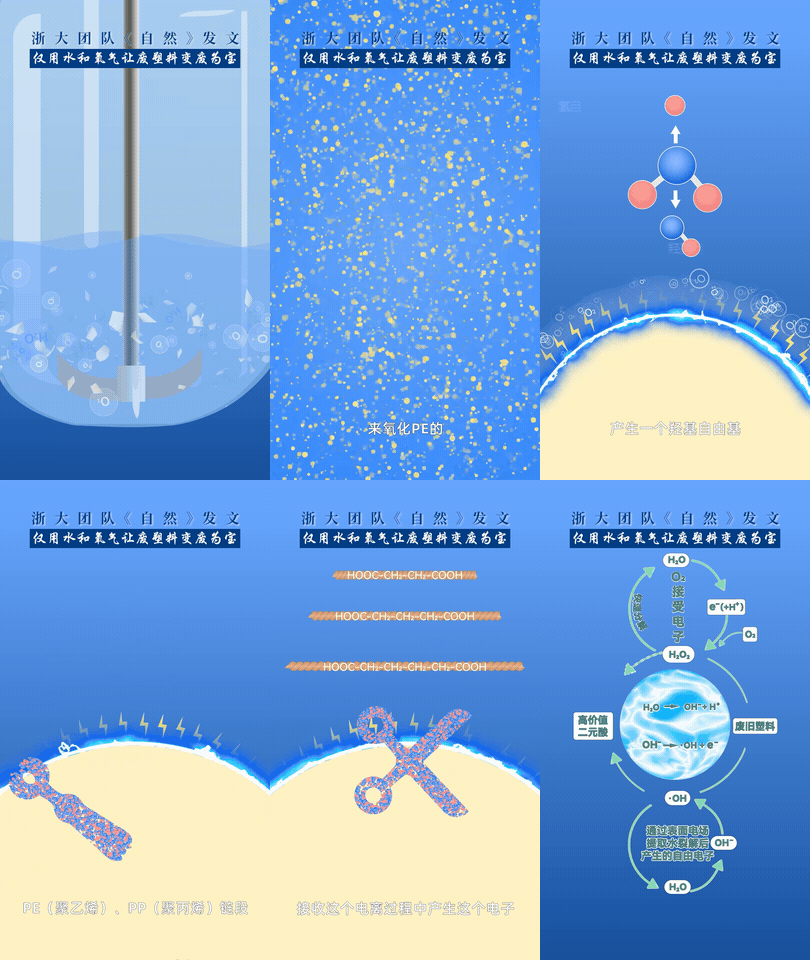
When molten plastic is heated with water and oxygen while being stirred, it breaks into countless microscopic oil droplets suspended in water. At the boundary where oil meets water, molecules arrange themselves asymmetrically, generating intense localized electric fields.These microscopic electric fields promote the formation of highly reactive hydroxyl radicals (·OH) directly at the droplet interface.
The radicals act like molecular scissors, progressively cutting the long carbon chains that make up polyethylene and polypropylene into much smaller molecules, including dicarboxylic acids. These valuable feedstocks are used to manufacture nylon, biodegradable plastics, pharmaceuticals, fragrances and other industrial chemicals.
Remarkably, the reaction proceeds at temperatures only slightly above 100 °C, requires no added catalyst and leaves behind no detectable microplastic residues.
“The entire transformation relies only on water and oxygen,” said WANG Yong. “The plastic is not merely fragmented. It is converted into useful chemical products.”
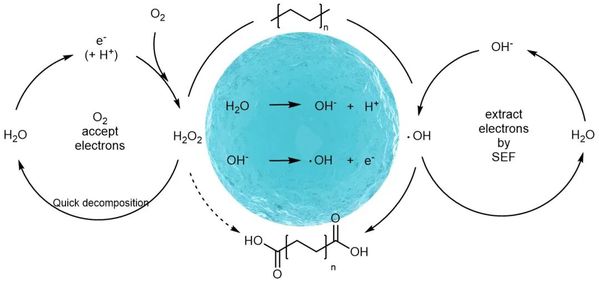
Perhaps the study’s most surprising implication is that catalysis may not always require a separately added conventional catalyst.
For decades, researchers have viewed metal surfaces as the active centers that drive chemical recycling. Here, the catalytic function instead appears to emerge from the unique chemical environment created at the surface of microscopic droplets. “The catalyst isn’t a metal,” said co-corresponding author MAO Shanjun. “The catalytic activity comes from the localized electric field at the droplet interface and the reactive oxygen species it generates.”
That shift in perspective could influence far more than plastic recycling. Similar interfacial effects may also play a role in other oxidation reactions, suggesting a broader framework for designing catalytic processes without conventional catalysts. The discovery also offers a potentially attractive route for tackling one of the world's fastest-growing waste streams.
Because the process avoids expensive catalysts, tolerates impurities and operates under relatively mild conditions, it could help to address several longstanding obstacles facing chemical recycling. Instead of treating plastic waste as an environmental liability, the approach converts it into valuable industrial feedstocks, creating a more circular use of carbon resources.
The researchers are now working to scale up the technology and evaluate its industrial potential. Whether the approach can be translated into large-scale recycling remains to be seen. But the discovery has already accomplished something equally important: it reveals an unexpected way in which water can promote chemical reactions, opening new possibilities not only for recycling plastics, but also for designing greener oxidation processes in the future.

Adapted and translated from the article written by YUE Sicong, ZHOU Tianyu
Photos: TING Guang
Translator: FANG Fumin
Editor: DING Chenwei