ZJU scientists discover molecular scaffold that enables near-1,000-fold boost in anticancer drug precursor production


The Madagascar periwinkle is an unassuming flowering plant. Hardy, drought-tolerant and common in gardens around the world, it hardly looks like the source of one of modern medicine’s most important anticancer drugs.
Yet the plant remains the only known natural source of vinblastine, a chemotherapy drug widely used to treat leukemia, lymphoma and several other cancers. The problem is that vinblastine occurs in exceedingly small amounts: producing just one gram requires roughly 2,000 kilograms of dried leaves, making the drug expensive to manufacture and vulnerable to fluctuations in agricultural supply.
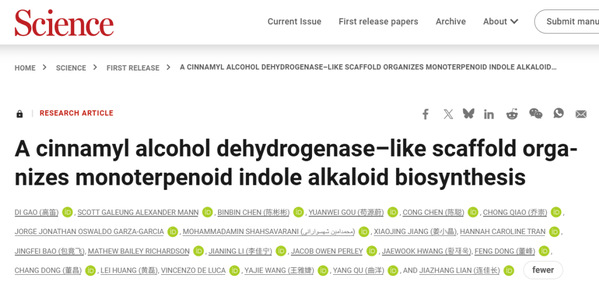
Now researchers have taken a major step toward changing that equation. A team led by LIAN Jiazhang at the College of Chemical and Biological Engineering, in collaboration with researchers from the University of New Brunswick (Canada) and Westlake University (China), uncovered a previously unknown molecular mechanism that dramatically improves microbial production of vinblastine precursors. Their work increased the production of catharanthine — one of vinblastine’s two immediate precursors — to 164.9 milligrams per liter in engineered yeast, nearly 1,000 times higher than previously reported. Their findings were published online in Science as a First Release on July 16.
Over the past decade, scientists have increasingly turned to microorganisms such as baker’s yeast as miniature chemical factories. By rewriting their genetic programs, researchers can persuade these microbes to produce pharmaceuticals that would otherwise have to be extracted from plants or synthesized through lengthy chemical processes. Compared with conventional production methods, microbial fermentation offers the promise of safer, more sustainable and scalable manufacturing.
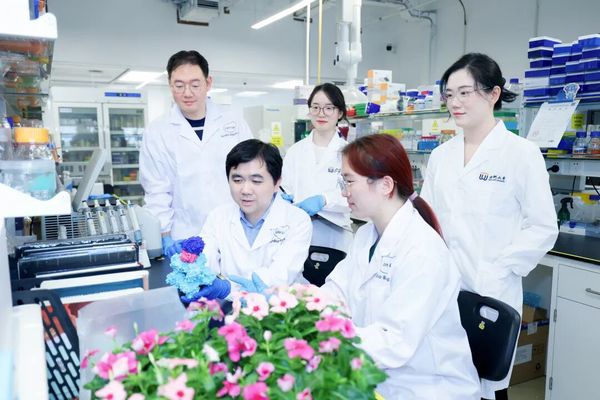
LIAN Jiazhang’s group has pursued that vision for several years. In 2022, the team successfully reconstructed in yeast the approximately 30-step biosynthetic pathway leading to vinblastine precursors, a milestone that demonstrated the feasibility of producing the compound without relying on the plant itself. Yet one critical challenge remained. Despite the complete pathway being present, production stalled at only micrograms per liter, orders of magnitude below what would be required for industrial manufacturing.
The researchers suspected that something fundamental was missing. Their attention soon focused on one of the most fragile moments in the biosynthetic pathway.
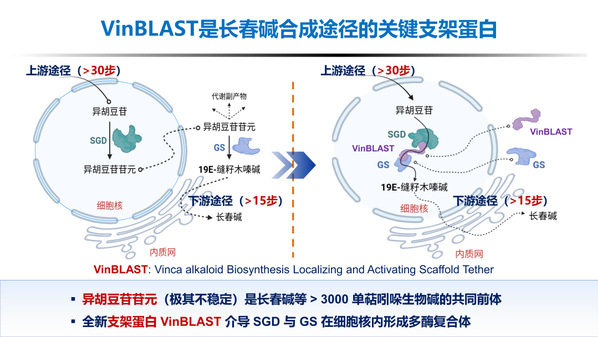
The precursor molecules that ultimately become vinblastine are not produced along a single uninterrupted assembly line. Instead, they are synthesized across multiple compartments inside plant cells. One particularly unstable intermediate, strictosidine aglycone, is generated in the nucleus by the enzyme strictosidine β-glucosidase (SGD) before being converted by another enzyme, geissoschizine synthase (GS), which resides primarily in the cytoplasm. Because the two enzymes are physically separated by the nuclear membrane, much of the unstable intermediate decomposes before reaching the next reaction, severely limiting overall production.
“The yields we obtained in yeast were far lower than those produced naturally by the Madagascar periwinkle,” LIAN Jiazhang said. “That suggested the plant possessed an unknown factor that was helping coordinate the process.”
Finding that missing factor proved daunting. The Madagascar periwinkle genome contains tens of thousands of genes, and no obvious candidate had been identified despite years of investigation.
The breakthrough emerged from an international collaboration.LIAN Jiazhang’s group maintained a long-standing dialogue with QU Yang’s laboratory at the University of New Brunswick, whose research focuses on plant biochemistry. During discussions about previous experiments, the two teams revisited an intriguing observation from virus-induced gene silencing studies. Whenever a gene known as CAD2 was switched off, vinblastine production collapsed to roughly one-tenth of its normal level.The result was bewildering because CAD2 had generally been regarded as a gene associated with lignin biosynthesis, the pathway responsible for producing a major structural component of plant cell walls.
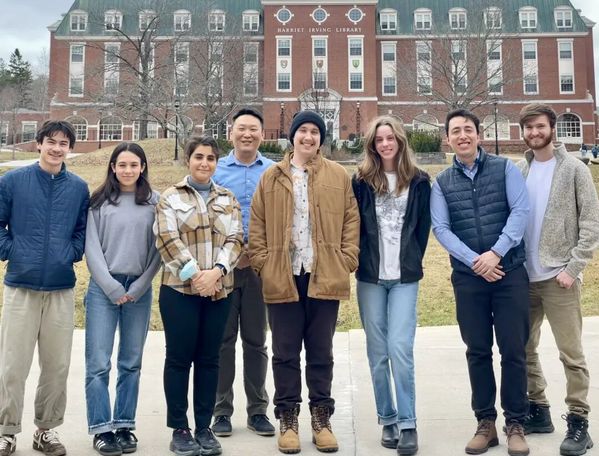
Another clue soon emerged.CAD2 sits immediately beside the gene encoding geissoschizine synthase in the plant genome and is co-expressed with several genes known to participate in vinblastine biosynthesis. The stronger a plant tissue’s capacity to produce vinblastine, the higher the expression of CAD2.
The researchers soon realized that they had most likely identified the long-sought missing component.To investigate its function, they joined forces with WANG Yajie’s team at Westlake University, combining expertise in synthetic biology, plant biochemistry and protein engineering.
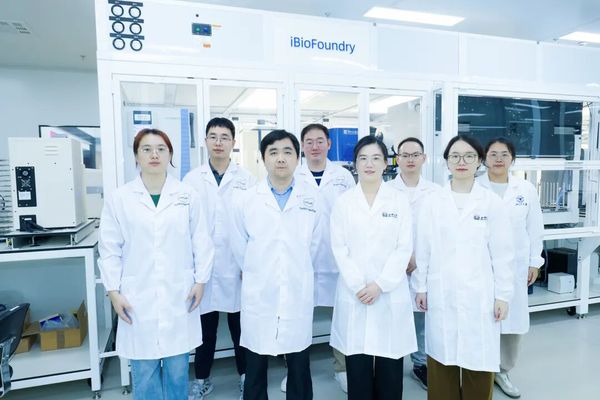
The collaboration quickly paid off.When CAD2 was introduced into the engineered yeast strain, production of vinblastine precursors increased dramatically. Further biochemical and structural studies confirmed that the protein encoded by CAD2 played a completely unexpected role. Rather than acting as another enzyme in the pathway, it functioned as a molecular scaffold that physically organized the biosynthetic machinery. The researchers named the protein VinBLAST, short for Vinca alkaloid Biosynthesis Localizing and Activating Scaffold Tether.
VinBLAST works like a molecular bridge.One end binds SGD inside the nucleus, while the other binds GS. By physically bringing the two enzymes together within the same cellular compartment, it enables the unstable intermediate to be transferred directly from one active site to the next before it can degrade. Instead of diffusing through the cell and being lost, the molecule is efficiently channeled through the pathway.
But VinBLAST performs another function as well. Using molecular dynamics simulations together with biochemical experiments, the researchers found that VinBLAST also remodels the substrate access tunnel of GS after binding to the enzyme. This subtle structural change dramatically enhances catalytic efficiency, increasing GS activity by approximately 24-fold.
The combination of these two effects — preventing loss of an unstable intermediate while simultaneously accelerating its conversion — proved transformative.Engineered baker’s yeast expressing VinBLAST produced 164.9 milligrams of catharanthine per liter, nearly 1,000-fold higher than previous microbial production systems and, in terms of this key intermediate, and achieving a biosynthetic efficiency that rivals — or even exceeds — that of the plant itself.
The implications extend far beyond vinblastine. The pathway controlled by VinBLAST produces geissoschizine, a pivotal intermediate that gives rise to more than 700 monoterpenoid indole alkaloids, a family of natural products that includes not only vinblastine but also compounds with antiarrhythmic, analgesic and other pharmacological activities.
Equally striking was another discovery.The researchers found that proteins closely related to VinBLAST are widely conserved throughout the plant kingdom. Homologous proteins from distantly related species, including tobacco and grapevine, neither of which naturally synthesizes vinblastine, were likewise able to enhance alkaloid production when introduced into yeast.
“We’ve uncovered more than a solution to a single biosynthetic pathway. We’ve identified what could become a broadly applicable strategy for engineering the production of valuable plant-derived natural products,” LIAN Jiazhang said.
For LIAN Jiazhang, the project also carries personal meaning. Soon after he joined Zhejiang University, Academician REN Qilong shared decades-old laboratory notes from his early work on vinblastine and vinorelbine. “I was deeply inspired,” LIAN Jiazhang recalled. “Technology may change across generations, but the goal remains the same: to make life-saving medicines more accessible.”
That goal is now closer than before. The team is collaborating with industrial partners to further scale up microbial production of vinblastine precursors and related alkaloids. If successful, the technology could provide a more reliable and economical manufacturing route than plant extraction while offering a general framework for producing a broad range of complex natural products.
For a modest flower that has shouldered the world’s supply of vinblastine for decades, the burden may one day be shared by engineered microbes, helping bring one of the world's most important anticancer medicines within reach of more patients.
Adapted and translated from the article written by YUE Sicong, ZHOU Tianyu
Photos: TING Guang
Translator: FANG Fumin
Editor: DING Chenwei