From football turf to underwater forests: ZJU team pioneers modular ecological restoration for rivers


When a football match is underway, fans keep their eyes on spectacular goals. For researchers at Zhejiang University, however, even a damaged patch of turf may sow the seed of a new idea for ecological restoration.

On a football pitch, damaged turf can be quickly replaced. Workers use a square cutting frame to remove the affected section, roots and all, and lay down a pre-grown replacement patch. In less than half an hour, the worn-out area is transformed back into a smooth stretch of green.
This simple process inspired researchers at Zhejiang University’s Innovation Center of the Yangtze River Delta to ask a bold question: if grasslands on land can be restored rapidly in modular sections, could ecologically degraded rivers be repaired in a similar way?
What if submerged plants, functional microorganisms and ecological substrates could be assembled into ready-made modules and placed directly into rivers? Could these “underwater carpets” take root on barren riverbeds, gradually developing into thriving underwater forests?
That idea, born from the everyday maintenance of football pitches, has since evolved into an ingenious water-restoration technology developed by the team: Oasis Carbon Grass. The technology has now been deployed in more than 10 rivers and lakes across the Yangtze River Delta, including sites in Jiangsu and Zhejiang provinces. In waterways once plagued by murky water and unpleasant odors, aquatic vegetation has returned, water quality has improved, and fish and birds have begun to reclaim their habitats.
In earlier years, some urban waterways were lined with concrete, masonry or prefabricated blocks to improve flood control, drainage and shoreline management. Although these measures appeared to strengthen urban water management, they could also disrupt the connection between waterways and the natural environment.
Without soil, aquatic plants may struggle to take root. Without pores and crevices, microorganisms may have nowhere to live. A barren riverbed also provides little habitat for fish, shrimp and other aquatic life.
Restoring a functioning aquatic ecosystem on such a riverbed is far from easy. Conventional restoration usually requires draining the river, removing sediment, preparing the riverbed and planting aquatic vegetation. The process can take several months. Even then, a single flood may wash away the newly planted vegetation and undo the restoration work.
The question was: could there be a faster and more resilient way to rebuild aquatic ecosystems?
The answer began with an unexpected source of inspiration. After watching a video about football-pitch maintenance, the team at the Innovation Center of the Yangtze River Delta came up with a new idea: what if restoring a river ecosystem could be as simple as replacing a patch of turf?
The team’s initial idea of an “underwater carpet” eventually evolved into a series of modular underwater ecological units. Each unit consists of a carbon-based substrate that serves as an artificial ecological foundation, enriched with functional microbial communities and planted with submerged aquatic vegetation.
Once placed in the water, the ecological carpet gradually absorbs water and releases trapped air, allowing it to sink naturally under its own weight and settle closely against the riverbed.
As the modules settle, they gradually anchor themselves and connect with one another, eventually forming a relatively continuous underwater ecological layer.
The process is much like laying a carpet at home. There is no need to drain the river or carry out large-scale dredging. Workers simply transport the prefabricated carpets by boat and place them directly into the water, making the system ready for immediate use.
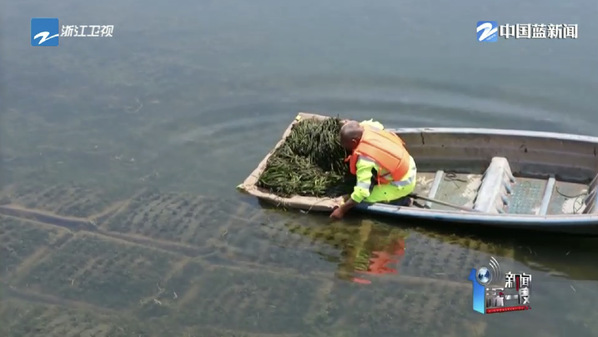
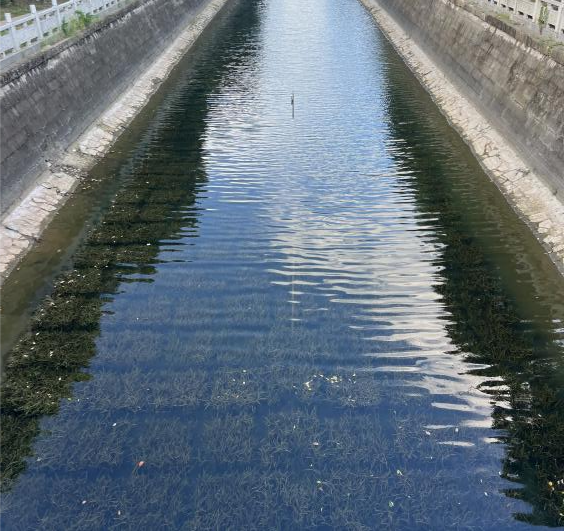
Field applications across the Yangtze River Delta have shown significant improvements in water quality within two months of installation.
At the river running through Zhenjiang Sports Park in Jiangsu Province, water transparency was less than 0.3 meters before restoration. One year after the installation of Oasis Carbon Grass, transparency had increased to more than 1.2 meters. The once murky and foul-smelling waterway has since become a vibrant aquatic habitat, with underwater vegetation swaying in the current and small fish, snails and shellfish returning to the river. Together, these changes have helped rebuild a functioning miniature aquatic ecosystem.
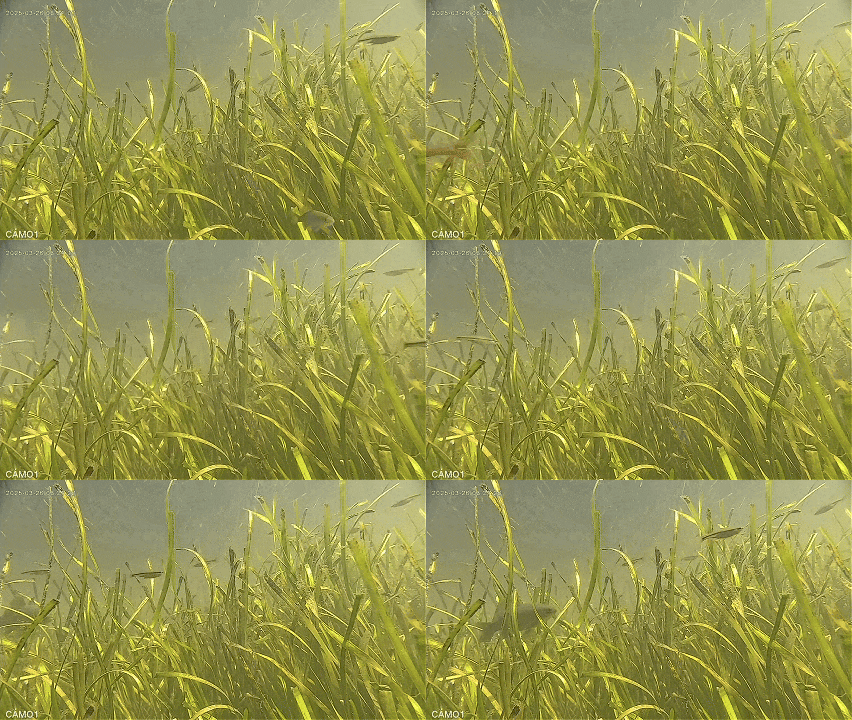
The idea of laying an ecological carpet underwater may sound simple, but turning it into a practical solution required two key breakthroughs: a materials innovation and an engineering innovation.
The materials innovation reduces costs. The carbon-based substrate at the core of Oasis Carbon Grass is made from waste materials, including straw, sludge and algal residue. These discarded resources are converted into artificial soil. With compact supporting equipment, the treatment cost can be reduced to less than 200 yuan per metric ton, while carbon emissions are cut by half. The process also enables the recycling of solid waste.
The engineering innovation makes installation easier. “The substrate, produced by combining green carbon-based materials with newly developed ecological microbial communities, can be paired with different submerged plants to meet the needs of diverse environments,” said ZHU Liang, deputy director of the Innovation Center of the Yangtze River Delta.
In conventional water-restoration projects, soil, microorganisms and aquatic plants are typically introduced separately, making the process time-consuming and labor-intensive.
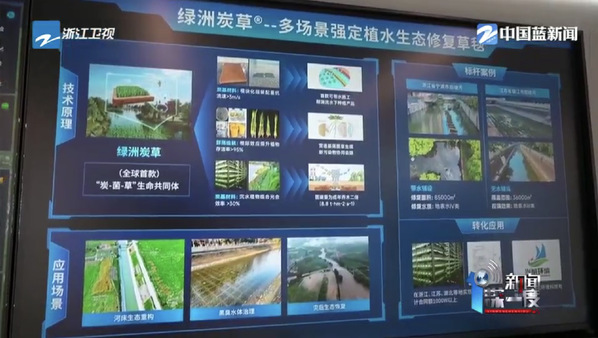
Oasis Carbon Grass integrates the carbon-based substrate, microbial communities and low-growing submerged plants into a single prefabricated module. Each unit is delivered as a ready-to-deploy restoration system. Once placed in the water, it immediately begins to purify the water, stabilize the riverbed and improve the landscape.
This modular approach substantially reduces construction and maintenance costs and can be adapted to different rivers, lakes and other aquatic environments.
Maintenance is also relatively simple.The system uses low-growing Vallisneria plants, typically 20-50 centimeters in height, whose growth can be naturally controlled without excessive spread or obstruction of the water surface.
The system is designed as a low-maintenance ecological restoration solution. Routine work mainly involves routine water-quality monitoring and occasional removal of plant residues. Its operation and maintenance costs are estimated to be 40-50 percent lower than those of conventional restoration approaches.
The underwater carpet alone is not enough. The Innovation Center has also developed an intelligent algae-control robot. Together, the two technologies form an integrated water-management system designed to prevent cyanobacterial blooms and support long-term ecological recovery.
In the Yangtze River Delta, cyanobacterial blooms are most common between June and September. Cyanobacteria rely on internal gas vesicles to remain at the water surface, where they can multiply rapidly under favorable conditions. Traditional approaches, such as manual removal, often address only the visible symptoms, while chemical treatments may introduce additional environmental concerns.
The intelligent algae-control robot takes a different approach. Using ultrasound technology, it disrupts the buoyancy structures that allow cyanobacteria to remain afloat, causing them to sink below the surface. Without sufficient sunlight underwater, the algae are unable to maintain rapid growth. Because the process does not rely on chemical agents, it does not harm fish, shrimp or aquatic plants. “This intelligent robot can enable precise prediction, early warning and targeted control of different types of algae,” said ZHU Liang.
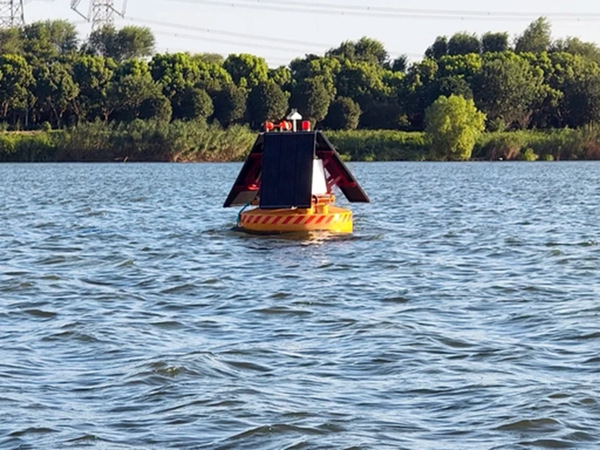
Together, the two technologies create what the team calls a “golden partnership” for water restoration: the robot addresses algal blooms, while Oasis Carbon Grass rebuilds the underlying aquatic ecosystem.
During periods of intense cyanobacterial growth, the robot can first suppress algae proliferation. Oasis Carbon Grass can then be deployed to establish a stable underwater ecosystem, gradually transforming algae-dominated, turbid water into a clearer and more resilient aquatic environment.
Looking ahead, the team will continue to optimize the formulation of Oasis Carbon Grass, upgrade its AI-powered ecological management system and advance low-carbon restoration technologies, contributing Zhejiang University’s expertise to building healthier and more sustainable waterways.
Adapted and translated from the article written by ZHU Liang, FANG Xun, YU Zhuodong, DING Luetao, HAN Lei
Photo: ZHU Liang, YU Zhuodong, Zhejiang Satellite TV
Translator: FANG Fumin
Editor: DING Chenwei