Reading cells by the light of chemistry


For more than a century, microscopes have relied on a seemingly obvious principle: To see something, you have to shine something on it.But that illumination comes at a cost.
Now, researchers in China have developed a way to produce super-resolution images without relying on external light excitation. Instead, the technique harnesses the faint light generated by chemical reactions.
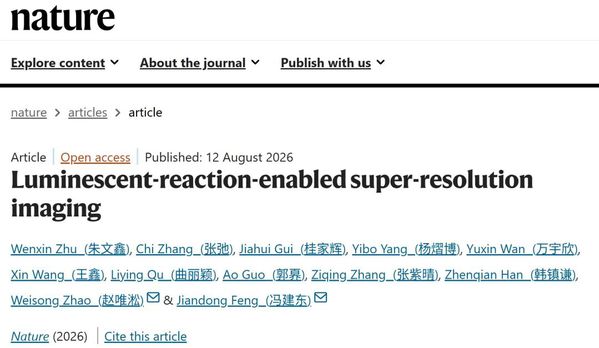
The approach, described on August 12 in Nature by researchers at Zhejiang University and the Harbin Institute of Technology, could allow scientists to observe biological processes for far longer than is possible with many existing techniques.The method, called RIED, can achieve a spatial resolution of about 100 nanometers and has enabled continuous imaging of living cells for as long as 41 hours.
The limits of optical microscopy have been known since 1873, when German physicist Ernst Abbe showed that conventional optical microscopes could not resolve structures smaller than roughly half the wavelength of light, or about 200 nanometers. Below that scale, diffraction causes fine details to blur together.
The development of super-resolution fluorescence microscopy eventually broke through that limit, ushering optical microscopy into the nanoscale era. The breakthrough was recognized with the 2014 Nobel Prize in Chemistry.
Yet the advance came with another problem.
Modern microscopes and analytical instruments generally rely on some form of external excitation. Fluorescence microscopes use lasers to excite fluorescent molecules, while electron microscopes use high-energy electron beams to reveal fine structures.Such external inputs can disturb the samples being observed. Electron microscopy is generally unsuitable for observing living cells because cells cannot survive exposure to high-energy electron beams. Super-resolution fluorescence microscopy can image living cells, but the intense lasers it uses can cause photobleaching and phototoxicity, interfering with normal cellular activity and making long-term observation difficult.
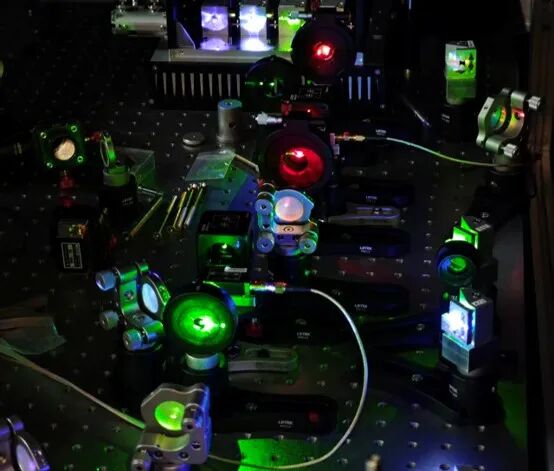
For live-cell imaging, scientists have therefore faced a persistent trade-off: seeing clearly or seeing for a long time.
FENG Jiandong, a professor at Zhejiang University who led the research with ZHAO Weisong of the Harbin Institute of Technology, approached the problem from another direction: What if a microscope did not need external excitation light at all?
Chemical reactions — and living organisms themselves — can produce light. The challenge is that this light is extremely weak, making high-resolution imaging difficult.
FENG Jiandong’s team spent years trying to overcome that obstacle.
After returning to China in 2018, FENG Jiandong began to build his laboratory from scratch. In 2021, his team demonstrated that electrochemiluminescence reactions could be used for single-molecule super-resolution imaging. But electrochemiluminescence could be used only in a limited range of imaging scenarios.
Over the next five years, the researchers expanded the approach into a general framework encompassing electrochemiluminescence, chemiluminescence and bioluminescence. The method enabled three-dimensional imaging of multiple organelles in living cells at high spatial and temporal resolution, reaching about 100 nanometers — comparable to mainstream fluorescence-based super-resolution techniques for live cells.
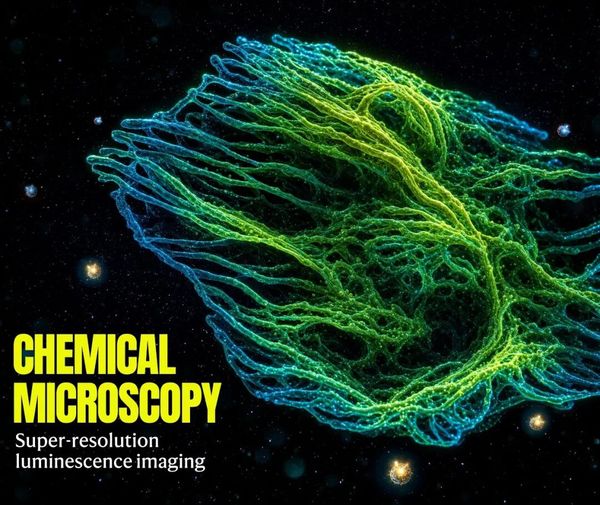
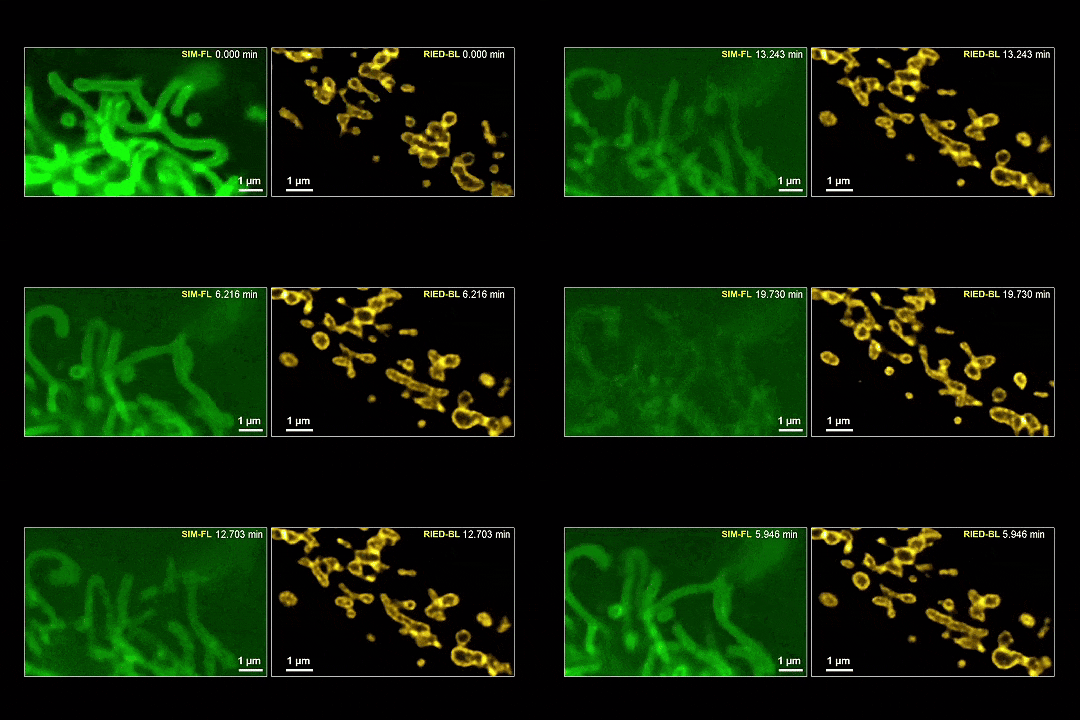
More importantly, the new method does not require external laser excitation, avoiding the photobleaching and phototoxicity associated with fluorescence microscopy. Under comparable conditions, the researchers said, the technique extended continuous imaging time by more than a hundred times compared with fluorescence microscopy.
“With conventional fluorescence microscopy, once the laser is directed onto the cells, the fluorescent molecules may bleach within just over ten minutes,” said ZHU Wenxin, a postdoctoral researcher in chemistry at Zhejiang University and lead author of the study. Increasing the laser power, he added, can irreversibly damage living cells.
“With our method, however, we can observe cells continuously for as long as 41 hours while the cells remain in good condition and the images stay clear,” ZHU Wenxin said.
The extended observation time allowed the researchers, for the first time, to track the complete dynamics of a single mitochondrion as it transferred from one cell to another. “A quantitative increase in observation time can lead to a qualitative transformation in live-cell imaging,” ZHU Wenxin said.
The researchers’ solution depended not simply on detecting faint light, but on extracting information hidden within it.
“The light produced by chemical reactions may be weak, but the background is completely dark,” FENG Jiandong said. “It is like the light of a firefly. Its glow is faint, but in the darkness of night, we can see it easily.”
Reaction-generated light also contains information in its fluctuations and changes over time. To capture that information, the researchers introduced a “spatiotemporal isolation” strategy to collect photon signals that fluctuate strongly across space and time. Computational methods then use that information to improve image resolution.
The work required expertise extending far beyond chemistry. FENG Jiandong’s team collaborated with ZHAO Weisong’s group at the Harbin Institute of Technology, which provided algorithms tailored to reaction-generated luminescence. The project brought together chemistry, optics, biology and computational science.
“Our ability to ‘see’ such faint light from chemical reactions was made possible by interdisciplinary collaboration,” said ZHANG Chi, a doctoral student in chemistry at Zhejiang University and a co-lead author of the paper.
FENG Jiandong named the technology RIED, short for Reaction-enabled super-resolution Imaging via Entropy-weighted correlation combined with Deconvolution. The acronym is pronounced like “read.” “I hope it can help us better read the microscopic processes of life,” FENG Jiandong said.
For FENG Jiandong, the technology reflects a broader effort to rethink what a microscope can be. “When people traditionally think about microscopes, they tend to regard them as a matter of optics or physics,” he said. “What I want to do is build microscopes through chemistry.”
Instead of relying on external light to illuminate the microscopic world, RIED suggests another possibility: letting chemistry provide the light — and learning how to read what that faint glow reveals.
Adapted and translated from the article written by YUE Sicong
Photo: TING Guang
Translator: FANG Fumin
Editor: DING Chenwei