Prof. HUANG He and Prof. Mohamad Mohty collaborate on landmark systematic review of cGVHD


In June 2026, Professor He Huang team from the First Affiliated Hospital, Zhejiang University School of Medicine, together with the team of Professor Mohamad Mohty, member of the French Academy of Medical Science, and several international scholars, published a systematic review titled “Chronic graft-versus-host disease” in the top-tier international medical journal Nature Reviews Disease Primers (impact factor 79.8). Associate Chief Physician Dr. Yishan Ye from Prof Huang’s team is the first author of the paper. This study comprehensively summarizes the epidemiology, pathogenesis, diagnosis, treatment, and future perspectives of chronic graft-versus-host disease (cGVHD), providing authoritative guidance for clinical practice worldwide.

Heavy disease burden and major challenges in diagnosis and treatment
Chronic graft-versus-host disease (cGVHD) is one of the most severe complications following allogeneic hematopoietic stem cell transplantation, affecting 30%–70% of transplant recipients and representing the leading cause of non-relapse mortality. Its pathogenesis is complex, involving aberrant activation of B cells and T cells, as well as macrophage-driven fibrotic processes. Although glucocorticoids remain the cornerstone of first-line therapy, about 50% of patients develop steroid-refractory or steroid-dependent disease, and long-term use is associated with serious toxicities.
Therapeutic breakthroughs and unmet needs
In recent years, the FDA has approved four second-line therapies—ibrutinib (targeting B-cell signaling), ruxolitinib (the JAK-STAT pathway), belumosudil (the ROCK2 pathway), and axatilimab (the CSF1R pathway)—which have significantly transformed the treatment landscape for refractory cGVHD. However, 30%–40% of patients still show no response or develop secondary resistance to these novel agents, and there remains a lack of effective interventions for highly disabling manifestations such as pulmonary fibrosis and skin sclerosis.
The review specifically highlights the dual JAK/ROCK inhibitor rovadicitinib as a therapy with big clinical potential. The clinical trial of rovadicitinib for the treatment of cGVHD was led by Professor He Huang, with the results presented by Chief Physician Dr. Yanmin Zhao at the 2024 American Society of Hematology (ASH) Annual Meeting and subsequently published in Blood in 2025. In addition, the review systematically summarizes innovative therapies for cGVHD. In discussing the preventive and therapeutic role of CAR-T cells, it places particular emphasis on the “Hangzhou protocol” reported by Professors He Huang and Yongxian Hu in the New England Journal of Medicine in 2024, and notes that the highly efficient depletion of T cells by CD7 CAR-T cells is the key mechanism that allows this regimen to omit conventional GVHD prophylaxis.
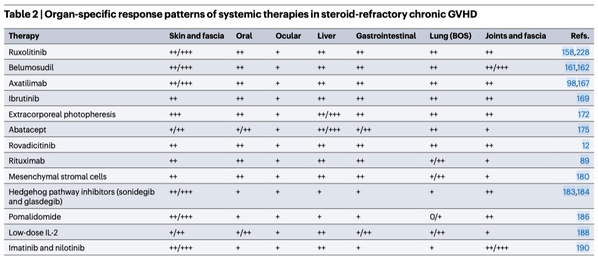
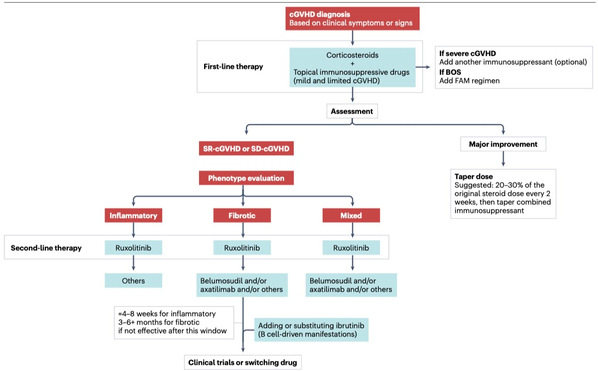
The review emphasizes that future efforts in the prevention and treatment of chronic GVHD should focus on three major directions: developing anti-fibrotic agents, establishing organ-specific therapeutic strategies, and refining biomarker-guided individualized treatment. Furthermore, the review innovatively provides organ-specific reference tables for different drugs, as well as decision algorithms that guide cGVHD management based on organ involvement or disease characteristics.
Multidisciplinary collaboration and comprehensive care
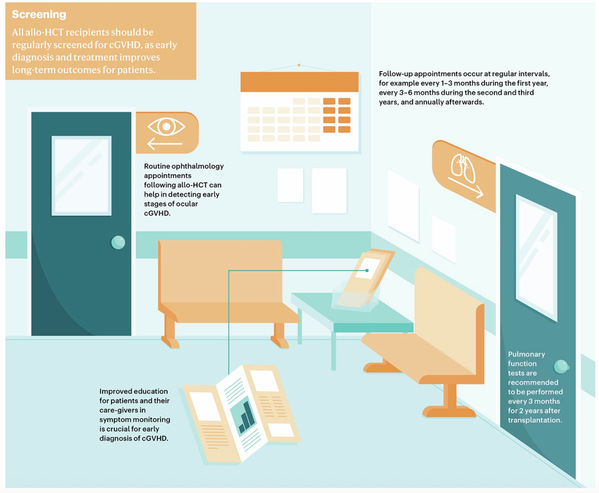
Comprehensive, lifelong management and psychosocial support are particularly crucial for patients with cGVHD. The review points out that effective cGVHD care requires the integration of infection prevention and control, psychological support, and organ-specific rehabilitation (such as pulmonary function training). The research team calls for the establishment of a global collaborative network to leverage multi-omics technologies in identifying precise therapeutic targets and to promote the clinical translation of innovative therapies (including CAR-T cells and microbiome modulation), ultimately achieving a shift from “complication control” to “functional cure.”
This review brings together global expertise, not only demonstrating that the team’s research on complications of hematopoietic stem cell transplantation has reached the forefront of the international field, but also highlighting the deepening international collaborations and the continuously growing academic impact.
Source: YE Yishan
Editor: DING Chenwei