ZJU researchers build exceptionally strong graphene films with new nanoscale fold locks


What makes a structure strong? Consider two familiar types of building blocks. Traditional wooden blocks rely on gravity to stay in place and can easily topple. Plastic lego bricks, by contrast, lock together, allowing even elaborate structures to remain stable. But what if the same principle could work at the nanoscale?
Researchers at Zhejiang University have found a way to make it happen.

In a study published in Nature on October 14, a team led by Professor Gao Chao and Associate Professor Xu Zhen from Zhejiang University’s Department of Polymer Science and Engineering, in collaboration with Professor Xu Zhiping’s team at Tsinghua University, reported a new approach to assembling graphene into exceptionally strong, tough and elastic films.
The secret lies in tiny folds on the surfaces of multilayer graphene oxide flakes. Much like interlocking plastic bricks, these folds allow neighboring layers to clasp together, overcoming a longstanding weakness in graphene-based materials.
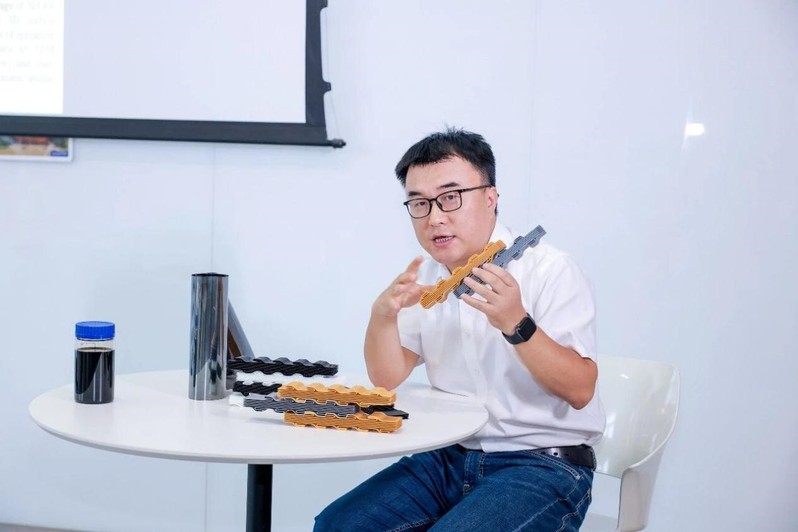
The discovery opens a new avenue in designing two-dimensional materials: rather than simply stacking atomically thin sheets, researchers can engineer their three-dimensional structures to improve their performance.
Graphene, a single layer of carbon atoms arranged in a honeycomb lattice, is renowned for its remarkable strength, stiffness, and electrical and thermal conductivity. It is also extraordinarily smooth.
But that remarkable smoothness comes at a cost.
When graphene sheets are stacked into larger structures, they are held together mainly by weak van der Waals forces. Under stress, the layers can slide past one another, preventing forces from being distributed evenly throughout the material. The result is a structure that can separate or fracture despite the extraordinary strength of its individual sheets.
For nearly two decades, Gao Cao’s team has sought ways to overcome this limitation. One promising idea was to design delicated fold structures to act as locks, which tightly hold neighboring layers and prevent sliding. The challenge was finding a reliable way to create those folds.
The breakthrough came unexpectedly.
While preparing a graphene oxide dispersion, the researchers lowered the reaction temperature from usual room temperature to below freezing in an attempt to modify the resulting material. Films made from the dispersion turned out to be remarkably strong.
A closer examination revealed why. Under a high-resolution electron microscope, the researchers discovered unusual sandwich-like flakes, with flat, crystalline layers in the middle and folded, roughened surfaces on the outside. Better still, the folds could be created simply by controlling the reaction temperature.
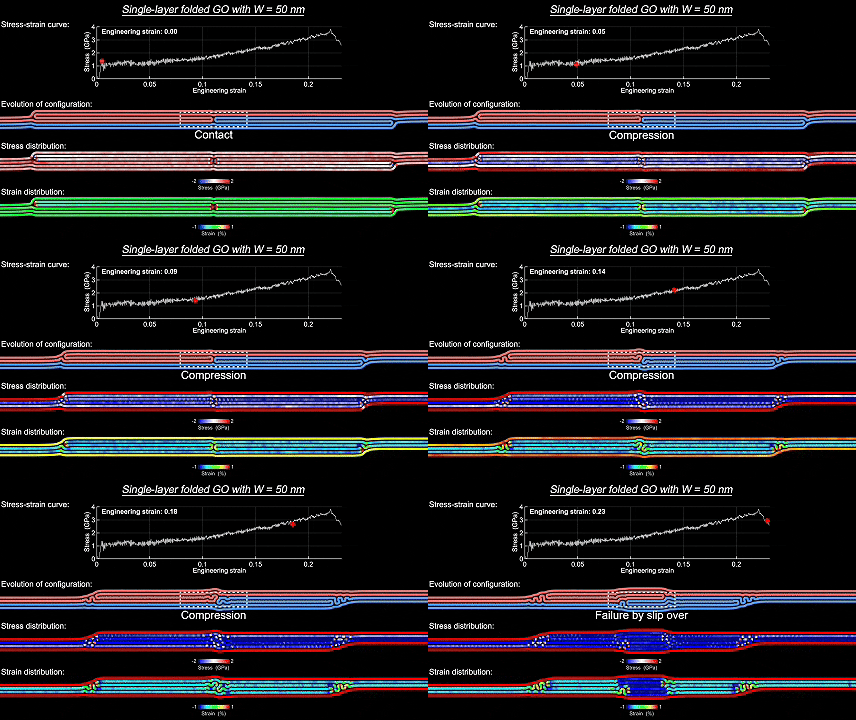
Schematic Diagram of the Force-Chain Conversion Mechanism in Pull-to-Push
“During coating, these surface-folded multilayer graphene oxide flakes spontaneously assemble and clasp together, forming a stable macroscopic film that combines high strength, toughness and elasticity,” explained Wang Lidan, a postdoctoral researcher at Zhejiang University and co-first author of the study.
The resulting film achieved a tensile strength of 2.9 gigapascals, roughly 50 percent higher than that of conventional graphene films and greater than that of many conventional steels, while remaining far lighter and thinner. “What makes this material particularly remarkable is its combination of high strength, elasticity and toughness,” Xu Zhen said.
Achieving all three properties at once has long been a challenge in materials science. Making a material stronger often reduces its ability to stretch or absorb energy without breaking. The new graphene structure appears to offer a way around that trade-off.
The key lies in the nanoscale folds that act like tiny hooks between adjacent graphene layers. In conventional graphene films, smooth layers tend to slip apart when pulled. In the new material, the folds act like tiny hooks. As the film stretches, neighboring folds press against one another, converting part of the pulling force into compressive forces between the layers.
The researchers call this a “pull-to-push” mechanism. By improving how forces are transferred between layers, it allows the material to withstand greater stress without sacrificing toughness or elasticity.
Nature offers a parallel. Seashells contain tiny protrusions between their layered structures that help hold the layers together and strengthen the shell.
“But this kind of architecture has not previously been demonstrated in artificially assembled two-dimensional materials at the atomic scale,” Gao Cao said. “That is one of the most important innovations of our work.”
The implications could extend beyond graphene. By engineering how atomically thin sheets fit together, researchers may be able to develop other lightweight materials that combine exceptional strength with toughness and elasticity.

Adapted and translated from the article written by Yue Sicong
Photo: Ting Guang
Translator: Fang Fumin
Editor: Hu Chenyue