ZJU Scientists Reveal“Covered” Secret about Transmission of Avian Flu


The avian flu outbreaks in 2009 and 2013 have left vivid memory and great concern among the general public. A ban on live poultry trading has not yet been lifted in Hangzhou to prevent the transmission from birds to humans through close contact with diseased birds or their feces. Previous studies shows that human-to-human transmission of avian flu is limited, which makes you wonder about the reason.
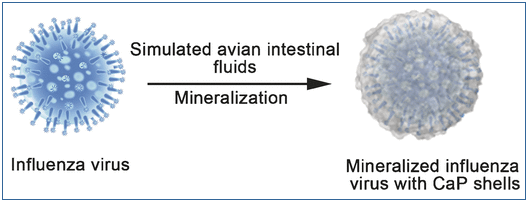
As reported in August issue of the journal Angewandte Chemie (Ruikang Tang et al., Angewandte Chemie International Edition, doi.org/10.1002/anie.201705769), Chinese researchers led by Ruikang Tang at ZJU reveal the “covered” secret, an eggshell-like mineral layer acquired by the viruses under the high calcium concentration in the intestines of birds, which makes these mineralized viruses more robust and heat stable than the native ones.
It was previously assumed that mutation or recombination with another pathogen is needed for these viruses to cross the species barrier. However, identical sequences of avian flu viruses isolated from infected humans and those from birds refute this hypothesis. So how is it that humans catch the disease from birds?
Results from Dr. Tang’s work demonstrate the viruses acquire a mineral “shell” in a calcium-rich environment which happens naturally in the digestive tract of birds—the primary location of avian flu viruse. Under a laboratory condition that simulates the bird intestine environment, a calcium phosphate mineral shell about 5 to 6 nm thick forms around H9N2 and H1N1 viruses, which alters the electric surface potential of the viruses and allow much more efficient absorption onto the surfaces of future host cells. In addition, the host uses a different uptake mechanism for this mineralized viruses. Instead of docking at receptors on the human cell surface then being brought inside, this eggshell inhibit this process but stimulates very efficient uptake on its own. Once inside the host cell, lysosomes take in the mineralized viruses, whose slightly acidic environment dissolves the mineral shell and releases the viruses.
Their experiments also confirm these mineralized viruses proved to be significantly more infectious—and deadly—than the native viruses both in vitro and in vivo. In humans, the calcium concentration in the airways and body fluids is too low for mineralization of viruses, which thus limits the human-to-human transmission. This new line of evidence may facilitate the development of innovative measures against the avian flu.
This article is adapted from Newsroom from “Virus with an Eggshell: Mineral layer around avain flu pathogen may be the cause for human infections” at the Wiley Newsroom-Press Releases, News, Events & Media(http://newsroom.wiley.com/)