Nobel Laureate Edvard Moser Speaks at Zhejiang University


On September 20, Edvard I. Moser, the winner of the Nobel Prize in Physiology or Medicine 2014, gave a talk titled “Grid Cells and the Entorhinal Positioning System” at Zhejiang University.
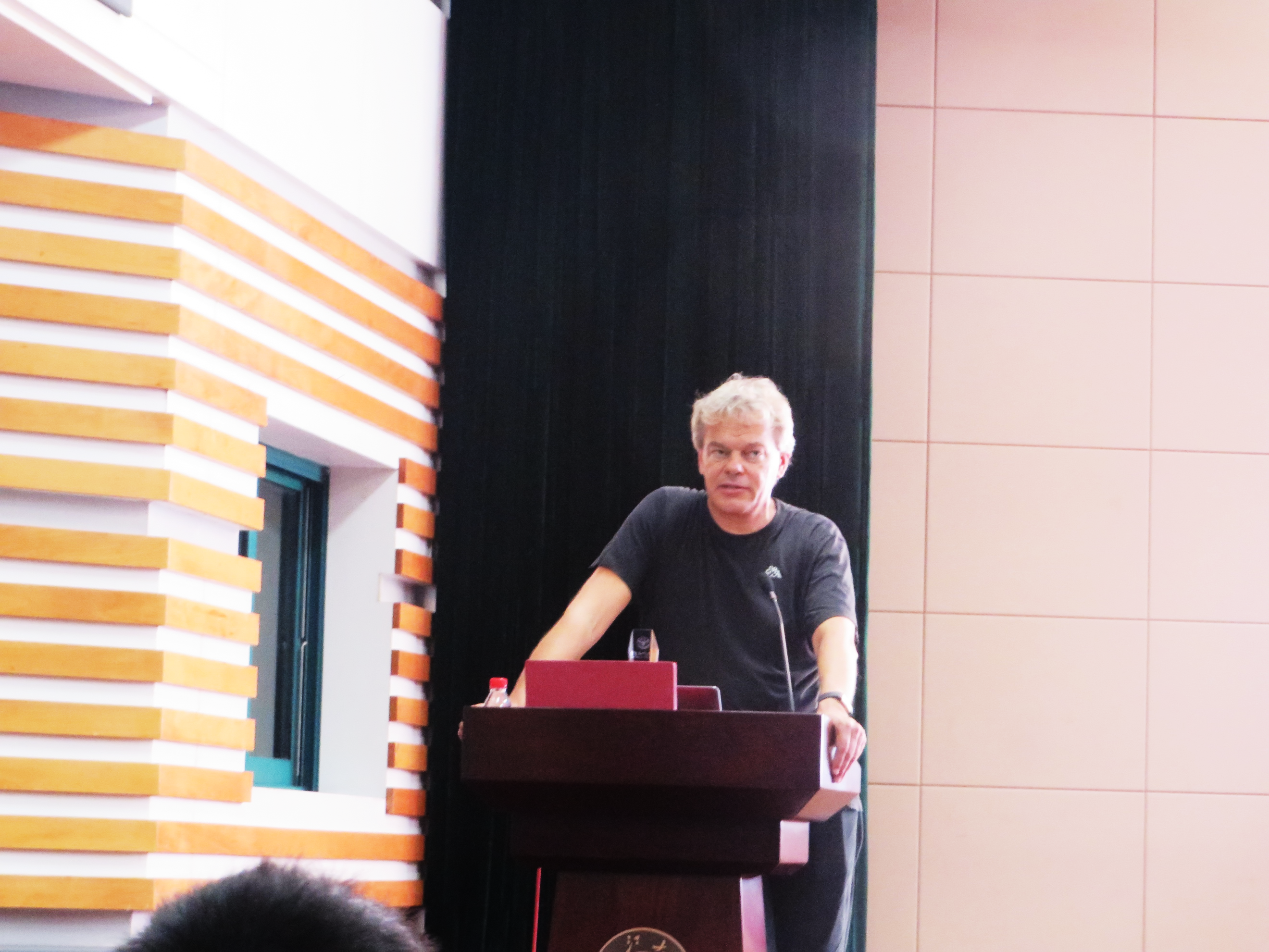
Edvard Moser is a Norwegian psychologist and neuroscientist. He is currently a professor of psychology and neuroscience at the Norwegian University of Science and Technology (NTNU) and the director of the Institute for Systems Neuroscience at NTNU. In 2005, Prof. Moser and his wife—May-Britt Moser—identifying the grid cells that make up the brain’s positioning system.
A grid cell is a place-modulated neuron whose multiple firing locations define a periodic triangular array covering the entire available surface of an open two-dimensional environment. Grid cells are thought to form an essential part of the brain’s coordinate system for metric navigation. They have attracted attention because the crystal-like structure underlying their firing fields is not imported from the outside world, but created within the nervous system. Understanding the origin and properties of grid cells is an attractive challenge for anybody wanting to know how brain circuits compute.
Prof. Moser started his talk with an experiment on rats in the 1930s and pointed out that information was not simply stored in the brain by means of stimulation-response. There exist a cluster of individual neurons in rat hippocampus. When the rat passed by a given location, a place cell would emit an action potential. The dots built up to form small clusters, but frequently there was only one cluster (one “place field”) in a given environment. However, little was known about the reason for the formation of place cells.
Early experiments demonstrate that in spite of the isolation of the CA1 from the earlier stages of the hippocampus, cells with place fields could still be identified in CA1, although the firing fields were often somewhat more blurred than in control animals. The findings suggested that spatial information was computed either by the CA1 circuit alone, or that the signal came in to the CA1 via direct inputs from the entorhinal cortex that bypassed the CA3. On this basis, Prof. Moser identified grid cells.
In his talk, Prof. Moser also introduced his latest research findings: the entorhinal cortex includes a series of cells, including grid cells, head direction cells that increase their firing rates above baseline levels only when the animal’s head points in a specific direction, boundary cells that respond to the presence of an environmental boundary at a particular distance and direction from an animal, and speed cells that respond to the speed of the animal’s movement and is not dependent on external factors such as visual surroundings.
At last, Prof. Moser expressed his sincere hope that students and rising scientists would boast a brilliant future.