Scientists Reveal the Effects of Bacterial Pathogens on Host Cells


Vibrio vulnificus is a species of Gram-negative, motile, curved, rod-shaped (bacillus), pathogenic bacteria of the genus Vibrio. Present in marine environments such as estuaries, brackish ponds, or coastal areas, V. vulnificus is related to V. cholerae, the causative agent of cholera.

Recently, the research team led by Prof. ZHU Yongqun of ZJU’s Life Sciences Institute discovered that a toxin produced by the bacterium that causes cholera has a catalytic activity that contributes to its effects on the cytoskeleton of host cells.
The multifunctional autoprocessing repeats-in-toxin (MARTX) toxins are a family of large toxins that are extensively distributed in bacterial pathogens. MARTX toxins are autocatalytically cleaved to multiple effector domains, which are released into host cells to modulate the host signaling pathways. The Rho guanosine triphosphatase (GTPase) inactivation domain (RID), a conserved effector domain of MARTX toxins, is implicated in cell rounding by disrupting the host actin cytoskeleton.
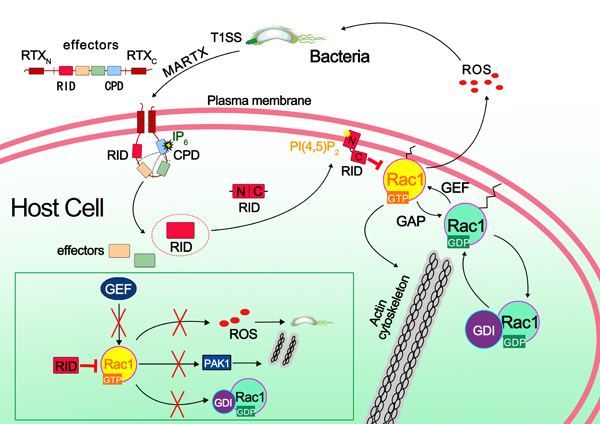
The research team found that the RID is an Nε-fatty acyltransferase that covalently modifies the lysine residues in the C-terminal polybasic region of Rho GTPases. The resulting fatty acylation inhibited Rho GTPases and disrupted Rho GTPase–mediated signaling in the host. Thus, RID can mediate the lysine Nε-fatty acylation of mammalian proteins and represents a family of toxins that harbor N-fatty acyltransferase activities in bacterial pathogens.
This research will be helpful to develop new anti-bacterial drugs in response to such bacterial pathogens as Vibrio vulnificus and V. cholera.
Relevant research findings are published in the October 27 issue of the journal Science.