New research reveals bismuth-based nanomedicine for treating tumor


The lab of LING Daishun, a professor of pharmaceutical sciences at ZJU’s College of Pharmaceutical Sciences, has published an article titled “Renal-Clearable Hollow Bismuth Subcarbonate Nanotubes for Tumor Targeted Computed Tomography Imaging and Chemoradiotherapy” in the top-tier research journal Nano Letters (IF: 12.712). They reported on the hollow bismuth subcarbonate nanotubes (BNTs) assembled from renal-clearable ultrasmall bismuth subcarbonate nanoclusters for tumor-targeted imaging and chemoradiotherapy.
It has been scientifically proved that malignancy poses a detrimental influence towards our well-being. For the sake of diagnosing and treating tumors more effectively, researchers have developed various functional inorganic nanomaterials on the basis of imaging technologies (such as chemotherapy and radiotherapy) and therapies of tumor (such as computed tomography).
The US Food and Drug Administration (FDA) stipulates that medical contrast agents should be excreted from the body in a certain period of time to avoid any potential toxicity that may be caused by their long-term accumulation in the body. However, due to their outstanding renal clearance properties, metallic nanomaterials have short circulation time in vivo, so they are not so effective for tumor targeting.
Thus, it is urgent to develop a kind of nanomaterial that can be excreted by the kidney and have longer circulation time. It also provides a train of thought for the development of efficient and safe tumor diagnosis and treatment preparations.
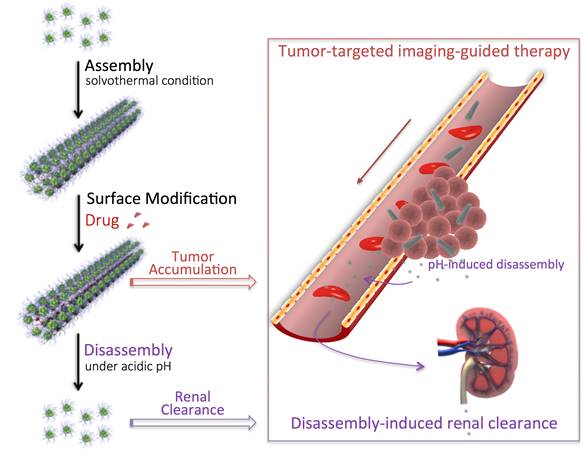
According to LING's research, controlled assembly of nanoparticles into various shapes and structures for tunable functionality are expected to promote their targeted delivery and allow their controlled elimination from the body. Xi et al. achieved the designed assembly of small-sized (BiO)2CO3 nanoclusters (BNCs) into elongated and hollow (BiO)2CO3 nanotubes (BNTs). Compared to nanoclusters, the elongated BNTs showed longer in vivo circulation time, and could penetrate leaky tumor blood vessel walls more efficiently to achieve tumor accumulation.
Apparently, the unique nanostructure of the BNTs promoted their tumor homing and enabled the drug loading, which were useful not only for tumor-targeted CT imaging, but also for synergistic radio- and chemotherapy.Simultaneous radio- and chemotherapy using doxorubicin-loaded BNTs could significantly increase cellular reactive oxygen species (ROS), aggravate DNA damage and suppress tumor volumes, highlighting their potential application in CT imaging-guided therapy.
Importantly, the elongated BNTs could be disassembled into isolated small nanoclusters in the acidic tumor microenvironment, which are smaller than the size threshold for efficient renal filtration (~8 nm), accelerating the payload release and kidney excretion. This disassembly process is expected to avoid potential long-term toxicity as theFDA declared. Such body clearable CT contrast agent with high imaging performance and multiple therapeutic functions shall have a substantial potential for biomedical applications.
This work was carried out by Ph.D. student HU Xi, Prof. SUN Jihong, Dr. LI Fangyuan et al. under the supervision of Professor LING Daishun. This research was mainly completed by ZJU’s
People

Professor,
By: XU Xiao (Foreign Affairs Secretary, College of Pharmaceutical Sciences); ZHOU Hongliang, ZHANG Xiang (Student Journalists, Office of International Relations)