ZJU scientists develop a system for CRISPR-Cpf1-mediated genome editing in human pluripotent stem cells


Human pluripotent stem cells (hPSCs), including human embryonic stem cells (hESCs) and human induced pluripotent stem cells (hiPSCs), offer a promising solution to study human early development and investigate human diseases.It is of paramount importance to develop methods for rapid, efficient, and controllable genetic manipulation of hPSCs. However, precise genome editing in hPSCs remains time-consuming and labor-intensive.
CRISPR-Cpf1 has been recently identified as being able to identify thymidine (T)-rich protospacer adjacent motif (PAM) sequences (TTTN), expanding the range of RNA-guided genome editing.
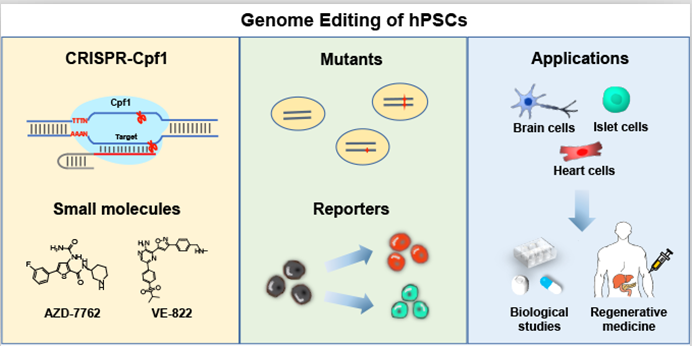
The research team led by Prof. Zhu Saiyong with the Life Sciences Institute, Zhejiang University carried out a systematic research into knockout and knockin hPSC lines. Through chemical screening, they identified two interesting small molecules VE-822 and AZD-7762 that enhance CRISPR-Cpf1-mediated precise genome engineering. CRISPR-Cpf1 and small molecules can also be further developed and applied for in vivo genome editing and human germline genome editing. These advances will undoubtedly expand the molecular toolbox of genome engineering and accelerate the development of innovative approaches for curing human diseases.
Relevant findings are published on the April 3 issue of the journal Nature Communications.