How not to be an online conversation killer


Artificial intelligence can tell whether your next post to an online forum will engage others or fall flat.
JIAO Yunhai, a senior student majoring in computer science at Zhejiang University, developed a deep learning model called the ConverNet, which can judge whether or not a conversation will continue after careful analyses. AI can tell what kind of words will run a higher risk of becoming a conversation killer via a deep learning model driven by big data.

This kind of chat-savvy computer code, described in a paper accepted to the 2018 Web Conference in Lyon, France, could someday notify users before they hit “submit” if a post is likely to shut down discussion.
The ConverNet is a specially designed recurrent neural network which is capable of modeling the internal structure of a long conversation and its appropriate encoding of the contextual information of the conversation through the effective integration of attention mechanisms.
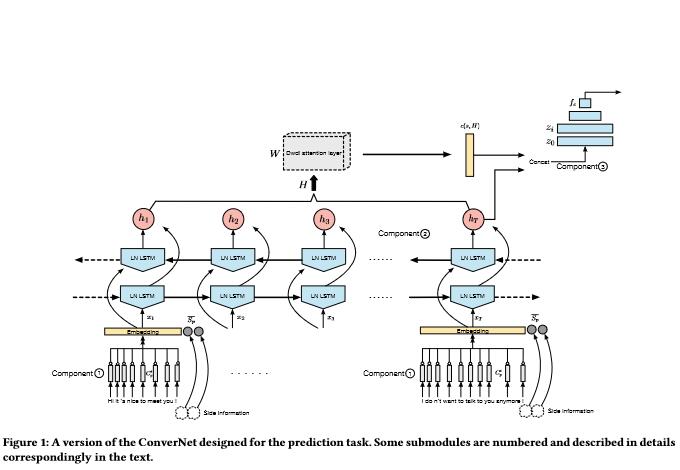
With the help of Prof. MEI Qiaozhu of the University of Michigan in Ann Arbor, JIAO Yunhao found two public datasets: One containing threads of Reddit posts, which is extracted from Reddit.com, one of the largest online forums that cover a variety of topics and the other being a collection of conversations extracted from the Cornell Movie-Dialogs Corpus.
A series of large-scale experiments with these two datasets were conducted. The results demonstrate great effectiveness and generality of the ConverNet, which outperforms a portfolio of strong baselines, including feature-based SVMs and deep learning methods equipped with standard attention mechanisms.
This study explored five key components of being an online conversationalist.
1) Sharing. Comments that include words such as “Mr.”, “Mrs.”, “talked,” “heard” or “seen”, “care” are liable to incite further discussion. Posts that include insulting or intense language, such as curse words or an all-caps “YOU”, are inclined to discourage a back and forth.
2) Turn. The more time that elapses between a post and a reply, the more likely that reply will go unanswered.
3) Length. Unlike in-person chats, where long monologs can bore those within earshot, lengthier online posts tend to get more responses.
4) Time. A conversation initiated at midnight may well cause offense, thereby becoming a killer.
5) Emotion. A negative emotion is likely to create empathy and elicit discussion in a group conversation whereas it is disposed to end a dialogue in a private chat.