Researchers track down the culprit of deafness


Recently, ZJU scientists “captured” a particular gene for hearing impairment: mtu1. Mtu1 deficiency results in the “power shortage” of our auditory organ. This research is published in the August 22 issue of Nucleic Acids Research.
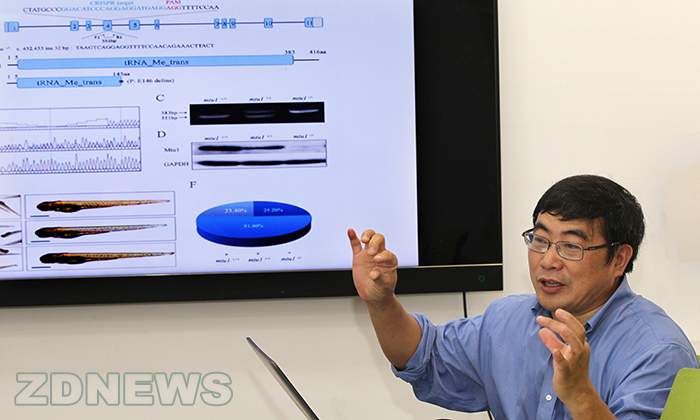
These findings are part and parcel of massive research into deafness treatment. The research team led by Prof. GUAN Minxin at ZJU’s Institute of Genetics is currently searching for more deafness-inducing genes among thousands of human genes.
“Among 27.8 million deaf cases in China, roughly half of them are hereditary. The genetic information on a particular gene causes innate deafness or hearing impairment due to the complications of a particular drug,” GUAN Minxin said. The discovery that mtu1 mutation triggers deafness may be translated to an effective cure for over 11 million deaf people and the establishment of a pre-warning deafness system for more people.
This research reveals that the genetic defect of mtu1 destroys mitochondria —a source of energy in the cell that the faculty of hearing requires.
“Hair cells are the most crucial sensory receptor of the auditory system in ourinner ears. They derive energy from consuming a considerable quantity of mitochondria and are therefore able to function properly,” GUAN Minxin said, “When mtu1 affects the function of mitochondria adversely, this ‘power shortage’ will lead to auditory dysfunction.”
Researchers discovered that mtu1 exerts a direct impact on the carrier in our body—tRNA, a transfer RNA which serves as the physical link between the mRNA and the amino acid sequence of proteins. tRNA does this by carrying an amino acid to the protein synthetic machinery of a cell and ultimately mitochondria. The flaws with mtu1 tremendously reduce the efficiency of tRNA. While a machine is lacking in energy, the ‘power plant’ will inevitably collapse.
Zebrafish can point to this phenomenon. This kind of freshwater fish in tropical areas exhibits a striking resemblance to human beings genetically. “The mtu1 knock-out zebrafish suffer from deafness,” said co-lead authors ZHANG Qinhai and ZHANG Luwen, who are currently pursuing master’s degree at the School of Medicine.
A school of zebrafish swim to and fro in tranquil water. Out of the blue, a drop of water plummets from the height and sets off ripples across the lake. Normal zebrafish swim away in different directions immediately whereas mtu1 knock-out ones make no response. Meanwhile, due to the fact that hair cells help vertebrates to maintain a balance, these mtu1 knock-out zebrafish swim in a different manner. They lie on their side stationary at the bottom of the lake.
At present, scientists have identified more than 100 deafness-associated human genes and more deafness-inducing genes, particularly among Chinese population, are yet to be found. “People will benefit enormously from the findings concerning hereditary deafness,” said GUAN Minxin, “Latent deafness-inducing genes are detected through genetic screening so that an early diagnosis and prevention system will be set up, thus freeing millions of people from the agony of deafness. To develop a novel remedy for hearing impairment by using stem cells will also be a real boon for deaf people.”