ZUSM scientists unlock potent, addiction-free pain relief


Cannabis has long walked a fine line between medicine and abuse. While it has shown potential for relieving pain and regulating mood, cannabis-based drugs are strictly controlled worldwide due to side effects such as tolerance, addiction and cognitive impairment. For years, scientists have sought a solution that could preserve therapeutic effects while eliminating these risks – a truly safe and effective approach.

Professor LI Xiaoming (2nd from left) and his team.
A collaborative team from the School of Medicine and College of Pharmaceutical Sciences of Zhejiang University has rationally designed a series of small-molecule drugs. These compounds offer potent pain relief while effectively bypassing the risks of addiction and drug tolerance. The study, recently published in the international flagship journal Cell, represents a significant leap forward for chronic pain sufferers worldwide seeking safer, non-opioid alternatives.
Targeting the brain's pain and emotion centers
Previous studies from the team revealed that stress and other negative stimuli can trigger abnormal activity in the amygdala, a key brain region for emotional regulation. Reduced expression of type 1 cannabinoid receptors (CB1) contributes to this imbalance, potentially leading to anxiety and depression. Activating CB1 in the amygdala with exogenous cannabinoids can restore emotional balance, while CB1 in the thalamus influences pain thresholds, making it a critical target for central analgesic effects.
Molecular surgery and the bio-switch
CB1 receptors signal through two pathways: the Gi/o pathway, which mediates therapeutic effects like pain relief, and the β-arrestin pathway, which is linked to side effects such as addiction and tolerance. Conventional CB1 agonists activate both pathways, leading to undesirable consequences.
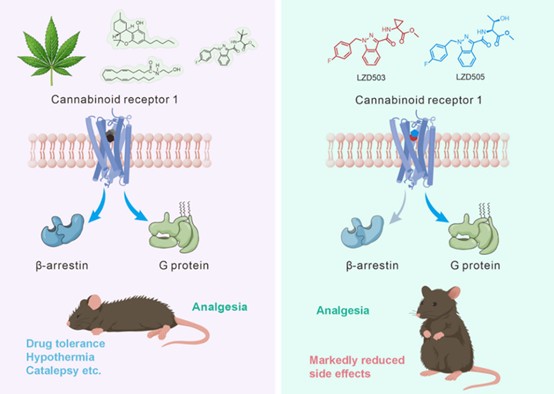
Comparison between traditional CB1 agonists and rationally designed biased small molecules.
The Zhejiang University team applied structure-activity relationship analyses to rationally design small molecules that selectively activates the Gi pathway while minimizing β-arrestin signaling. This biased signaling approach allows pain relief without the typical side effects of cannabinoid drugs.
Reviewers praised the study for its innovative approach. One noted, This work is the first one to make a rational use of the differences in the binding pocket between G protein and arrestin coupled receptors. Another added, The study is a tour de force presentation of structure-based design of CB1 agonists that appear to prefer G protein signaling over β-arrestin1 recruitment.
Promising results and the road ahead
In animal experiments, these compounds provided robust analgesia across multiple pain models, without evidence of addictive behavior or declining effectiveness. They also reduced side effects on motor activity and body temperature, successfully avoiding the central nervous system complications associated with conventional cannabinoids.
The Leading researcher, Professor LI Xiaoming, said the team is optimizing these compounds and conducting systematic validation in preparation for clinical trials.
Our goal is to start from clinical needs, uncover disease mechanisms through basic research, identify therapeutic targets and develop drugs that genuinely improve patients' quality of life, said LI.
As research continues, this biased-signaling strategy could open a new era of precision medicine, offering transformative therapeutic possibilities not only for chronic pain but also for a wider range of complex disorders.
Source: School of Medicine
Editor: HAN Xiao