Artificial intelligence reshapes education at Zhejiang University


From May 11 to 12, the 2026 World Digital Education Conference was held in Hangzhou, focusing on “AI + education: Transformation, Development and Governance.” Zhejiang University took part in several major sessions of the conference, presenting how it is using artificial intelligence to reshape education and cultivate future innovators.
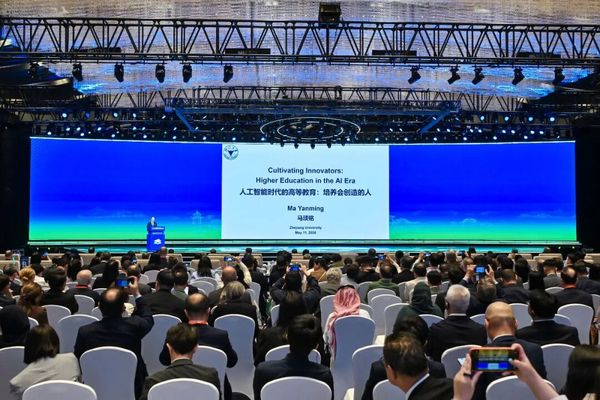
During the conference, ZJU President MA Yanming delivered a keynote speech titled “Cultivating Innovators: Higher Education in the AI Era”. The university also hosted a parallel session on “Leading Higher Education through Digital and Intelligent Innovation: Building a New Ecosystem for Talent Development” and presented a future classroom demonstration on the design of high-speed, low-carbon and safe quadruped robots.
Beyond the exhibitions, Zhejiang University also contributed to the drafting of “Ethics of Artificial Intelligence in Education: A Reference Framework” and “Hangzhou Initiative on AI and Education”. It signed memorandums of understanding on cooperation in digital education and knowledge innovation with three overseas universities. The university’s AI learning assistant for general education courses was selected among the first batch of “Higher Education Intelligent agents of Chinese Universities”, and its fourth Global SDG Summer School was recognized as one of the first model cases for the Global Outreach of Digital Education of Chinese Universities. Other highlights included the humanoid robot BOLT and lightning talks presented by X-Lab.
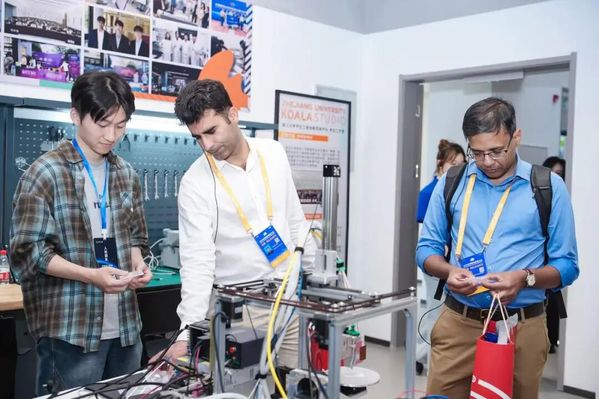
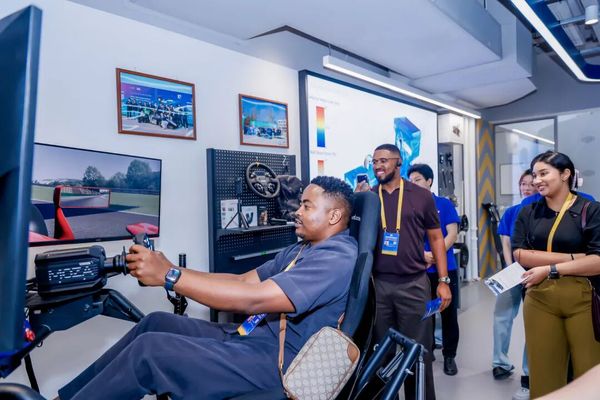
On May 11, conference guests from China and abroad visited ZJU’s Future Learning Center, which made its debut as an official conference stop. The visit offered an on-site look at the university’s approach to innovation-driven education in the AI era.
One of the most watched demonstrations took place in the embodied agricultural robotics laboratory, where WANG Shu, a student majoring in agricultural electrification and automation, operated a robot to pick strawberries. The demonstration highlighted how embodied intelligence can be applied in agricultural settings. Daryll Matthew, minister of education, science and technology of Antigua and Barbuda, closely observed the robot’s movements and recorded the process on his phone, impressed by its precision.
Guests also stopped at the “Luban” dexterous teleoperation system. Wearing a VR headset, an operator could have hand movements captured in real time and transmitted to a remote robotic arm, which reproduced the same delicate actions with high synchronization. Oyunaa Purevdorj, an education expert from Mongolia, said it was hard to believe such advanced projects had been developed by student teams. She added that Zhejiang University offers a valuable example of talent cultivation for the age of AI.
According to WU Fei, dean of the Undergraduate School, the Future Learning Center is designed as a progressive training model that moves from interest discovery and capability building to project incubation and innovation creation. The goal is to help students develop interdisciplinary problem-solving skills in real-world contexts and grow from readers into innovators. As AI accelerates change across fields, the university sees disciplinary integration as a key pathway for nurturing top innovative talent.
The center is organized across four floors. The first floor focuses on co-creation among teachers, students and intelligent tools, allowing students to engage with frontier interdisciplinary research with AI support. The second floor emphasizes research training and future classrooms, featuring student projects such as a lightweight formula race car, an intelligent fruit-picking robot and self-luminous plants, alongside teaching scenarios including a digital twin energy base, a metaverse for robot dogs, a moon-earth robotic arm system and international cultural exchange. The third floor supports academic competitions and innovation contests while fostering both creative and entrepreneurial capabilities. It is also home to X-Lab, a student-run innovation community. The fourth floor serves teams in the incubation stage, building an open-source AI community and connecting education with industry and social resources.
Taken together, the conference offered a concentrated view of Zhejiang University’s latest experiments in AI-enabled education. Its model points toward a more open, interdisciplinary and practice-oriented approach to talent development, one in which education moves beyond one-way knowledge delivery and helps students build the capacity to create for the future.
Adapted and translated from the article written by WU Wenbo, ZHANG Shufan
Translator: DING Chenwei
Photo: Tide News, Zhejiang Online, and the event organizers
Editor: DING Chenwei