ZJU team wins RoboMaster Jiangsu title with six straight victories


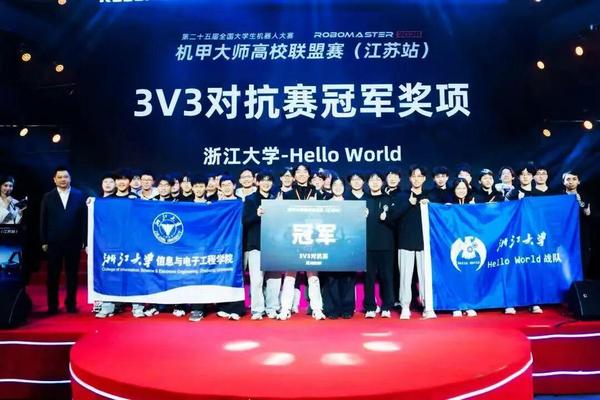
Zhejiang University’s Hello World team won the 3V3 championship at the Jiangsu regional of the RoboMaster University League, part of the 25th National University Robot Competition, after finishing the tournament with six wins from six matches. Guided by the College of Information Science and Electronic Engineering, the team secured the best result in its history and its first title since the team was founded in 2015.
Hello World has more than 80 active members, including undergraduate, master’s and doctoral students from over 10 schools and disciplines, among them information and electronic engineering, control science, mechanical engineering, electrical engineering and energy engineering. The team is led by LIU Jianyu, an undergraduate student majoring in Electronic Science and Technology in the Class of 2023 at the College of Information Science and Electronic Engineering.
The competition schedule was tight from the start. After arriving at the temporary venue in Jiangyin, Jiangsu, the team quickly assembled and tuned its robots to prepare for the event. In the group stage, Hello World won every match by 2:0 and advanced smoothly to the knockout rounds.
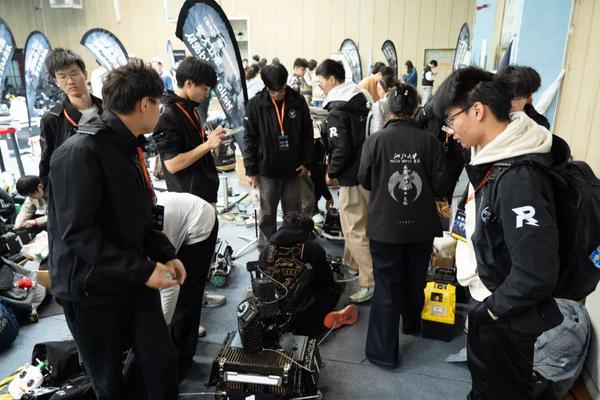
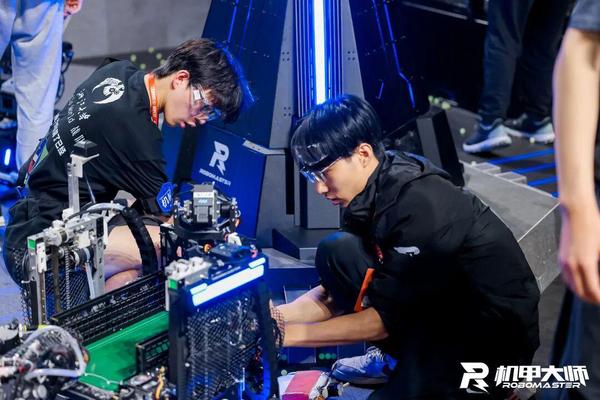
Its toughest test came in the round of 16. A series of failures hit at once: the supercapacitor module on the infantry robot malfunctioned and could not be repaired in time, leaving the machine operating at low power; the sentry robot became stuck because of a stair-climbing strategy problem; and the hero robot could not fire after ammunition jammed in the barrel. The team lost the first game badly.
Under heavy pressure, however, Hello World recovered to win the next two games and move into the quarterfinals. Faculty advisor LOU Dongwu said the team carried out a full inspection of the robots immediately afterward so it could better handle sudden environmental changes and the high intensity of later matches.
Preparation had already become a routine part of the team’s approach. Before each match, members reviewed video footage, discussed tactics and adjusted plans according to the characteristics of both their own robots and their opponents. FANG Beining, the infantry operator and an undergraduate student in the Class of 2024 from the Department of Architecture, said that this targeted planning helped the team develop different solutions for different opponents. Hello World then defeated two strong rivals by 2:0 in the quarterfinal and semifinal to reach the final.
In the championship match, the opposing team opened with aggressive firepower. Hello World responded with disciplined tactics and calm execution, absorbing the early pressure, dragging the contest into a more balanced exchange and gradually taking control of the rhythm. When the opponent launched one last counterattack, the ZJU team held firm and closed out the final 2:0 to claim the title.
Although a 3V3 match lasts only about five minutes, the result reflected a year of sustained work. Team members train together every Saturday from 1:30 p.m. to 9:30 p.m., and they also complete a three-week winter intensive program. GU Fujia, an undergraduate student majoring in Electronic Science and Technology in the Class of 2023 who is responsible for project management, recalled that in the two weeks before the Jiangsu event, the competition vehicle groups gathered almost every night after 9:30 p.m. classes for functional testing and scrimmages in order to resolve as many risks as possible before departure.
The team also made a bold technical choice in response to increasingly complex match rules: it sacrificed cross-terrain capability in exchange for maximum mobility. That decision allowed its robots to maneuver more flexibly in several close contests and became an important factor in the title run.
Behind the result is a long-term team-building system. With support from the college, Hello World has developed five technical divisions: mechanical design, electrical control, computer vision, hardware, and communications and operations. New members are selected through both theory assessment and project-based practice, then trained by senior students through hands-on projects. According to faculty advisor ZHOU Xiaoxin, the goal is not flawless completion but the development of independent thinking and practical problem-solving skills.
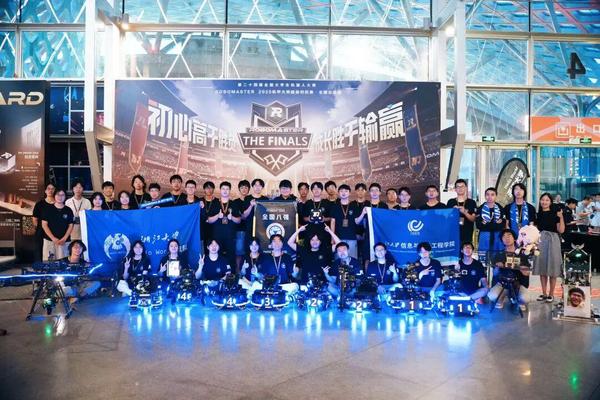
That structure has helped the team build continuity across generations of members. New recruits move through a cycle of joining, training, competing, reviewing performance and mentoring younger students. The gains have been steady: Hello World first reached the national competition in 2021, broke into the national top four in 2024, and has now won the Jiangsu regional 3V3 title with a perfect six-match record. Team members say the core values behind that progress are truth-seeking, unity, dedication and the pursuit of excellence.
Adapted and translated from the article written by MAO Yixuan, LIU Jingchun, ZHANG Shu
Translator: DING Chenwei
Photo: the interviewees
Editor: DING Chenwei