Scientists report the regulatory evolution of new genes in their life history


The research team led by ZHOU Qi from the Life Science Institute of Zhejiang University published a research paper entitled “On the regulatory evolution of new genes throughout their life history” in the November 3 issue of Molecular Biology and Evolution.
Every gene has a birthplace and an age, i.e., a cis-regulatory environment and an evolution lifespan since its origin. However, how the two shape the evolution trajectories of genes remains obscure. ZHOU Qi et al. addressed this basic question by comparing phylogenetically dated new genes in the context of both their ages and origination mechanisms.
In both Drosophila and vertebrates, researchers confirmed a clear ‘out of the testis’ transition from the specifically expressed young genes to the broadly expressed old housekeeping genes, observed exclusively in the testis but not in other tissues. Many new genes have displayed crucial functions during embryogenesis, manifested as either specific activation at maternal-zygotic transition, or different spatiotemporal expressions from their parental genes. These expression patterns are primarily driven by an age-dependent evolution of the cis-regulatory environment.
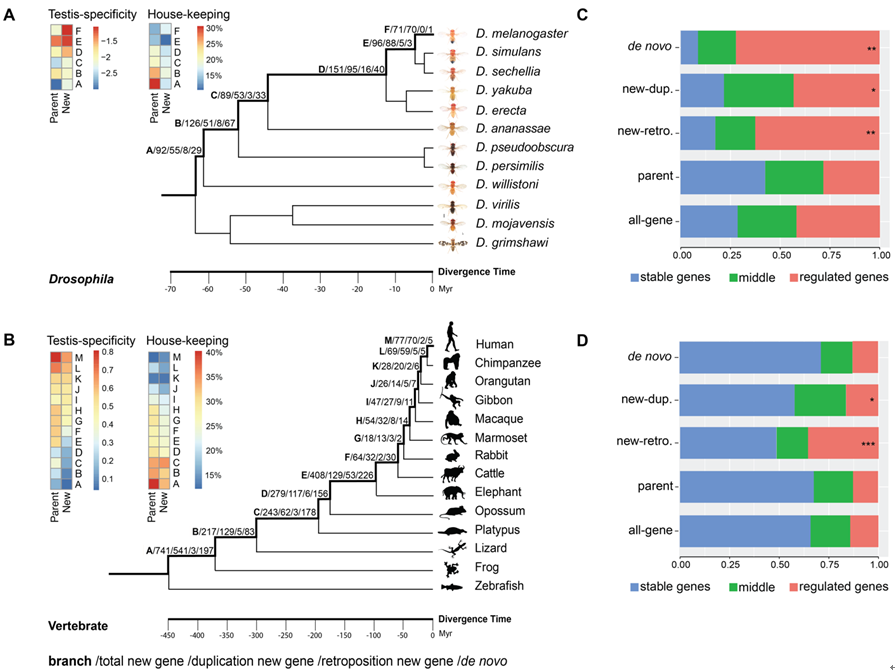
Drosophila and vertebrate new genes and their expression patterns
They discovered that retrogenes are more frequently produced in a pre-existing repressive regulatory domain, and are more diverged in their enhancer repertoire than the DNA-based gene duplications. During evolution, new gene duplications gradually gain active histone modifications and undergo more enhancer turnovers when becoming older, but exhibit complex trends of gaining or losing repressive histone modifications in Drosophila or vertebrates respectively. Interestingly, vertebrate new genes exhibit an ‘into the testis’ epigenetic transition that older genes become more likely to be co-occupied by both active and repressive (‘bivalent’) histone modifications specifically in testis.
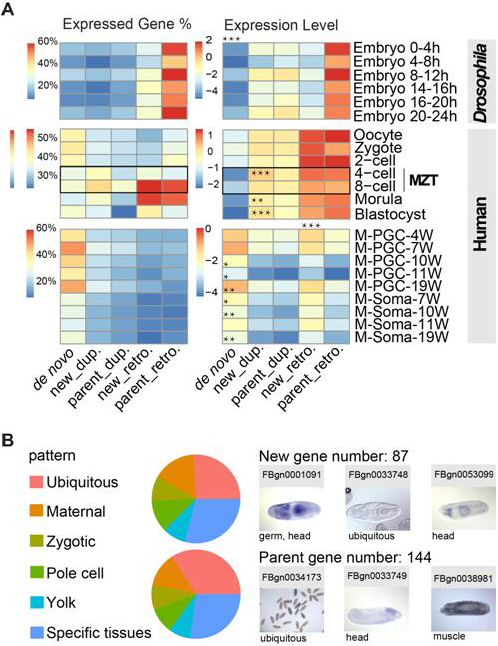
Dynamic expression of new genes in early embryos
These findings reveal the regulatory mechanisms underpinning the stepwise acquisition of novel and complex functions by new genes, and illuminate the general evolution trajectory of genes throughout their life history.
Edited by: Ian Chew