Augmented reality brings cultural relics to life


A scroll is unfolded bit by bit on the screen and Portrait of a Flower-wearing Maid—a famous painting in ancient China—is unveiled in front of an audience. A maid attired in a Tang Dynasty costume walks out of the painting, composed and graceful.
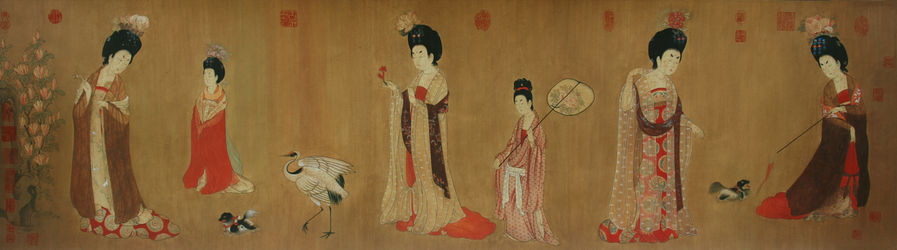
Modern technology brings to life “dormant” cultural relics ranging from static objects to dynamic images like a magic wand. Four screens display four different stories in a synchronized image-on-image manner. The audience can savor a holistic visual and audio feast by merging an ancient world with a modern scenario.
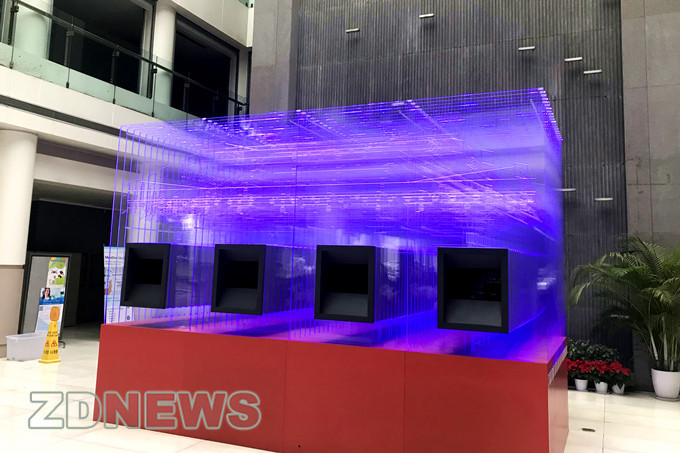
This is a mysterious “box” located in the hall of the Agriculture and Medicine Library on Zijingang Campus. As a matter of fact, it is a 2.3-meter-long visual device. On the surface, it looks like a colossal sliced box, but it is actually a superimposed virtual imaging device. It made its debut at the “Internet + Chinese Civilization” exhibition at the fifth edition of the annual World Internet Conference.
Moving cultural relics into ZJU
WANG Xiaosong, a ZJU professor in the Department of Arts, is in charge of designing the image device and directing films. “This is a reconstruction of Baoguo Temple, which is located in the north of Ningbo City and can date back to 1013 during the Northern Song Dynasty, in a dynamic artistic device. Designers use a total of 120 high-quality acrylic sheets weighing over 7 tons and cut them into 40 slices using digital modeling technology. Layered imaging helps create a three-dimensional pattern. A digital three-dimensional model of Baoguo Temple will eventually be constructed by using light, digital modeling and sliced carving,” said WANG Xiaosong.
In this way, Baoguo Temple, one of the oldest and best-preserved wooden constructions in China, travels more than one thousand years and over a long distance to exhibit its aesthetically appealing feature to the audience.
Opening the window of time
The superimposed virtual imaging device adopts a synchronized image-on-image approach. It interprets different aspects of the traditional Chinese culture, such as the elegance of costumes, the beauty of dance and music, the pleasure of sports and the brilliance of light, through a myriad of cultural relics. It thus can achieve a holistic three-dimensional effect, enabling the audience to understand the evolution of the Chinese civilization, appreciate craftsmanship and feel the vicissitudes of history.
“Ancient artifacts used to be images in books or collections that were forbidden to touch in museums, and their display was often constrained by space, time, and media.In addition, cultural relics used to be interpreted in abstruse words, thereby denying the ordinary audience access to knowledge. Thanks to today’s state-of-the-art technology, cultural relics hidden in the depths of history can come to life, and people are led into a historical scenariovia holographic images, which is more conducive to the inheritance of conventional culture. With ancient rules and modern technology, the audience can communicate with cultural relics while history embedded in cultural relics can take roots in the minds of the audience, thus providing a source of motivation for the preservation of cultural relics,” WANG Xiaosong remarked.
This project is also the outcome of interdisciplinary fusion. The project is headed by Prof. WANG Xiaosong, screenplays and acting are undertaken by a team led by Prof. GUI Ying, the device is developed by a team led by Prof. LU Dongming and images are primarily selected from Portrait of a Flower-wearing Maidin Liaoning Provincial Museum. This team is the very epitome of multi-disciplinary and interdisciplinary academic treasures in a comprehensive research-oriented university.