Air pollution inhibits global warming?


A study, jointly conducted by Chinese and foreign scientists, sheds light on the impact of air pollution on global warming. Scientists point out that aerosol particulate pollution caused by human activities has a cooling effect on the earth, which can thus in part offset global warming triggered by greenhouse gases. It is also possible to make a more precise measurement of the climate effects of aerosol-affected clouds and improve the accuracy of future climatic forecasts. The study is published in the journal of Science. Prof. YU Shaocai from ZJU's College of Environmental and Resource Sciences is one of the corresponding authors of the article.
Studies reveal that the cooling effects of aerosols are more substantial than what was previously estimated. Aerosols are suspendingtiny particles in the air that can be formed naturally (such as desert dust) or artificially formed (such as combustion from fossil and non-fossil fuels, transportation, and smog from various industrial emissions). Aerosols act as cloud condensation nuclei. When air is raised and cools off, vapor condenses on aerosol particles and forms cloud droplets. Clouds are formed by meteorological processes of air uplifting and cooling, but the microphysical structure of clouds is largely determined by aerosols. When a large number of aerosol particles are present in the air, the cloud is composed of a large number of small cloud droplets. The smaller the cloud droplets are, the longer it takes for cloud droplets to form via collisions. Therefore, polluted clouds contain more cloud water, last longer, and covers] more, thereby reflecting more energy from the sun back into space and producing a cooling effect on the earth.
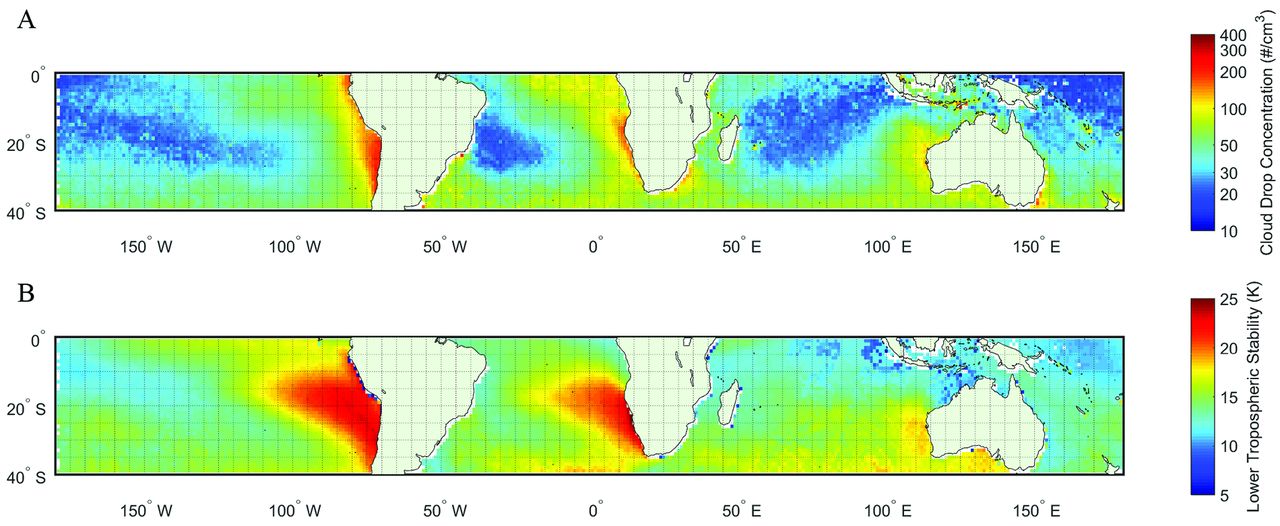
This study reveals a much greater sensitivity of cloud radiative forcing to cloud condensation nuclei than previously reported, which means too much cooling if incorporated in present climate models. This offers a clue to yet unknown compensating aerosol warming effects, possibly through deep clouds.