ZJU researchers make a major breakthrough in transcranial ultrasound imaging


Recently, the research team led by ZHENG Yinfei, an associate professor in the Institute of Medical and Health Information Engineering, Zhejiang University, proposed a novel imaging technology based on ultrasound materials and a plane wave imaging method—transcranial ultrasound imaging. This technology breaks through the “no-go zone” in cranial imaging and opens the door to human transcranial ultrasound imaging.
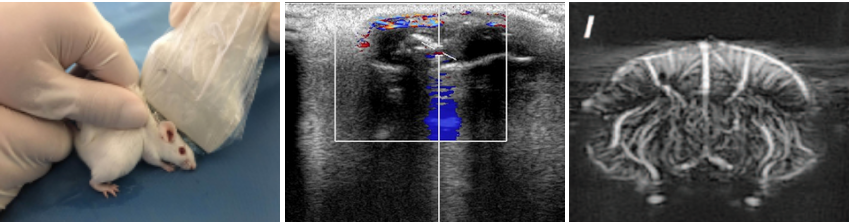
A modern ultrasound machine detects tissue structures and the flow of blood by analyzing the echo signals reflected by the body. Compared with CT and MRI, ultrasound imaging is defined as real-time, non-invasive and low-cost and it can be employed in surgeries. However, due to its high salient density, the skull exerts a conspicuous attenuation and distortion effect on ultrasound. It has therefore posed a formidable barrier for conventional ultrasound to capture echo information reflected by the brain.
The key to transcranial ultrasound imaging is to boost the permeation performance of a modern ultrasound device. The state-of-the-art technology developed by ZHENG Yinfei et al. combines the effective medium theory and the beam forming framework to achieve high-resolution images about tissue structures and the flow of blood in the mouse brain. ZHENG Yinfei et al. employs the metamaterial developed by the research team led by Prof. WU Yongjun of the School of Materials Science and Engineering, Zhejiang University, to perform craniocerebral imaging. This material can press elastic resonance back to the skull as if ultrasound put on an “invisible cloak”, thus reducing the reflection of sound waves to the minimum. In addition, by integrating plane wave imaging with novel nanoparticle imaging, ZHENG Yinfei et al. puts forward an innovative imaging approach by utilizing the plane wave imaging method by which the resolution and sensitivity of the image can be tremendously improved. The transducer emits a plane wave, and the information of the entire imaging area can be obtained in one shot. It not only elevates the data volume of echo signals, but also captures high-resolution and high-sensitivity images of the brain.