Scientists develop a new method to synthesize positively charged sequence-defined polymers


A team headed by Prof. GAO Chao, director of Zhejiang University’s Institute of Polymer Science, developed a new polar-inverse strategy (PIS) for scalable synthesizing sequence-defined polymers with positively charged backbone by alternately processing Menschutkin reaction and Cu-catalyzed azide–alkyne cycloaddition (CuAAC) reaction.
“Our research enables cost-effective large-scale production of multifunctional positively charged polymers, paving the way to their applied research and real applications, such as gene transfection and drug delivery. It’s a good start,” Prof. GAO Chao said. Their work was published in the Journal of the American Chemical Society (JACS).

In polymer science, the synthesis of artificial sequence-defined macromolecules is an issue of great importance. To date, no report on synthesizing monodisperse polymers with positively charged backbone of quaternary ammonium has been published, mainly due to the difficulties in molecular design, synthesis, and characterization.
Well sequence-defined polymers with positively charged backbone offer water-soluble property, resulting in a great advantage in bioapplications compared with existing water-insoluble sequence-defined polymers. Furthermore, well-defined cationic polymers can precisely interact with negatively charged DNA and siRNA, leading to greater control in gene transfection and drug delivery. Therefore, synthesizing cationic sequence-defined polymers is of great significance.
The method devised by the team offers extremely high yields (average yield >95% for each step), favoring cost-effective large-scale production (reaction can be achieved in grams). Because of the independent reactivity of selected functional groups, the cationic sequence-defined polymers are highly programmable, including backbone composition, sequence order, functional side groups, terminal groups and topological structure. Due to the dramatic polarity difference between weak polar feed molecules and strong polar target molecules, simple precipitation in weak polar solvents is enough to obtain pure sequence-defined polymers.
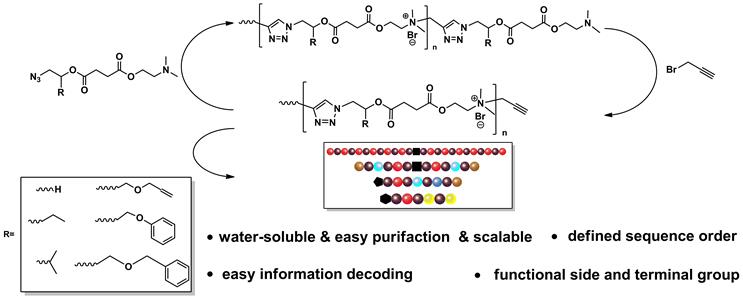
To increase the stability of onium ions, lithium bis (trifluoromethane sulfonimide)(LiTf2N) was used to exchange the bromide anions of polymers. This enabled researchers to observe molecular ion peak and single charged fragment peaks clearly in matrix-assisted laser desorption / ionization time-of-flight mass spectrometry (Maldi-Tof MS). In subsequent Maldi-Tof MS measurements, the molecular ion peak ([Px+[Tf2N–]x−1]+, wherein P represents the main part of polymer) of each sequence-defined polymer and fragment peaks caused by rupture of quaternary ammonium bond were observed clearly. Furthermore, the combination of SEC, Maldi-Tof MS, nuclear magnetic resonance (NMR), and infrared (IR) spectroscopy measurements confirmed the fine structures of cationic functional sequence-defined polymers.
Source: Department of Polymer Sciences
Edited by: Ian Chew